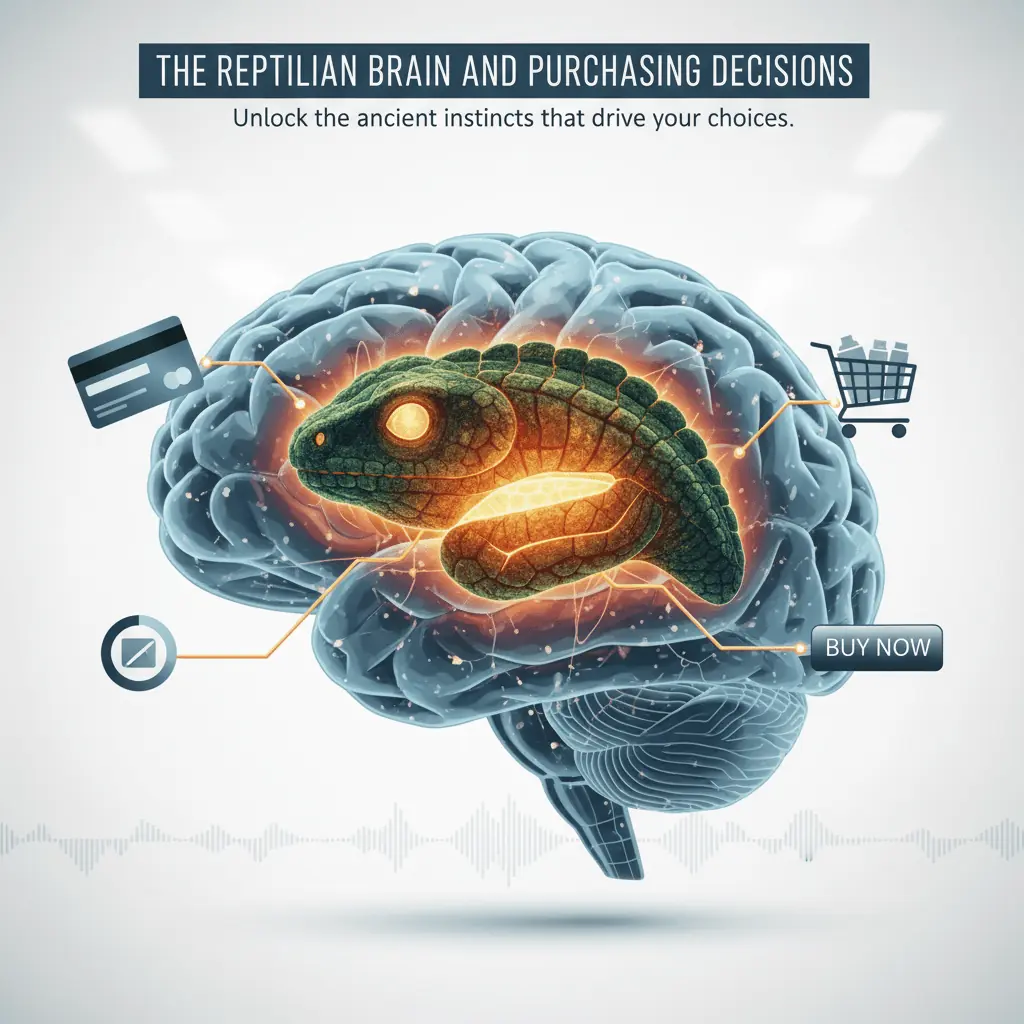
The reptilian brain and purchasing decisions
Commercial persuasion targets fast, automatic decisions, and the same advertising and data infrastructure can be repurposed for influence operations. The line between marketing and influence work is getting harder to draw.

Key judgments
- Commercial persuasion systems are built to act on fast, automatic decisions, through reward-based reinforcement and emotionally engaging design. Advertising and targeting infrastructure is dual-use: the tools used to sell products can be repurposed by state and non-state actors for influence campaigns. Cambridge Analytica's claims about psychographic targeting were overstated, but the industrialization of behavioral data is real. Consent-based rules such as GDPR and CCPA assume a deliberate reading of privacy terms that persuasion systems are designed to bypass, which limits their protective value.
Imagine this: A defense contractor’s procurement team sits in a conference room, evaluating competing cybersecurity platforms. The presentation begins with stark red warnings about imminent threats, followed by reassuring green checkmarks promising immediate protection. Within minutes, the reptilian brain has processed these visual cues faster than conscious analysis can begin. This scenario illustrates a fundamental challenge in understanding influence operations: the cognitive architecture that commercial persuasion targets is the same system that processes security-related information and strategic decisions.
The reptilian brain concept, drawn from Paul MacLean’s triune brain theory, describes the oldest and most automated layer of human cognition—the system responsible for survival responses, pattern recognition, and immediate threat assessment. While neuroscience has moved beyond MacLean’s literal three-brain model, the underlying insight remains operationally relevant: humans possess rapid, unconscious decision-making systems that can be systematically targeted by both commercial actors and influence operations. Available evidence suggests that understanding this cognitive architecture has become essential for assessing how persuasion infrastructure operates across commercial and security domains.
Commercial Platforms and Automatic Response Systems
The modern attention economy operates on principles that directly engage what behavioral economists term System 1 thinking—the fast, automatic, pattern-matching cognitive processes that the reptilian brain metaphor captures. Facebook’s documented use of emotional contagion experiments, revealed in a 2014 study published in the Proceedings of the National Academy of Sciences, demonstrated how platforms could systematically trigger emotional responses through algorithmic content curation. The experiment manipulated 689,003 users’ news feeds to show either more positive or negative emotional content, then measured how this influenced the emotional tone of users’ subsequent posts.
Engagement Architecture as Behavioral Targeting
Platform engagement systems are designed around what behavioral scientists call intermittent variable reinforcement—the same mechanism that drives gambling addiction. TikTok’s algorithm, according to internal documents revealed in the Wall Street Journal’s Facebook Files investigation, specifically optimizes for “time spent” rather than user satisfaction, creating what researchers term “behavioral addiction pathways.” These systems target the brain’s reward prediction mechanisms, which operate below the threshold of conscious decision-making.
Visual and Emotional Triggers in Interface Design
The design principles of major platforms incorporate specific triggers that activate automatic response systems. Red notification badges exploit the brain’s threat-detection mechanisms, while infinite scroll features bypass natural stopping cues that would normally engage deliberative thinking. Google’s Material Design guidelines explicitly reference “emotional design” principles that target subconscious pattern recognition rather than conscious evaluation. This represents a systematic approach to bypassing deliberative cognitive processes in favor of automatic responses.
How Does Psychographic Targeting Access Unconscious Decision Pathways?
Psychographic targeting represents the industrialization of behavioral influence, combining massive data collection with behavioral science insights to predict and influence decision-making at the unconscious level. Cambridge Analytica’s documented use of the OCEAN personality model (Openness, Conscientiousness, Extraversion, Agreeableness, Neuroticism) attempted to map individual psychological profiles to specific persuasion strategies. While the effectiveness claims surrounding Cambridge Analytica were significantly overstated, the underlying approach—using behavioral data to predict psychological vulnerabilities—has become standard practice across the commercial advertising ecosystem.
Data Collection and Behavioral Prediction Models
The surveillance capitalism framework, as documented by Harvard Business School’s Shoshana Zuboff, describes how digital platforms extract “behavioral surplus”—data about user actions, preferences, and responses that can be used to build predictive models of future behavior. Amazon’s recommendation algorithms, for instance, track not just purchase history but also browsing patterns, time spent viewing items, and even cursor movement to predict purchasing decisions. These systems specifically target what behavioral economists call “choice architecture”—the environmental factors that influence decisions below the level of conscious awareness.
Micro-Targeting and Cognitive Vulnerabilities
Political advertising on digital platforms has demonstrated how micro-targeting can exploit specific cognitive biases. The 2016 Brexit campaign’s use of Facebook advertising, documented by the UK Parliament’s Digital, Culture, Media and Sport Committee, showed how different demographic groups received completely different messages about the same policy proposal—each crafted to trigger specific emotional responses. This approach bypasses critical evaluation by presenting information in formats designed to activate automatic agreement rather than analytical thinking.
Dual-Use Infrastructure: From Commerce to Influence Operations
The infrastructure developed for commercial persuasion has become a dual-use system that state and non-state actors can access for influence operations. The Internet Research Agency’s documented use of Facebook’s advertising platform during the 2016 election cycle illustrates how commercial behavioral targeting tools can be repurposed for strategic influence campaigns. According to the Mueller investigation’s findings, Russian operators spent approximately $100,000 on Facebook ads that reached an estimated 126 million users—demonstrating the scalability of commercial persuasion infrastructure for influence operations.
State Actor Access to Commercial Data
Intelligence services have documented access to commercial behavioral data through both legal and extralegal means. The NSA’s PRISM program, revealed in the Snowden documents, showed how intelligence agencies could access user data from major technology platforms. More recently, reports in the Wall Street Journal documented how data brokers sell location and behavioral information to government agencies, including foreign intelligence services. This creates a pathway for state actors to access the same behavioral targeting capabilities used in commercial advertising.
Information Operations Using Commercial Techniques
Recent influence campaigns have demonstrated sophisticated understanding of how to trigger automatic cognitive responses. The Prigozhin-linked Internet Research Agency’s 2020 operations in Africa, documented by the Stanford Internet Observatory, used carefully crafted visual content designed to activate tribal identity responses rather than engaging analytical thinking. These campaigns specifically targeted what cognitive scientists call “motivated reasoning”—the tendency to process information in ways that confirm existing beliefs rather than evaluating evidence objectively.
Regulatory Responses and Documented Limitations
Current regulatory frameworks largely fail to address the core mechanisms through which commercial platforms access and manipulate unconscious decision-making processes. The General Data Protection Regulation (GDPR) focuses on consent and data protection but does not restrict the use of behavioral science insights to design persuasive systems. Similarly, the California Consumer Privacy Act (CCPA) provides data access rights but does not limit how behavioral data can be used to influence decision-making.
The Consent Paradox in Behavioral Targeting
The fundamental limitation of consent-based regulation is that it requires conscious deliberation about systems designed to bypass conscious awareness. Research by Carnegie Mellon’s Aleecia McDonald and Lorrie Cranor found that reading all the privacy policies encountered by an average internet user would require 244 hours per year—demonstrating the practical impossibility of informed consent in the current digital environment. This creates what researchers term the “consent paradox”: users cannot meaningfully consent to manipulation of cognitive processes they cannot consciously monitor.
Platform Self-Regulation and Its Limits
Major technology platforms have implemented various content policies and advertising standards, but these typically focus on prohibited content rather than persuasion techniques. Facebook’s advertising policies prohibit certain targeting categories (such as those based on health conditions) but do not restrict the use of psychological manipulation techniques in ad design. Google’s political advertising transparency requirements mandate disclosure of who paid for ads but do not limit how behavioral targeting can be used to influence political opinions.
A Framework for Analyzing Reptilian Brain Targeting in Information Environments
Security professionals and policy analysts need systematic approaches for assessing how influence operations target unconscious cognitive processes. The following framework provides indicators for evaluating when commercial persuasion infrastructure may be used for strategic influence purposes:
Technical Indicators of Systematic Behavioral Manipulation
- Micro-targeting precision: Advertising campaigns that use highly specific demographic and psychographic targeting parameters, especially those that segment audiences based on emotional or psychological characteristics
- A/B testing sophistication: Evidence of systematic testing of different messages, images, or interface elements to optimize for specific behavioral responses rather than user satisfaction
- Cross-platform coordination: Synchronized messaging or targeting across multiple platforms, suggesting coordinated campaign management rather than organic content creation
- Emotional triggering patterns: Systematic use of fear-based messaging, social proof mechanisms, or scarcity tactics designed to bypass analytical thinking
Content and Messaging Analysis
- Visual design assessment: Evaluate whether content uses color schemes, imagery, and layout designed to trigger immediate emotional responses rather than convey information
- Cognitive bias exploitation: Identify systematic use of confirmation bias, availability heuristic, or other documented cognitive shortcuts
- Narrative structure analysis: Assess whether messaging follows patterns designed to activate tribal identity or threat response rather than analytical evaluation
- Call-to-action urgency: Examine whether content creates artificial time pressure or scarcity to encourage immediate action without deliberation
Data Flow and Targeting Infrastructure
Understanding how behavioral data moves through commercial advertising systems provides insight into potential influence operation capabilities. Key assessment areas include data broker networks that aggregate behavioral profiles across platforms, programmatic advertising systems that enable real-time behavioral targeting, and cross-device tracking capabilities that create comprehensive behavioral profiles. According to research by Princeton’s Center for Information Technology Policy, the average website shares user data with 76 third-party services, creating multiple potential access points for both commercial and state actors seeking to influence behavior through targeted messaging.
The intersection of commercial persuasion infrastructure and influence operations represents a fundamental challenge for cognitive security. The same systems that drive consumer purchasing decisions provide scalable platforms for strategic influence campaigns targeting unconscious decision-making processes. As behavioral targeting becomes more sophisticated and data collection more comprehensive, the distinction between commercial marketing and influence operations may become increasingly meaningless—a development that demands new approaches to both regulation and defense.
Sources
Kramer, A. D., Guillory, J. E., & Hancock, J. T. (2014). Experimental evidence of massive-scale emotional contagion through social networks. Proceedings of the National Academy of Sciences, 111(24), 8788-8790.
McDonald, A. M., & Cranor, L. F. (2008). The cost of reading privacy policies. I/S: A Journal of Law and Policy for the Information Society, 4(3), 543-568.
Zuboff, S. (2019). The Age of Surveillance Capitalism: The Fight for a Human Future at the New Frontier of Power. PublicAffairs.
UK Parliament Digital, Culture, Media and Sport Committee. (2019). Disinformation and ‘fake news’: Final Report. House of Commons.
Englehardt, S., & Narayanan, A. (2016). Online tracking: A 1-million-site measurement and analysis. Proceedings of the 2016 ACM SIGSAC Conference on Computer and Communications Security.
DiResta, R., Shaffer, K., Ruppel, B., Sullivan, D., Matney, R., Fox, R., … & Johnson, B. (2019). The Tactics & Tropes of the Internet Research Agency. New Knowledge.