Understanding the need for control conspiracies in modern information warfare
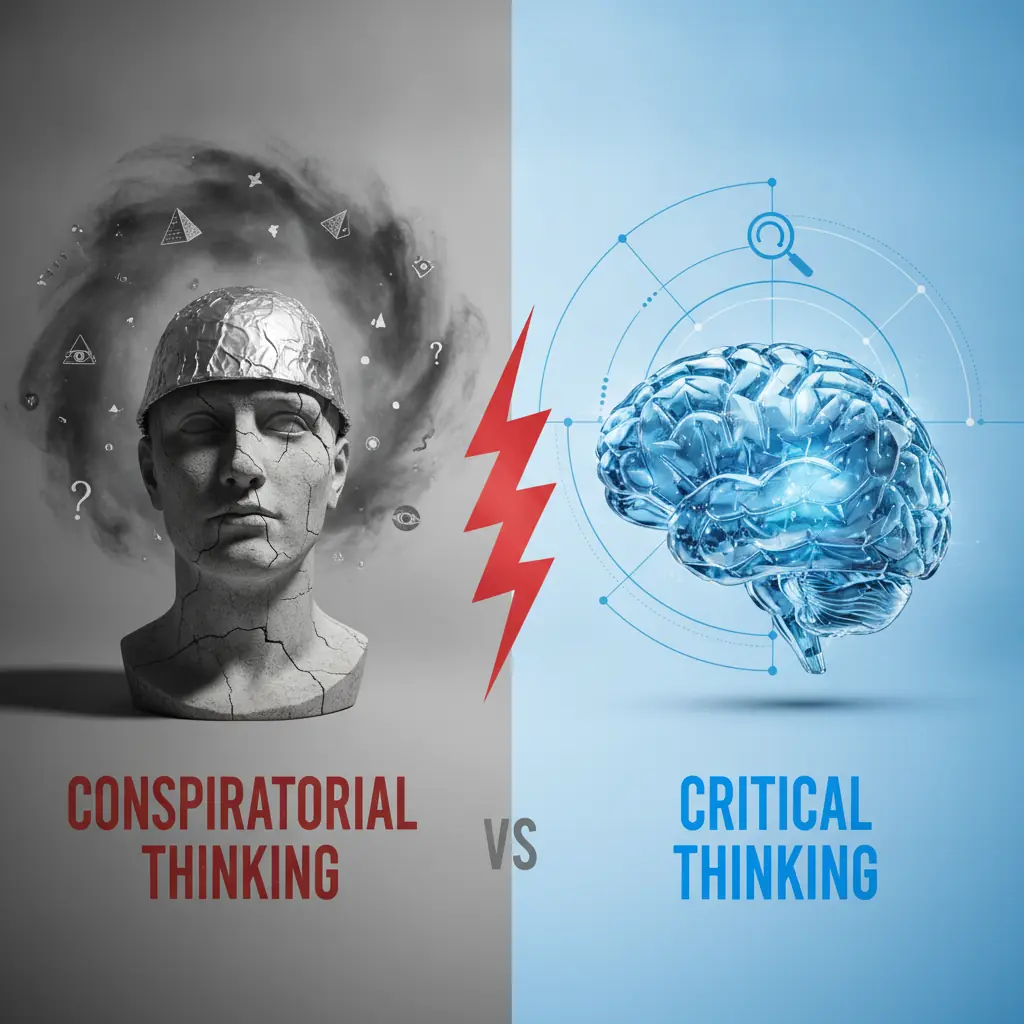
Conspiracy theories answer a real psychological need to regain control, and they thrive where institutions are opaque or have failed. That demand is exactly what hostile actors exploit.


Key judgments
- Conspiracy beliefs meet a psychological need to restore control, but where institutions are opaque or have visibly failed, adopting them can be a plausibly rational response rather than a pathology. State actors mostly amplify existing domestic conspiracy theories instead of inventing new ones, which gives them deniability and makes detection harder. Conspiracy communities reconstitute quickly after takedowns, so content moderation alone cannot address the structural drivers. Factual debunking has limited reach; durable responses address the underlying need for control and reduce the institutional opacity that fuels demand.
Imagine discovering that your government has been tracking your digital communications for decades through programs you never knew existed. Then imagine learning this revelation came not through investigative journalism or official disclosure, but through a massive data leak that also contained fabricated documents designed to discredit legitimate oversight concerns. This scenario—mixing genuine institutional overreach with manufactured disinformation—captures the central challenge of our current information environment. The need for control conspiracies emerges from this gray zone where real institutional failures create demand for explanatory narratives that hostile actors can exploit and amplify. Understanding this dynamic requires moving beyond simple true-or-false framings to examine how conspiracist thinking functions as both a response to genuine uncertainty and a vector for deliberate influence operations.
The psychological foundations of control-seeking through conspiracy theories
Research consistently demonstrates that conspiracy theories serve specific psychological functions, with control restoration being among the most significant. When individuals face uncertainty or perceive threats to their agency, conspiracist explanations offer a compelling alternative to acknowledging complexity or randomness. However, this individual-level analysis only captures part of the phenomenon.
Epistemic security and institutional trust
The concept of epistemic security—confidence in one’s knowledge base and information sources—provides a more nuanced framework for understanding conspiratorial thinking. According to research by C. Thi Nguyen on epistemic bubbles and echo chambers, individuals operating within degraded information environments may rationally adopt conspiratorial explanations when mainstream institutions consistently fail to provide credible accounts of significant events.
This dynamic becomes particularly pronounced during periods of institutional opacity. When government agencies, corporations, or international organizations operate with limited transparency while making decisions that significantly impact public welfare, the resulting information vacuum creates space for alternative explanations to flourish. The need for control conspiracies often emerges from this gap between institutional power and public understanding.
Social proof and collective sense-making
Individual psychological needs intersect with social dynamics to create collective sense-making processes. Communities forming around shared conspiratorial beliefs often develop sophisticated internal logic systems and evidence evaluation criteria that can appear rational within their epistemic framework. These communities provide both social belonging and intellectual coherence—two powerful motivators that help explain why factual debunking often proves ineffective.
How platform architecture amplifies control-oriented conspiracy narratives
Modern information platforms are not neutral conduits for conspiracy theories; their algorithmic structures actively shape which types of conspiratorial content gain traction. Understanding this amplification mechanism is crucial for analysts working on cognitive security.
Engagement optimization and emotional salience
Platform algorithms optimize for engagement metrics that correlate strongly with emotional arousal. Conspiracy theories offering simple explanations for complex phenomena—particularly those involving powerful actors manipulating events—generate high engagement rates through anger, fear, and validation. This creates a structural bias toward conspiratorial content that promises restored agency and clear enemy identification.
The feedback loop operates at both individual and community levels. Individual users receive more conspiracy-adjacent content as they engage with initial posts, while communities dedicated to specific theories become increasingly isolated from contradictory information. Platform recommendation systems inadvertently create what researchers term “rabbit holes”—algorithmic pathways that lead users from mainstream content toward increasingly extreme conspiratorial interpretations.
Network effects and viral amplification
Research on information diffusion patterns shows that conspiracy theories spread through network structures differently than factual information. False information often spreads faster and reaches wider audiences than corrections, particularly when the false information provides simple explanations for complex events or confirms pre-existing beliefs about institutional malevolence.
The network structure of conspiracy theory communities also demonstrates resilience against disruption. When platforms remove specific accounts or content, the underlying network often reconstitutes quickly around alternative narratives or platforms, suggesting that content moderation alone cannot address the structural drivers of conspiratorial thinking.
What role do state actors play in weaponizing need for control narratives?
Available evidence indicates that multiple state actors have identified conspiracy theory amplification as an effective tool for cognitive warfare. However, the relationship between organic conspiratorial thinking and state-sponsored disinformation is more complex than simple manipulation models suggest.
The amplification versus creation distinction
Analysis of documented influence operations reveals that state actors typically amplify existing conspiracy theories rather than creating entirely new ones. This approach offers several advantages: it leverages pre-existing social tensions, appears more organic to platform detection systems, and provides plausible deniability since the core narratives often originate from domestic sources.
For example, Internet Research Agency operations documented in U.S. intelligence assessments primarily amplified existing American conspiracy theories about electoral integrity, public health measures, and institutional corruption. The effectiveness of this approach stems from its exploitation of genuine social divisions rather than reliance on wholly fabricated narratives.
Targeted narrative injection
More sophisticated operations involve injecting specific details or interpretive frameworks into organic conspiracy theory communities. These injections often aim to redirect conspiratorial thinking toward specific targets or policy positions that align with state interests. The technique requires deep understanding of target community psychology and existing belief structures.
NATO’s Cognitive Warfare framework recognizes this targeting of cognitive processes as a distinct category of hybrid threat that operates below the threshold of traditional conflict while potentially achieving strategic effects comparable to conventional operations.
Institutional failure modes that create demand for conspiratorial explanations
Understanding why conspiracy theories gain traction requires honest assessment of the institutional failures that create demand for alternative explanations. This analysis should not validate unfalsifiable conspiratorial thinking, but it must acknowledge the rational basis for institutional skepticism in many contexts.
Transparency deficits and accountability gaps
Government agencies, multinational corporations, and international organizations often operate with limited public oversight while making decisions that significantly impact civic life. When these institutions fail to provide timely, accurate, or complete information about their activities—particularly during crises—the resulting information vacuum encourages speculative explanations that may evolve into conspiracy theories.
The challenge for institutions lies in balancing legitimate operational security needs with public transparency requirements. However, excessive secrecy or delayed disclosure often proves counterproductive, creating more suspicion than the original information would have generated.
Expert disagreement and scientific uncertainty
Public health emergencies, environmental issues, and technological risks often involve genuine scientific uncertainty and expert disagreement. When institutions present confident public positions while internal documents reveal significant uncertainty or debate, the contradiction can undermine institutional credibility and create space for conspiratorial alternatives.
Effective institutional communication during uncertain situations requires acknowledging the limits of current knowledge while explaining the decision-making processes used under uncertainty. Failure to do so often results in public discovery of suppressed disagreements, which can appear to validate conspiratorial suspicions about institutional deception.
A framework for analyzing conspiracy theory amplification and state involvement
Security professionals and researchers need systematic approaches for distinguishing between organic conspiracy theory development and state-sponsored amplification. The following framework synthesizes current analytical methodologies used by cognitive security practitioners.
Indicators of organic versus manufactured conspiracism
Organic conspiracy theories typically exhibit certain characteristic patterns that distinguish them from state-manufactured disinformation:
- Evolutionary development: Organic theories evolve gradually through community interaction, developing internal inconsistencies and branching narratives over time
- Local relevance: They often incorporate locally relevant details, cultural references, and community-specific concerns
- Amateur production values: Content creation shows individual effort rather than professional production capabilities
- Decentralized leadership: Multiple individuals contribute to theory development without clear hierarchical organization
State-sponsored operations often demonstrate different characteristics:
- Coordinated messaging: Multiple accounts promoting consistent talking points or interpretive frameworks
- Professional production: High-quality graphics, videos, or written content requiring significant resources
- Strategic timing: Theory promotion aligned with geopolitical events or domestic political cycles
- Cross-platform synchronization: Simultaneous appearance across multiple platforms and languages
Assessment methodology for conspiracy theory influence operations
Analysts should employ multiple verification methods when assessing potential state involvement in conspiracy theory amplification:
- Network analysis: Map the relationship patterns between accounts promoting specific theories
- Content forensics: Analyze production techniques, linguistic patterns, and metadata for professional indicators
- Temporal correlation: Compare theory emergence or amplification with geopolitical events or documented influence campaigns
- Beneficiary analysis: Assess which actors benefit from increased conspiratorial thinking around specific topics
- Technical indicators: Examine digital artifacts for evidence of coordinated inauthentic behavior
Self-assessment checklist for conspiracy theory evaluation
Practitioners can use this checklist when encountering potentially state-sponsored conspiracy content:
- Does this theory provide unusually simple explanations for complex events?
- Are the primary sources of information difficult to verify independently?
- Does believing this theory require assuming extensive coordination among typically competing actors?
- Are contradictory evidence and alternative explanations systematically dismissed rather than addressed?
- Does promotion of this theory align with known state interests or documented influence campaigns?
Beyond debunking: adaptive responses to conspiracy theory influence operations
Traditional approaches focusing on factual correction have demonstrated limited effectiveness against established conspiracy theory communities. More sophisticated responses must address the underlying needs that conspiracy theories fulfill while building resilience against manipulation.
Institutional transparency and accountability measures
The most effective long-term approach involves addressing the institutional failures that create demand for conspiratorial explanations. This requires proactive transparency about decision-making processes, acknowledgment of uncertainty, and rapid correction of errors when they occur.
Institutions should also develop capabilities for monitoring conspiratorial narratives about their activities, not for suppression purposes but for understanding public concerns and communication failures that may require institutional response.
Cognitive security and epistemic resilience
Building societal resilience against conspiracy theory manipulation requires improving collective capacity for information evaluation and source verification. This involves education about cognitive biases, platform algorithm dynamics, and techniques for assessing information credibility.
However, epistemic resilience cannot simply mean teaching people to trust institutional sources unconditionally. Effective cognitive security requires developing skills for navigating uncertainty, evaluating competing claims, and maintaining appropriate skepticism toward all information sources while avoiding unfalsifiable conspiratorial thinking.
The need for control conspiracies represents a persistent feature of modern information environments that security professionals must understand and address systematically. Rather than treating conspiracy theories as simple content problems requiring debunking, effective responses must address the structural conditions—institutional opacity, platform amplification dynamics, and deliberate state exploitation—that create and sustain these narratives. As cognitive warfare techniques continue evolving, the intersection between organic conspiratorial thinking and manufactured disinformation will likely become increasingly sophisticated, requiring equally sophisticated analytical frameworks and response strategies. Future research should focus on developing real-time detection capabilities for state-sponsored conspiracy theory amplification while addressing the institutional reforms necessary to reduce public demand for conspiratorial explanations of complex events.
Sources
Nguyen, C.T. (2020). Echo chambers and epistemic bubbles. Episteme, 17(2), 141-161.
Imhoff, R., & Lamberty, P. (2020). A bioweapon or a hoax? The link between distinct conspiracy beliefs about the Coronavirus disease. Social Psychological and Personality Science, 11(8), 1110-1118.
Pomerantsev, P. (2019). This is not propaganda: Adventures in the war against reality. PublicAffairs.
NATO Strategic Communications Centre of Excellence. (2021). Cognitive warfare: An attack on truth and thought. Riga: NATO StratCom COE.
Sunstein, C.R., & Vermeule, A. (2009). Conspiracy theories: Causes and cures. Journal of Political Philosophy, 17(2), 202-227.
Roozenbeek, J., & van der Linden, S. (2019). The fake news game: Actively inoculating against the risk of misinformation. Journal of Risk Research, 22(5), 570-580.