Soviet active measures during the Cold War
Soviet active measures were not just propaganda but a covert influence doctrine built on deniability, forgeries and long-term source cultivation. They anticipated much of today's hybrid toolkit and faced the same limits.

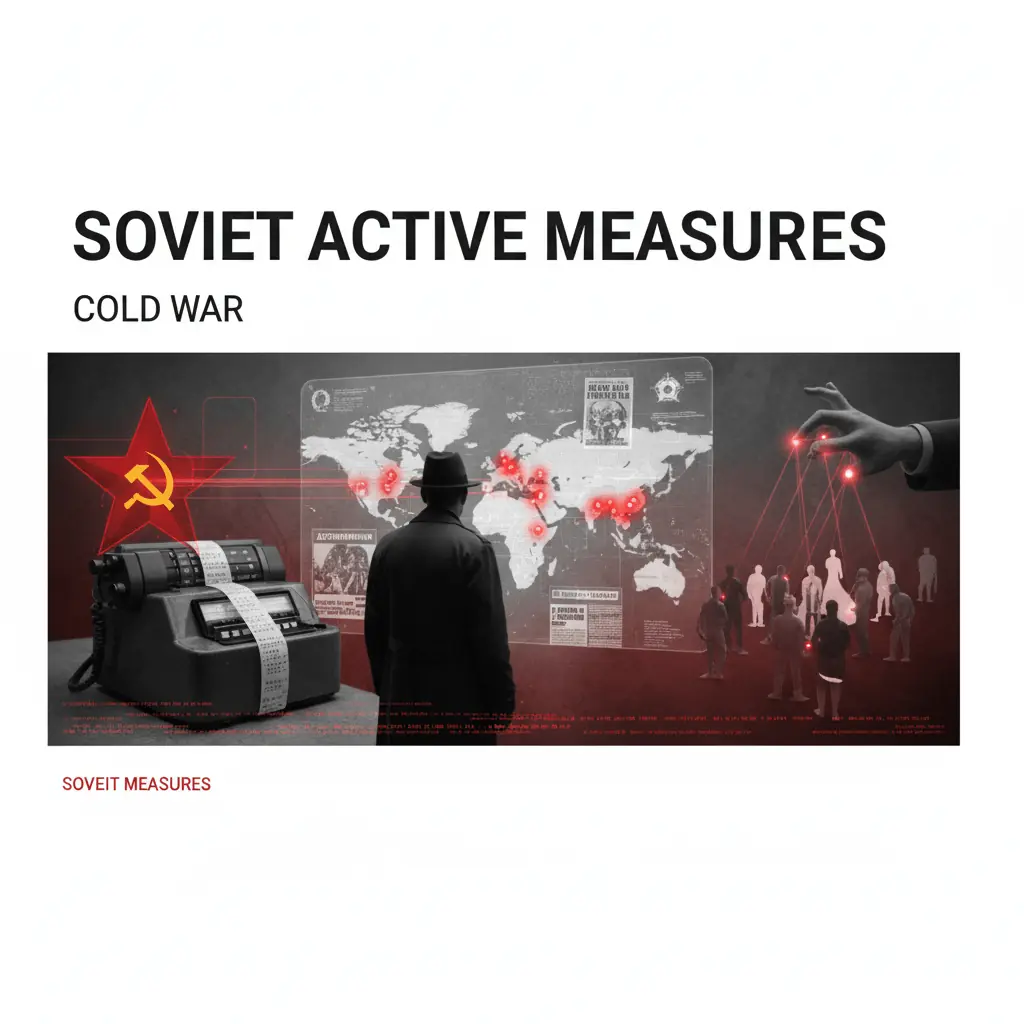
Key judgments
- Active measures relied on deniability and indirect attribution, which set them apart from overt state propaganda. They worked mainly by amplifying existing tensions in Western societies rather than creating new ones. Their strategic effect was limited: decades of effort did not stop NATO expansion or break the transatlantic alliance, even though tactical successes left lasting doubts about Western governments' credibility. Modern Russian operations show clear continuity with Soviet methods and face the same fundamental constraints, despite their new technology.
While nuclear missiles dominated Cold War headlines, a more insidious campaign unfolded in newsrooms, universities, and political movements across the Western world. Between 1945 and 1991, the Soviet Union deployed what intelligence professionals now recognize as the most comprehensive soviet measures program in modern history—a systematic effort to manipulate Western public opinion, sow discord among NATO allies, and undermine democratic institutions through disinformation, forgeries, and covert influence operations.
Declassified documents from both Soviet and Western archives reveal that these “active measures” (aktivnyye meropriyatiya) represented far more than propaganda. They constituted a sophisticated cognitive warfare doctrine that anticipated many contemporary hybrid threats. The scale was staggering: according to former KGB officer Stanislav Levchenko’s congressional testimony in 1982, the Soviet Union allocated more resources to active measures than to traditional espionage collection operations.
Understanding this historical precedent provides crucial insights for today’s analysts confronting Russian information operations, Chinese influence campaigns, and the evolving landscape of cognitive warfare. The Soviet playbook established operational templates that persist in contemporary threat actor behavior.
Doctrinal Foundations and Institutional Architecture
The Active Measures Concept
Soviet active measures differed fundamentally from traditional propaganda in their emphasis on plausible deniability and indirect attribution. Rather than broadcasting obvious Soviet messaging, these operations sought to influence Western audiences through ostensibly independent sources—journalists, academics, political activists, and cultural organizations.
The doctrinal foundation emerged from Lenin’s concept of “useful idiots”—Western intellectuals who would advance Soviet interests without direct coordination. By the 1960s, this evolved into a sophisticated framework combining psychological warfare principles with modern mass communication techniques.
Institutional Structure
The KGB’s First Chief Directorate Service A managed active measures operations globally, with regional residencies executing campaigns tailored to local political contexts. According to former CIA analyst Brian Latell’s analysis, Service A employed approximately 15,000 officers and agents worldwide by the 1980s.
Complementary organizations included the International Department of the Communist Party Central Committee, which managed relationships with foreign communist parties and front organizations, and various cultural and academic exchange programs that provided cover for influence operations.
Strategic Objectives
Soviet active measures pursued three primary strategic objectives. First, they aimed to discredit Western democratic institutions and leaders, particularly in NATO countries. Second, they sought to exacerbate existing social tensions—racial conflicts in the United States, anti-nuclear sentiment in Western Europe, and anti-American sentiment in developing nations. Third, they worked to promote Soviet policy positions on disarmament, détente, and Third World liberation movements.
Operational Mechanisms and Tactics
Disinformation and Forgery Operations
Document forgery represented a cornerstone of Soviet active measures. The most documented example involved Operation CHAOS, where Soviet operatives fabricated a U.S. Army field manual allegedly detailing plans for domestic surveillance and civil rights suppression. This forged document, distributed through leftist publications in the early 1970s, aimed to inflame anti-Vietnam War sentiment and discredit U.S. intelligence agencies.
According to Christopher Andrew and Vasili Mitrokhin’s analysis of KGB archives, Service A produced hundreds of forged documents between 1960 and 1985, including false diplomatic cables, fabricated military documents, and counterfeit newspaper articles designed to embarrass Western governments or military leaders.
Front Organizations and Influence Networks
The Soviet Union established and funded numerous international organizations that appeared independent while advancing Soviet foreign policy objectives. The World Peace Council, founded in 1949, coordinated anti-NATO campaigns across Western Europe. The World Federation of Trade Unions promoted labor unrest in strategic industries.
These organizations provided platforms for legitimate Western activists and intellectuals, creating what intelligence analysts now recognize as “blended influence”—operations mixing genuine grassroots sentiment with covert state direction.
Media Manipulation and Agent of Influence Operations
Soviet services cultivated relationships with Western journalists, editors, and publishers to place favorable stories or suppress unfavorable coverage. Operation CHAOS involved placing anti-American articles in major European newspapers, often through intermediary journalists who believed they were receiving legitimate scoops from independent sources.
The cultivation of “agents of influence”—prominent individuals who could shape public opinion without formal recruitment—proved particularly effective in academic and cultural circles. These operations required years of relationship-building and careful cultivation to maintain plausible deniability.
What Did Soviet Active Measures Achieve?
Measured Strategic Effects
Assessing the effectiveness of Soviet active measures requires distinguishing between tactical successes and strategic impact. Individual operations achieved significant tactical victories: the forged “U.S. biological warfare in Korea” documents influenced international opinion during the early 1950s, while anti-nuclear campaigns in Western Europe complicated NATO deployment decisions throughout the 1980s.
However, strategic effects proved more limited. Despite decades of investment, Soviet active measures failed to prevent NATO expansion, undermine the U.S.-European alliance, or significantly alter Western democratic institutions. What they did accomplish was creating persistent doubt about Western government credibility and exacerbating existing social divisions.
Unintended Consequences
Soviet active measures often produced counterproductive results. Exposure of disinformation campaigns, particularly after defector revelations in the 1980s, damaged Soviet credibility and provided ammunition for Western anti-communist messaging. The heavy-handed nature of many operations also alienated potential sympathizers who discovered Soviet manipulation behind apparently grassroots movements.
More significantly, these operations contributed to Western development of counter-intelligence capabilities and analytical frameworks that proved valuable during the Cold War’s final decade.
Operational Security Failures
Despite sophisticated planning, Soviet active measures suffered from systematic operational security weaknesses. KGB communications were intercepted by Western signals intelligence, while defectors like Yuri Bezmenov and Stanislav Levchenko exposed operational details that compromised ongoing campaigns.
The centralized nature of Soviet decision-making also created inflexibility, with operations continuing even after their cover had been blown or their effectiveness had diminished.
Contemporary Relevance and Doctrinal Evolution
Russian Federation Adaptations
Contemporary Russian information operations demonstrate clear lineage from Soviet-era active measures while adapting to digital-age realities. The Internet Research Agency’s activities during the 2016 U.S. election employed classic Soviet techniques—exploitation of social divisions, promotion of extreme viewpoints on both sides of controversial issues, and cultivation of unwitting amplifiers.
However, modern Russian operations also show tactical evolution. Social media platforms enable real-time adaptation and micro-targeting impossible during the Cold War, while the speed and volume of contemporary information flow create new vulnerabilities and opportunities.
Lessons for Current Threat Assessment
Soviet active measures provide crucial insights for contemporary cognitive warfare analysis. First, these operations succeeded primarily by amplifying existing social tensions rather than creating new ones—a principle evident in current Russian, Chinese, and Iranian influence campaigns.
Second, the most effective Soviet operations maintained plausible deniability and avoided obvious attribution markers. This lesson applies directly to current attribution challenges in cyber and information operations.
Third, successful active measures required years of patient development and relationship-building, suggesting that contemporary influence operations likely began much earlier than their public detection indicates.
A Framework for Analyzing Active Measures
Attribution Methodology
Analyzing Soviet active measures requires understanding the attribution challenges that contemporary analysts face with current operations. Historical documentation provides advantages unavailable in real-time analysis—declassified intelligence assessments, defector testimony, and access to foreign intelligence archives.
However, even with historical perspective, attribution confidence varies significantly across different operations. High-confidence attribution exists for operations documented in KGB archives accessed by historians like Christopher Andrew. Medium confidence applies to operations described by credible defectors but lacking archival confirmation. Lower confidence characterizes operations inferred from circumstantial evidence or single-source reporting.
Operational Pattern Recognition
Soviet active measures followed recognizable operational patterns that provide analytical frameworks for contemporary assessment:
- Target Selection: Focus on existing social, political, or economic tensions rather than artificial controversy creation
- Source Development: Multi-year cultivation of journalists, academics, and activists as unwitting amplifiers
- Content Strategy: Mixing accurate information with false details to maintain credibility while achieving disinformation objectives
- Distribution Networks: Layered dissemination through multiple intermediaries to obscure original sources
- Plausible Deniability: Consistent maintenance of alternative explanations for suspicious activities
Effectiveness Assessment Criteria
Measuring active measures effectiveness requires distinguishing between different types of success. Tactical effectiveness involves immediate operational objectives—media placement, target audience reach, or specific policy responses. Strategic effectiveness concerns broader objectives like alliance disruption or institutional delegitimization.
Long-term impact assessment proves most challenging, as active measures effects often accumulate over decades and interact with numerous other factors influencing public opinion and policy decisions.
Strategic Implications for Modern Cognitive Warfare
Soviet active measures established operational precedents that continue shaping contemporary cognitive warfare. The integration of intelligence collection, influence operations, and traditional diplomacy created what modern analysts recognize as “hybrid threats”—coordinated campaigns employing multiple tools of national power below the threshold of conventional conflict.
The historical record demonstrates both the potential and limitations of cognitive warfare as a strategic tool. While Soviet operations achieved significant tactical successes and imposed costs on Western governments, they failed to achieve transformative strategic objectives. This suggests that contemporary active measures, despite technological enhancements, face similar fundamental constraints.
For current practitioners and analysts, the Soviet experience provides crucial lessons about operational security, attribution challenges, and the importance of long-term strategic thinking in cognitive warfare domains. Understanding these historical precedents remains essential for developing effective responses to contemporary information threats and maintaining institutional resilience against foreign influence operations.
The evolution from Soviet active measures to modern Russian information operations illustrates both continuity and adaptation in state-sponsored cognitive warfare. As new actors enter this domain and technological capabilities continue advancing, the foundational principles established during the Cold War remain relevant for strategic analysis and defensive planning.
Sources
- Andrew, C., & Mitrokhin, V. (1999). The Sword and the Shield: The Mitrokhin Archive and the Secret History of the KGB. Basic Books.
- Rid, T. (2020). Active Measures: The Secret History of Disinformation and Political Warfare. Farrar, Straus and Giroux.
- Bittman, L. (1985). The KGB and Soviet Disinformation: An Insider’s View. Pergamon-Brassey’s.
- U.S. Department of State (1987). Soviet Influence Activities: A Report on Active Measures and Propaganda, 1986–87.
- Boghardt, T. (2009). Soviet bloc intelligence and its AIDS disinformation campaign. Studies in Intelligence, 53(4).