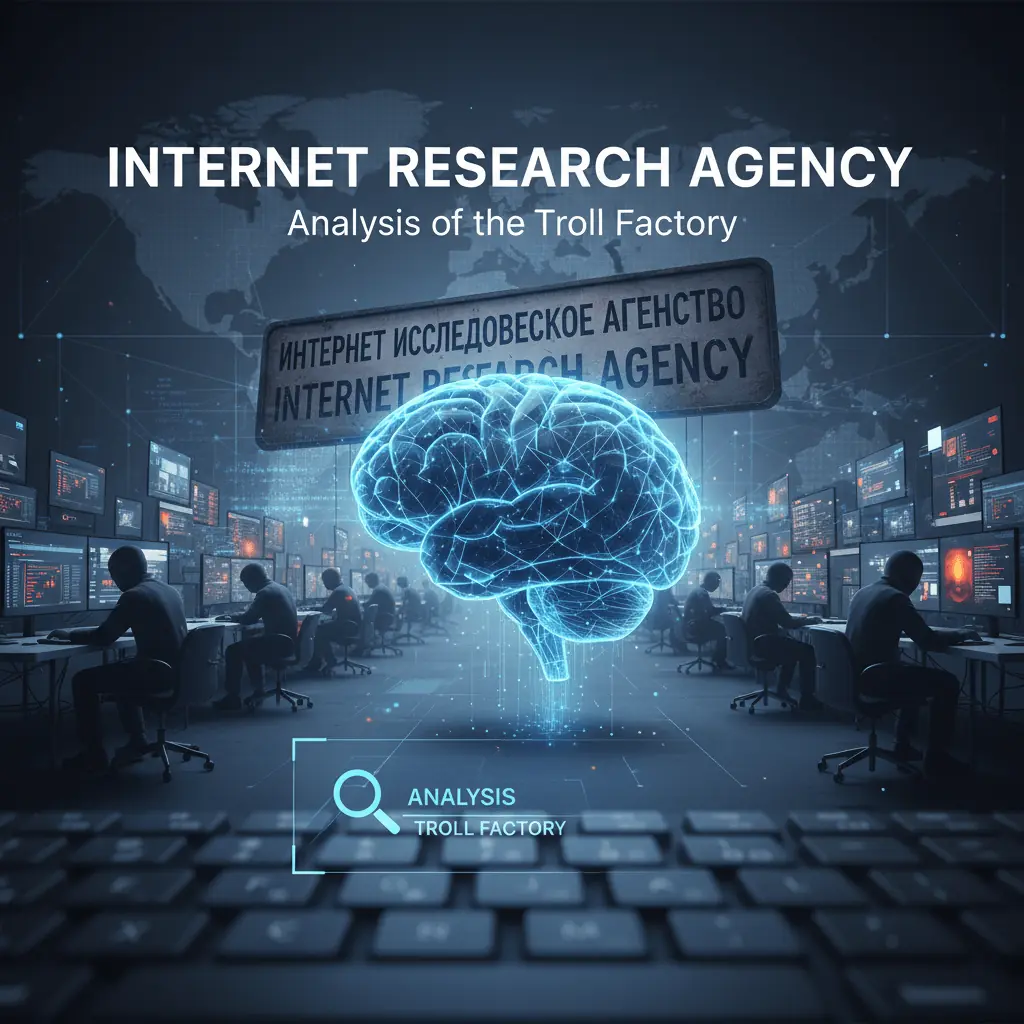
Internet Research Agency: analysis of the troll factory
The Internet Research Agency was an industrial-scale, state-linked operation whose strategic aim was to erode trust in democratic institutions and deepen social fragmentation. Elections were opportunities within that longer campaign, not its goal.

Key judgments
- The IRA's objectives went beyond election interference: its main aim was to erode institutional trust and widen existing divisions over race, immigration, guns and religion. Its main impact was agenda-setting and polarization rather than direct persuasion of voters. Funding and personnel links to Russian state structures show it was not a rogue commercial operation. Its model, based on culturally fluent human operators exploiting platforms' engagement and advertising tools, has since been adopted by other states, pointing toward a standardized playbook.
In February 2018, the U.S. Department of Justice unsealed indictments against thirteen Russian nationals and three entities, including the Internet Research Agency (IRA). The 37-page document revealed what intelligence professionals had long suspected: a sophisticated, well-funded organization conducting systematic information warfare against democratic institutions. This internet research agency analysis examines not just the IRA’s operational methods, but the broader implications for understanding state-sponsored cognitive warfare in the digital age.
The IRA represents a paradigm shift from traditional propaganda to what NATO’s Strategic Communications Centre of Excellence terms “computational propaganda”—the use of algorithms, automation, and human operatives to manipulate public opinion at scale. Unlike Cold War-era active measures, which relied on placement of disinformation through trusted intermediaries, the IRA exploited the democratization of information distribution inherent in social media platforms.
What makes this case study particularly valuable is the unprecedented level of documentation available through legal proceedings, platform investigations, and open-source intelligence (OSINT) analysis. This convergence of evidence allows for a forensic reconstruction of how a relatively small organization—fewer than 400 employees at its peak—achieved strategic influence across multiple democratic societies.
Operational Architecture and Methodology
Organizational Structure and Human Resources
The IRA’s organizational design reflected principles of operational security and plausible deniability. Established in 2013 and formally registered as a Russian company, it operated under the cover of legitimate social media marketing. According to federal indictments, the organization employed specialists in graphic design, data analytics, search engine optimization, and native-language content creation for target audiences.
Personnel recruitment followed a deliberate pattern: young, digitally native Russians with strong English-language skills and cultural familiarity with Western social media platforms. Training materials recovered through investigative reporting revealed systematic instruction in American political processes, cultural references, and regional dialects. This investment in human capital distinguished the IRA from automated bot networks, enabling more sophisticated social engineering.
Technical Infrastructure and Operational Security
The IRA’s technical architecture demonstrated sophisticated understanding of platform algorithms and content moderation systems. Operatives used VPNs, stolen identities, and purchased American PayPal accounts to maintain operational security. They leveraged legitimate advertising tools to amplify content, spending over $100,000 on Facebook advertisements alone between 2015 and 2017.
Platform analysis by the Atlantic Council’s Digital Forensic Research Lab revealed a multi-layered approach to content distribution. Initial posts from IRA-controlled accounts would be amplified through coordinated networks, then further distributed through unwitting American users who engaged with the content organically. This “seeding and amplification” model maximized reach while maintaining plausible deniability.
Target Selection and Audience Segmentation
The IRA’s targeting methodology reflected advanced understanding of American political psychology and media consumption patterns. Rather than promoting specific candidates or policies, the organization focused on amplifying existing social divisions around race, immigration, gun rights, and religious freedom. This approach aligned with active measures doctrine: exploit existing contradictions rather than create new ones.
Geographic targeting showed particular sophistication. The IRA concentrated efforts on swing states and politically competitive districts, suggesting access to American polling data and electoral analysis. Content was tailored to local issues and cultural references, indicating extensive research into target communities.
What Made the IRA Effective: Psychological and Technical Factors
Exploitation of Cognitive Biases
The IRA’s effectiveness stemmed partly from systematic exploitation of cognitive biases documented in social psychology research. Content design leveraged confirmation bias by presenting information that reinforced existing beliefs while avoiding cognitive dissonance. The organization understood that emotionally charged content generates higher engagement rates on social media platforms, aligning operational objectives with algorithmic optimization.
Particularly effective was the exploitation of in-group/out-group dynamics. IRA content consistently framed political issues as zero-sum conflicts between mutually exclusive identities. This approach amplified tribal thinking and reduced the cognitive effort required for audience members to process complex political information.
Platform Vulnerabilities and Algorithmic Amplification
The IRA succeeded by understanding and exploiting structural vulnerabilities in social media platforms. Facebook’s News Feed algorithm prioritized content that generated high engagement, inadvertently amplifying divisive material. Twitter’s trending topics feature could be manipulated through coordinated posting, creating artificial impressions of grassroots momentum.
Platform advertising systems provided sophisticated targeting capabilities originally designed for commercial marketing. The IRA used these tools to reach specific demographic and psychographic segments with tailored messages. Lookalike audience features allowed the organization to identify new targets based on existing engagement patterns.
Myth vs. Reality: Common Misconceptions About the IRA
Myth: The IRA Was Primarily About Election Interference
Reality: While the 2016 U.S. election provided a high-visibility target, the IRA’s operations began years earlier and continued afterward. The organization’s strategic objective was broader: degrading trust in democratic institutions and promoting social fragmentation. Elections were tactical opportunities within a longer-term strategy of cognitive warfare.
Myth: The IRA’s Impact Was Minimal Due to Limited Scale
Reality: Analysis by the Oxford Internet Institute found that IRA content reached approximately 126 million Facebook users and generated over 20 million engagements on Instagram. More importantly, the organization’s content was shared and amplified by legitimate users, extending its reach exponentially. The strategic impact lies not in direct persuasion but in agenda-setting and polarization.
Myth: The IRA Was a Rogue Operation
Reality: Financial records and personnel connections revealed integration with Russian state structures. The organization was funded through entities connected to Yevgeny Prigozhin, a businessman with extensive contracts with the Russian Ministry of Defense. This suggests coordination with broader Russian influence operations rather than independent activity.
A Framework for Analyzing State-Sponsored Information Operations
Key Indicators of Systematic Information Warfare
Based on the IRA case study, intelligence analysts can identify several indicators of state-sponsored information operations:
- Coordinated authenticity: Multiple accounts posting similar content with temporal clustering
- Cross-platform synchronization: Identical content appearing across multiple social media platforms simultaneously
- Sophisticated targeting: Content tailored to specific geographic and demographic segments
- Operational security measures: Use of VPNs, proxy servers, and identity obfuscation techniques
- Professional content quality: High-quality graphics, video production, and native-language proficiency
Assessment Methodology
Effective analysis of suspected information operations requires integrating multiple intelligence disciplines. Technical analysis identifies network behaviors and content distribution patterns. Linguistic analysis reveals non-native language patterns and cultural inconsistencies. Behavioral analysis examines posting patterns and engagement metrics for anomalies.
The NATO Strategic Communications Centre of Excellence recommends a layered analytical approach combining automated detection tools with human analyst review. This methodology acknowledges both the scale of modern information environments and the sophistication of adversary operations.
Institutional Response Frameworks
The IRA case reveals critical gaps in institutional preparedness for information warfare. Platform companies lacked adequate policies and technical capabilities for detecting coordinated inauthentic behavior. Government agencies operated under legal and jurisdictional constraints that limited rapid response capabilities.
Effective defense requires integration across multiple domains: technical countermeasures, legal frameworks, public awareness, and diplomatic pressure. The European Union’s Code of Practice on Disinformation and the U.S. Cybersecurity and Infrastructure Security Agency’s guidance represent evolving approaches to this challenge.
Forward Assessment: Evolution and Implications
The IRA’s operational model has influenced subsequent information operations by both state and non-state actors. Chinese influence campaigns targeting Hong Kong protests and Iranian operations during the 2020 U.S. election showed similar techniques adapted to different strategic objectives. This suggests the emergence of a standardized playbook for information warfare in democratic societies.
Platform countermeasures have evolved since 2016, but so have adversary capabilities. The integration of artificial intelligence for content generation and the emergence of deepfake technology present new challenges for detection and attribution. Future operations may achieve greater scale and sophistication while requiring fewer human operatives.
The strategic implications extend beyond electoral politics to fundamental questions about information integrity in open societies. The IRA case demonstrates that cognitive warfare represents a persistent challenge requiring sustained institutional adaptation rather than episodic response to specific incidents.
Sources
Rosen, G. (2020). Removing Coordinated Inauthentic Behavior. Meta Newsroom.
Howard, P.N. & Bradshaw, S. (2019). The Global Disinformation Order. Oxford Internet Institute.
Nimmo, B. (2019). The IRA, Social Media and Political Polarization in the United States. Digital Forensic Research Lab.
Lucas, E. & Pomeranzev, P. (2016). Winning the Information War. Center for European Policy Analysis.
NATO StratCom COE. (2018). Digital Hydra: Security Implications of False Information Online.
U.S. Department of Justice. (2018). United States v. Internet Research Agency et al. Criminal Indictment.