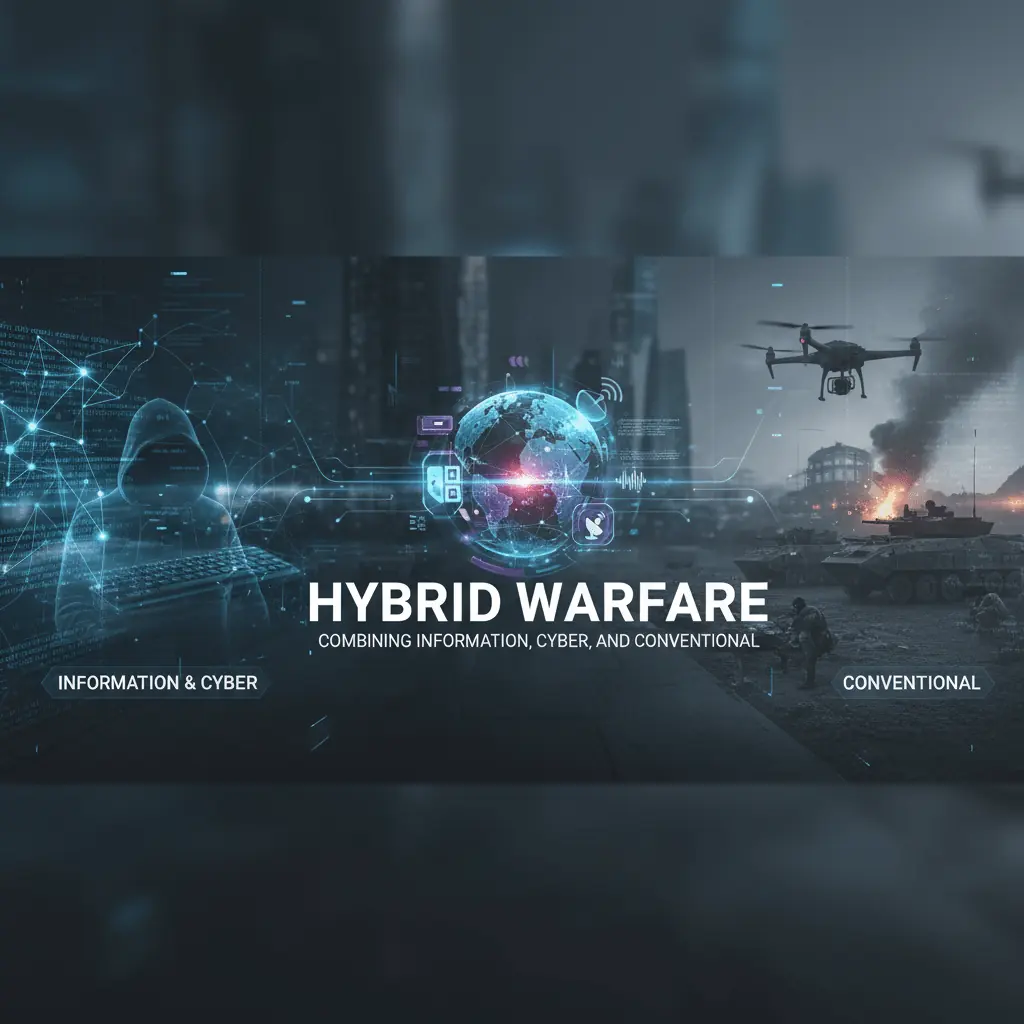
Hybrid warfare: combining information, cyber, and conventional
Hybrid warfare is not a new kind of war. It integrates information, cyber and conventional power into one strategy that blurs the lines between peace and war, and between civilian and military targets.

Key judgments
- In hybrid campaigns, information operations are a primary instrument of strategic effect, not a support function for military action. Conventional forces act mainly as escalation insurance, constraining the defender's response below the threshold of armed conflict. NATO's Article 5 framework is poorly suited to graduated, sub-threshold aggression, and that ambiguity favors the aggressor. Because private companies own much of the critical infrastructure and information space, effective defense depends on public–private coordination that democracies have only begun to build.
The Paradox of Modern Conflict: When War Becomes Invisible
In February 2022, as Russian tanks crossed the Ukrainian border, the world witnessed something unprecedented: a conventional military invasion preceded, accompanied, and amplified by sophisticated information operations that had been building for months. Yet even as artillery shells fell on Mariupol, the most consequential battles were simultaneously being fought in cyberspace, across social media platforms, and within the cognitive architecture of global audiences. This represents the operational reality of hybrid warfare—a strategic approach that dissolves the traditional boundaries between peace and war, military and civilian targets, and kinetic and non-kinetic effects.
The term hybrid warfare has become ubiquitous in defense circles, yet its precise definition remains contested. What emerges from careful analysis of contemporary conflicts is not a new form of warfare, but rather the systematic integration of information operations, cyber capabilities, and conventional military power into a coherent strategic framework. This integration challenges fundamental assumptions about deterrence, escalation, and the nature of conflict itself in the twenty-first century.
The Strategic Logic Behind Hybrid Integration
Information Operations as Force Multipliers
Modern hybrid warfare leverages information operations not as supporting activities, but as primary instruments of strategic effect. Unlike traditional propaganda, contemporary information operations exploit the structural vulnerabilities of open information environments. Russian operations in Ukraine since 2014 demonstrate this integration: military advances are preceded by information campaigns designed to fragment opposing coalitions, while cyber attacks on critical infrastructure create both tactical advantages and strategic messaging opportunities.
The cognitive dimension operates according to what Russian military doctrine terms “reflexive control”—the practice of conveying specially prepared information to influence decision-making processes. This approach recognizes that in democratic societies, public opinion directly constrains strategic options. By degrading the information environment through disinformation, amplifying existing social divisions, and creating uncertainty about basic facts, hybrid campaigns can achieve strategic effects without deploying kinetic force.
Cyber Capabilities as Strategic Enablers
Cyber operations in hybrid warfare serve multiple functions beyond traditional espionage or sabotage. They provide persistent access to adversary networks, enabling intelligence collection that informs both information and conventional operations. Simultaneously, cyber capabilities offer scalable tools for imposing costs while maintaining plausible deniability—a critical consideration in conflicts below the threshold of declared war.
The 2015 cyber attacks on Ukraine’s power grid illustrate this integration: while the immediate effect was tactical disruption, the strategic impact lay in demonstrating vulnerability and eroding confidence in critical infrastructure. This psychological effect proved more durable than the temporary blackouts, creating lasting uncertainty about the security of civilian systems that support modern societies.
Conventional Forces as Escalation Insurance
Paradoxically, conventional military capabilities in hybrid warfare often function more as strategic insurance than operational instruments. Their presence establishes credible escalation options that constrain adversary responses to information and cyber operations. This dynamic explains why hybrid campaigns typically occur in regions where conventional military balance favors the aggressor—the implicit threat of escalation provides protection for sub-threshold activities.
NATO’s Article 5 framework, designed for conventional invasion scenarios, struggles with this graduated approach. When faced with information operations backed by conventional deterrence, alliance responses become constrained by the need to avoid escalation. This asymmetry between aggressor flexibility and defender constraints represents a fundamental strategic advantage for actors employing hybrid approaches.
How Do Democratic Institutions Respond to Hybrid Challenges?
The Attribution Problem and Legal Frameworks
Democratic responses to hybrid warfare confront immediate challenges in attribution and legal authority. Information operations exploit free speech protections, making government counter-responses legally and politically constrained. Cyber attacks below the threshold of armed conflict exist in a legal gray zone where traditional deterrence mechanisms prove inadequate.
The requirement for public evidence in democratic systems creates additional vulnerabilities. Intelligence capabilities sufficient for policy decisions may be insufficient for public attribution, creating space for adversaries to operate below detection thresholds. This dynamic explains the persistent success of hybrid campaigns despite sophisticated intelligence awareness of their existence.
Institutional Adaptation Challenges
Effective hybrid defense requires cross-domain coordination between military, intelligence, law enforcement, and civilian agencies—precisely the kind of integration that democratic separation of powers is designed to prevent. NATO’s recognition of cyberspace as a domain of operations represents institutional adaptation, but implementation remains fragmented across national bureaucracies with different authorities and capabilities.
The private sector dimension compounds these challenges. Critical infrastructure, social media platforms, and telecommunications networks are predominantly privately owned, requiring public-private coordination that remains underdeveloped in most Western nations. This structural vulnerability becomes more pronounced as hybrid campaigns increasingly target civilian systems and social cohesion rather than military capabilities.
Strategic Communication Constraints
Democratic responses to information operations face inherent constraints that authoritarian systems do not. Government messaging in democratic societies operates under transparency requirements and competitive oversight that limit effectiveness in fast-moving information environments. Meanwhile, counter-disinformation efforts risk accusations of censorship or political manipulation, creating political costs for defensive measures.
This asymmetry means that democratic responses to hybrid warfare must rely heavily on resilience rather than counter-offensive capabilities. Building societal resistance to information manipulation through media literacy, institutional transparency, and social cohesion becomes the primary defensive strategy—but these approaches require sustained investment and show limited effectiveness against sophisticated adversary operations.
A Framework for Analyzing Hybrid Campaign Effectiveness
Strategic Objectives Assessment
Analyzing hybrid warfare requires moving beyond tactical metrics to strategic effect assessment. Successful hybrid campaigns achieve political objectives through integrated operations across multiple domains. Key indicators include: shift in target state policy positions, degradation of alliance cohesion, changes in domestic political dynamics, and erosion of institutional legitimacy.
The temporal dimension proves critical for assessment. Hybrid campaigns operate on extended timelines, with effects accumulating across multiple election cycles or policy decisions. Short-term tactical success may prove strategically counterproductive if it generates effective defensive responses or strengthens target resilience.
Cross-Domain Integration Indicators
Effective hybrid operations demonstrate coordination between information, cyber, and conventional activities. Analysis should examine: temporal correlation between domain activities, complementary targeting of the same strategic objectives, and escalation coordination that maintains operations below response thresholds.
| Domain | Primary Function | Strategic Effect | Integration Mechanism |
|---|---|---|---|
| Information | Cognitive influence | Decision disruption | Narrative coordination |
| Cyber | System disruption | Capability degradation | Intelligence fusion |
| Conventional | Escalation control | Response constraint | Deterrent positioning |
Defensive Resilience Metrics
Successful defense against hybrid warfare requires measuring resilience across targeted systems. Information resilience indicators include: diversity of information sources, institutional trust levels, and social cohesion metrics. Cyber resilience encompasses: network redundancy, incident response capabilities, and recovery timeframes. Conventional deterrence effectiveness appears in: alliance credibility, escalation response capabilities, and strategic messaging consistency.
The challenge lies in developing metrics that capture emergent properties of system resilience rather than simply measuring individual component performance. Hybrid warfare targets the interfaces between systems—the cognitive-technical, civil-military, and public-private boundaries that prove most difficult to defend and measure.
Strategic Implications for Future Conflict
Hybrid warfare represents more than tactical innovation—it constitutes a fundamental challenge to the Westphalian state system’s assumptions about sovereignty, conflict, and deterrence. As information infrastructure becomes increasingly central to economic and political systems, the distinction between civilian and military targets dissolves. This evolution demands new frameworks for understanding conflict, deterrence, and strategic stability.
The most significant implication may be the transformation of peacetime competition. When information operations, cyber intrusions, and conventional posturing operate continuously below the threshold of declared conflict, the traditional peace-war distinction becomes meaningless. Future strategic competition will require sustained integration of defensive and offensive capabilities across all domains—a challenge that democratic institutions are only beginning to understand.
Perhaps most importantly, hybrid warfare demonstrates that in the information age, the most decisive battles may be fought not for territory or resources, but for the cognitive architecture that shapes how societies understand reality itself.
Sources
- Galeotti, M. (2019). Russian Political War: Moving Beyond the Hybrid. Routledge.
- Hoffman, F. G. (2007). Conflict in the 21st Century: The Rise of Hybrid Wars. Potomac Institute for Policy Studies.
- NATO Strategic Communications Centre of Excellence. (2020). Cognitive Warfare: An Attack on Truth and Thought. NATO StratCom COE.
- Thomas, T. L. (2004). Russia’s Reflexive Control Theory and the Military. Journal of Slavic Military Studies, 17(2), 237-256.
- Walker, C., & Ludwig, J. (2017). The Meaning of Sharp Power: How Authoritarian States Project Influence. Foreign Affairs.
- Wigell, M. (2019). Hybrid interference as a wedge strategy: A theory of external interference in liberal democracy. International Affairs, 95(2), 255-275.