NATO’s Cognitive Warfare Concept: What the Alliance Actually Says
NATO has adopted the vocabulary of cognitive warfare, but the concept is not yet formal doctrine. This analysis reads the primary ACT documents directly to distinguish what the Alliance actually says from what is often assumed.

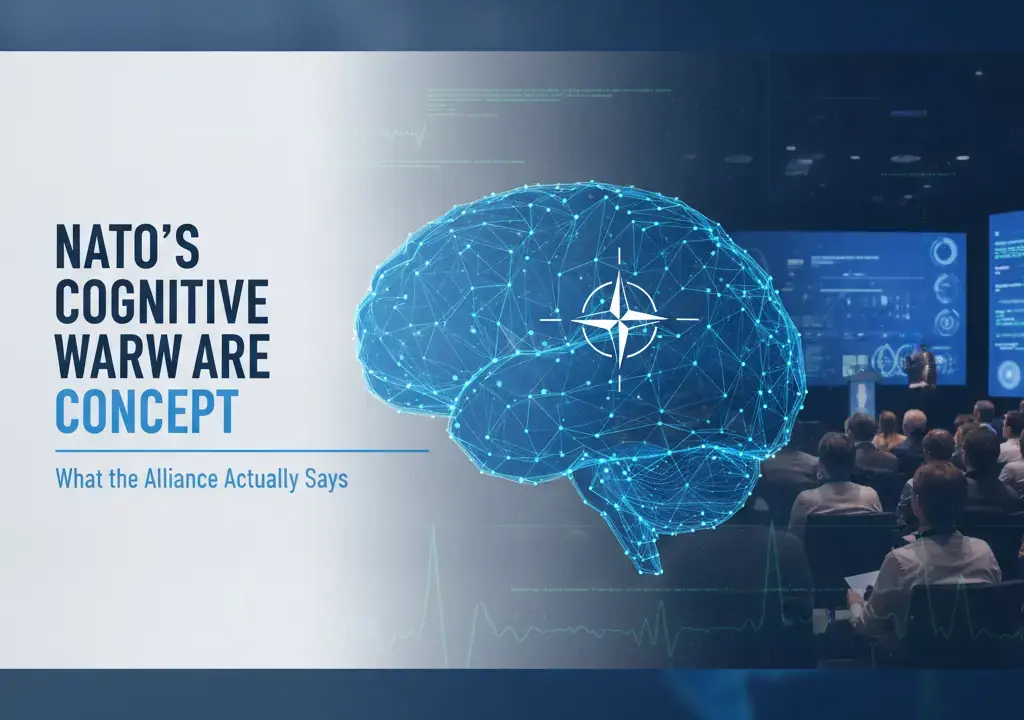
NATO Allied Command Transformation’s 2020 foundational report, authored by François du Cluzel for the NATO ACT Innovation Hub, made a claim that reframed how the Alliance thinks about conflict: that cognitive warfare adds a third major combat dimension to the modern battlefield — alongside the physical and informational — namely, a cognitive dimension. That assertion has since structured five years of institutional activity, two major scientific workshops, a Chief Scientist report, and, in 2025, the finalization of what ACT calls the Cognitive Warfare Concept. Yet a careful reading of these documents reveals something more complicated: a conceptually rich framework that has not yet achieved doctrinal status within NATO’s formal corpus, whose core innovation is contested even within the Alliance, and whose operational implications remain underspecified.
This analysis reads the primary ACT documents directly. The goal is to distinguish what the Alliance actually says about the NATO cognitive warfare concept from what is frequently assumed, misattributed, or compressed into shorthand. For analysts preparing briefings or researchers entering this literature, the distinction matters considerably.
Doctrinal genealogy: how cognitive warfare entered NATO vocabulary
The Innovation Hub as conceptual laboratory
NATO ACT’s Innovation Hub in Norfolk, Virginia, is not a doctrine-producing body in the formal sense. It functions as a conceptual incubator — generating exploratory concepts that may or may not migrate into official NATO doctrine. This distinction is foundational to reading the cognitive warfare literature correctly. When ACT’s Innovation Hub publishes a framework, it is articulating a candidate concept, not issuing an Alliance-wide directive.
Du Cluzel’s June–November 2020 report was explicitly framed as an exploratory concept. Its purpose was to map the cognitive warfare landscape and argue for its strategic relevance to NATO, not to codify capability requirements or assign doctrinal responsibilities. That exploratory status has persisted, in modified form, through the 2025 concept finalization — a process in which over twenty NATO member countries and stakeholders participated, with the stated goal of creating a shared understanding rather than binding operational guidance.
The 2021 Warfighting Capstone Concept and cognitive superiority
The clearest evidence that cognitive warfare thinking reached NATO’s highest strategic level is the 2021 NATO Warfighting Capstone Concept, which formally listed Cognitive Superiority as one of the Alliance’s warfare development imperatives — alongside layered resilience, influence and power projection, cross-domain command, and integrated multi-domain defence. This is significant: a NATO capstone document acknowledged that maintaining advantage in the cognitive dimension is a warfare development priority, which implies institutional resource attention even absent dedicated doctrine.
What the 2021 document did not do is define cognitive warfare as an operational domain equivalent to Maritime, Land, Air, Space, or Cyber. That distinction — between a warfare development imperative and a recognized operational domain — is one the Alliance has deliberately left unresolved, and the resolution of that question will significantly shape future capability development and force structure decisions. For fuller context on how information-related concepts have evolved into this domain debate, see the site’s historical evolution of information warfare doctrines.
What NATO’s cognitive warfare definition actually says
The working definition and its scope
NATO’s working definition, developed through an interdisciplinary Science and Technology Organization workshop and reflected in the ACT documentation, describes cognitive warfare as
Sources
- Innovation Hub – Jan 2021 Page 1 of 45 June-November 2020 François du Cluzel (innovationhub-act.org)
- NATO Chief Scientist Research Report on Cognitive Warfare 1 Cognitive Warfare (sto.nato.int)
- NATO’s Concept of Cognitive Warfare (puolustusvoimat.fi)
- Frontiers (frontiersin.org)
- Allied Command Transformation develops the Cognitive Warfare Concept to Combat Disinformation and Defend Against “Cognitive Warfare” – NATO’s ACT (act.nato.int)
- Cognitive Warfare Symposium (innovationhub-act.org)
- The Understanding of Cognitive Warfare in Comparative … (publications.sto.nato.int)
- 1 The “New” CogniƟve Dimension of CompeƟƟon and War: (cgsr.llnl.gov)
- Cognitive Warfare: The Case for Disaggregation (css.ethz.ch)
- (PDF) Cognitive warfare: a conceptual analysis of the NATO ACT cognitive warfare exploratory concept (researchgate.net)