SITUATION ASSESSMENT
In February 2022, as Russian forces massed on Ukraine’s border, a parallel offensive was already underway in cyberspace. Analysis by the Stanford Internet Observatory revealed that Russian information operations had been conditioning global audiences for months, seeding narratives about Ukrainian «biological weapons» and Western «provocations» across 470+ social media accounts. This campaign exemplified how the evolution of information warfare doctrines has transformed from crude propaganda broadcasts into sophisticated cognitive targeting systems that operate below the threshold of armed conflict.
Open-source evidence indicates that modern information warfare represents a fundamental shift from Cold War-era approaches. Where previous doctrines relied on centralized messaging through state-controlled media, contemporary operations deploy decentralized networks that exploit algorithmic amplification and psychological targeting at unprecedented scale. The operational pattern suggests we are witnessing the emergence of what NATO’s Cognitive Warfare concept describes as «the struggle for minds» — a domain where perception becomes the primary battleground.
THREAT VECTOR: Doctrinal Evolution Framework
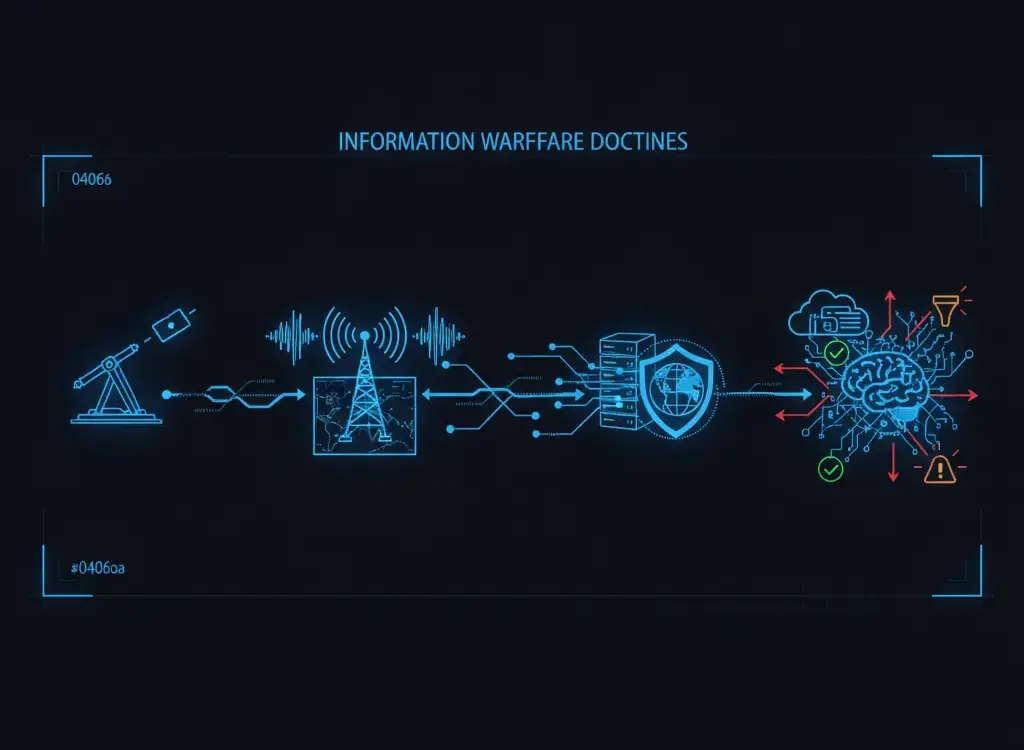
The evolution of information warfare doctrines can be mapped across four distinct phases, each marked by technological capabilities and strategic understanding. Research by Thomas Rid (2020) in «Active Measures» demonstrates how these phases built upon each other while adapting to new information environments.
Phase I: Industrial Propaganda (1920s-1960s)
Early information warfare doctrine centered on mass broadcast capabilities. The Soviet Union’s Active Measures program, documented extensively by the Mitrokhin Archive, relied on centralized messaging through radio broadcasts, printed materials, and agent networks. The operational framework emphasized repetition and authority, leveraging what Cialdini’s influence research would later identify as social proof and authority principles.
Phase II: Electronic Warfare Integration (1970s-1990s)
The integration of electronic capabilities marked a tactical shift toward real-time information manipulation. The RAND Corporation’s 2016 analysis of Cold War information operations reveals how doctrines began incorporating signals intelligence and electronic jamming as force multipliers for psychological operations. This period established the foundation for multi-domain information warfare concepts still deployed today.
Phase III: Digital Network Operations (2000s-2010s)
The emergence of internet-based platforms fundamentally altered information warfare doctrines. Russia’s Internet Research Agency (IRA), exposed by the Mueller investigation, demonstrated how state actors could weaponize social media algorithms to achieve strategic objectives. The operational innovation lay in exploiting platform design features — engagement algorithms, micro-targeting capabilities, and viral spread mechanisms — rather than controlling distribution channels directly.
Phase IV: Cognitive Warfare Doctrine (2015-Present)
Contemporary information warfare doctrine integrates artificial intelligence, big data analytics, and behavioral psychology into what NATO defines as cognitive warfare. Research by the EU DisinfoLab indicates that current operations target decision-making processes at neurological levels, using techniques aligned with Kahneman’s dual-process theory to bypass critical thinking mechanisms.
CASE STUDY: Operational Deployment Patterns
Operation: Russian Election Interference (2016-2020)
The IRA’s operations against U.S. electoral processes provide a documented case study in Phase IV doctrine implementation. Analysis by the Senate Intelligence Committee revealed a multi-layered approach:
- Audience Segmentation: Psychological profiling divided target populations into 32 distinct demographic clusters
- Narrative Injection: Conflicting messages were simultaneously deployed to polarize audience segments
- Amplification Networks: Coordinated inauthentic behavior leveraged platform algorithms for organic-appearing spread
- Cross-Platform Synchronization: Operations spanned Facebook, Twitter, Instagram, and YouTube to create information saturation
This aligns with documented TTPs for what RAND’s «Firehose of Falsehood» model describes as high-volume, multi-channel messaging designed to create confusion rather than persuasion.
Operation: COVID-19 «Infodemic» Campaigns (2020-2021)
The pandemic created optimal conditions for information warfare doctrine testing. The Atlantic Council’s DFRLab documented coordinated campaigns that exploited health anxieties across multiple state and non-state actors. Critical indicators included:
Assessment: The operational pattern suggests deliberate exploitation of uncertainty and fear responses, consistent with cognitive warfare doctrine’s focus on emotional rather than rational decision-making pathways.
Bellingcat’s investigation revealed how these operations integrated legitimate health concerns with strategic disinformation, making detection and debunking significantly more challenging than previous information warfare approaches.
DETECTION PROTOCOL: Behavioral Signatures
A critical indicator for identifying evolved information warfare operations is the presence of multiple concurrent signatures that distinguish sophisticated campaigns from organic information spread:
Technical Markers
- Coordination Indicators: Synchronized posting patterns across multiple accounts within 5-minute windows
- Network Analysis: Hub-and-spoke distribution patterns suggesting centralized control
- Content Fingerprinting: Identical or near-identical messaging with minor variations for algorithm evasion
- Platform Gaming: Exploitation of specific algorithmic features (hashtag trends, engagement triggers)
Content Patterns
- Emotional Triggers: Content designed to provoke immediate emotional responses over analytical thinking
- False Dichotomies: Presentation of complex issues as binary choices
- Source Obfuscation: Attribution chains that resist verification efforts
- Timing Correlation: Content release aligned with specific political or social events
DEFENSE FRAMEWORK: Multi-Layer Countermeasures
Individual-Level Cognitive Hygiene
- Source Verification Protocol: Cross-reference information against 3+ independent, credible sources before sharing
- Emotional Response Recognition: Pause for 24 hours before engaging with content that triggers strong emotional reactions
- Network Diversity Assessment: Actively seek information from sources outside your typical algorithmic bubble
- Platform Behavior Modification: Disable auto-play features and algorithmic recommendations on social media platforms
Organizational Defense Systems
Institutional protocols should integrate lessons from military cyber defense doctrine:
- Information Environment Monitoring: Deploy social media listening tools to detect narrative attacks against organizational interests
- Stakeholder Education Programs: Regular training on information warfare recognition, based on documented case studies
- Response Team Protocols: Pre-planned communication strategies for rapid response to disinformation campaigns
- Third-Party Verification Networks: Established relationships with fact-checking organizations and research institutions
Systemic Policy Approaches
Research by the Brookings Institution (2021) indicates that effective defense requires coordination across multiple domains:
The operational reality is that information warfare doctrines exploit gaps between individual awareness, platform policies, and international law. Defense strategies must address all three simultaneously.
Systemic countermeasures include algorithmic transparency requirements, international cooperation frameworks like the EU’s Code of Practice on Disinformation, and cross-platform coordination mechanisms for rapid response to large-scale operations.
ASSESSMENT: Strategic Intelligence Summary
KEY TAKEAWAYS
- Doctrinal Shift: Modern information warfare has evolved from broadcast propaganda to cognitive targeting systems that exploit psychological vulnerabilities and algorithmic amplification
- Technical Integration: Contemporary operations integrate artificial intelligence, behavioral psychology, and platform manipulation in ways that blur the lines between organic and artificial information spread
- Detection Complexity: Evolved doctrines deliberately mix legitimate information with strategic disinformation, making detection and debunking significantly more challenging
- Defense Requirements: Effective countermeasures require simultaneous action at individual, organizational, and systemic levels, with emphasis on cognitive resilience rather than reactive debunking
- Continuous Evolution: The evolution of information warfare doctrines continues to accelerate, driven by technological advancement and strategic learning from successful operations
Forward Assessment
The trajectory of information warfare doctrine evolution suggests continued integration of emerging technologies — particularly deepfake capabilities, large language models, and brain-computer interfaces — into cognitive targeting systems. The operational advantage will increasingly favor actors who can combine technical sophistication with deep understanding of psychological influence mechanisms.
Critical defensive preparation should focus on building cognitive resilience capabilities that can adapt to unknown attack vectors, rather than reactive measures targeting specific known techniques. The evolution of information warfare doctrines requires an equivalent evolution in information defense thinking.
REFERENCES
- Atlantic Council DFRLab (2021). «The COVID-19 ‘Infodemic’: How Social Media Helped Spread Coronavirus Misinformation.»
- Brookings Institution (2021). «Defending Democracy in the Digital Age: Policy Recommendations for Countering Information Operations.»
- European Union DisinfoLab (2020). «Indian Chronicles: Deep Dive into a 15-Year Operation Targeting the EU and UN to Serve Indian Interests.«
- NATO Strategic Communications Centre of Excellence (2021). «Cognitive Warfare: A Battle for the Mind.»
- RAND Corporation (2016). «The Russian ‘Firehose of Falsehood’ Propaganda Model.«
- Rid, Thomas (2020). «Active Measures: The Secret History of Disinformation and Political Warfare.» Farrar, Straus and Giroux.
- Stanford Internet Observatory (2022). «Repeat Offenders: Russian Information Operations During the 2022 Russian Invasion of Ukraine.»
- U.S. Senate Intelligence Committee (2020). «Report on Russian Active Measures Campaigns and Interference in the 2016 U.S. Election.«