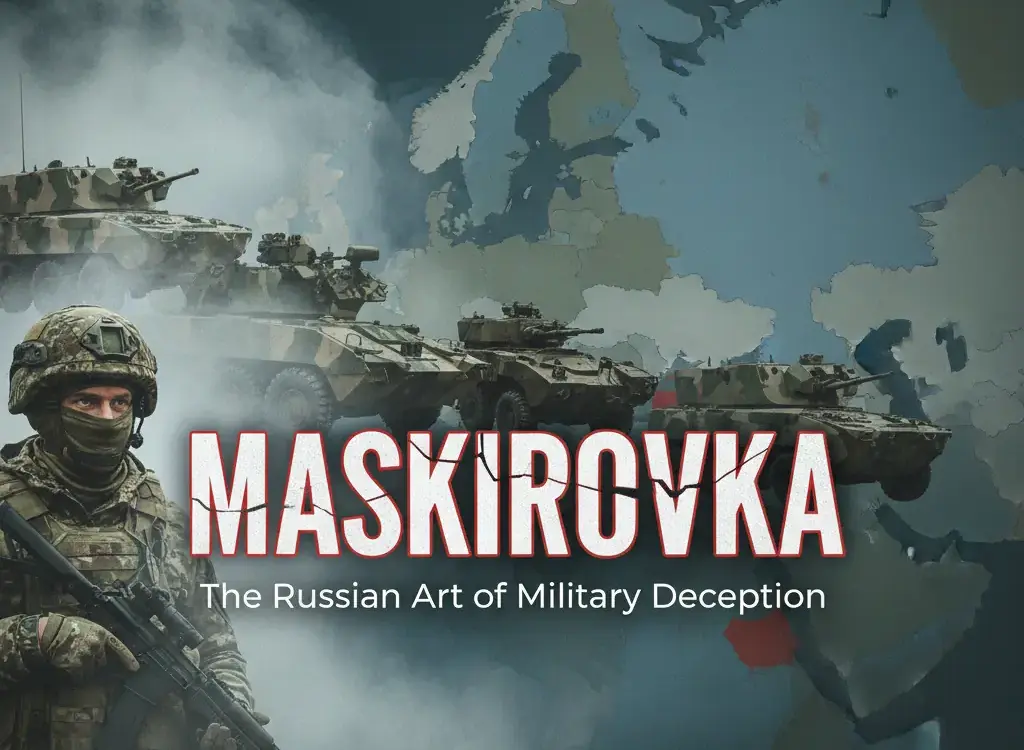
The Doctrine of Deception: Understanding Russian Military Maskirovka
In March 2014, as unmarked soldiers appeared across Crimea, Western intelligence agencies found themselves confronting a phenomenon that challenged conventional understanding of military deception. These «little green men» represented the operational manifestation of maskirovka—a comprehensive Russian military doctrine that extends far beyond traditional camouflage into the realm of strategic deception. The Crimean operation demonstrated how maskirovka has evolved from its Soviet-era origins into a cornerstone of contemporary Russian military doctrine, fundamentally reshaping how we must analyze and respond to hybrid threats.
Maskirovka represents more than tactical concealment; it constitutes a holistic approach to military deception that integrates operational security, strategic misdirection, and information warfare into unified campaign planning. Understanding its doctrinal foundations and operational applications has become essential for defense professionals analyzing Russian military capabilities and strategic intent.
Historical Evolution and Doctrinal Foundations
Soviet-Era Development
The conceptual framework of maskirovka emerged from Soviet military theorists who recognized deception as a force multiplier rather than merely a supporting element. The term itself derives from the Russian word «maska» (mask), but its doctrinal application encompasses what Soviet strategists termed «operational art»—the critical linkage between tactics and strategy that Western military thinking traditionally overlooked.
Soviet military doctrine, as codified in works like Marshal V.D. Sokolovskiy’s «Military Strategy» (1962), positioned maskirovka as an integral component of combined arms operations. Unlike Western approaches that typically treated deception as a specialized capability, Soviet doctrine embedded deceptive operations throughout the planning and execution cycle. This integration reflected a fundamental difference in strategic culture: where Western militaries often viewed deception with suspicion due to democratic transparency norms, Soviet doctrine embraced it as operationally necessary and morally neutral.
Post-Cold War Adaptation
The dissolution of the Soviet Union did not diminish Russian interest in maskirovka; instead, resource constraints and technological developments drove its evolution. The Russian General Staff, confronting NATO’s conventional superiority, refined maskirovka concepts to exploit asymmetric advantages in hybrid warfare scenarios. This adaptation process accelerated following NATO’s 1999 Kosovo intervention, which Russian military observers studied intensively for lessons about information warfare and strategic communication.
Contemporary Russian military doctrine, as reflected in documents like the 2014 Military Doctrine of the Russian Federation, explicitly acknowledges information confrontation as a primary threat vector. While these documents do not detail operational maskirovka techniques—such specificity would contradict the doctrine’s fundamental principles—they establish the conceptual framework for integrating deceptive operations across multiple domains.
What Constitutes Modern Maskirovka Doctrine?
Conceptual Architecture
Modern maskirovka operates across four integrated dimensions that distinguish it from conventional military deception. Operational maskirovka encompasses traditional concealment and misdirection of military movements and capabilities. Strategic maskirovka involves creating false impressions about national intent and policy objectives at the highest levels of government. Technical maskirovka focuses on concealing or misrepresenting military technological capabilities and electronic signatures. Information maskirovka leverages media manipulation and narrative warfare to shape adversary decision-making processes.
This multi-dimensional approach reflects Russian military thinking about the interconnected nature of contemporary conflict. Rather than viewing information operations as separate from kinetic operations, Russian doctrine treats them as mutually reinforcing elements of a unified campaign design. The 2013 Zapad military exercises, for example, demonstrated how maskirovka could simultaneously conceal force movements while conducting information operations to justify military positioning.
Integration with Hybrid Warfare
The relationship between maskirovka and what Western analysts term «hybrid warfare» represents a critical evolution in Russian military thinking. While Western doctrine typically treats hybrid threats as distinct from conventional military operations, Russian doctrine integrates deceptive elements across the full spectrum of conflict. This integration enables what Russian theorists call «non-linear warfare»—operations that blur the distinction between peace and war, military and civilian, domestic and foreign.
Available evidence suggests that Russian military planning treats maskirovka as the enabling capability for hybrid operations rather than simply one tool among many. The doctrine’s emphasis on maintaining plausible deniability while achieving operational objectives requires sophisticated deception planning from campaign inception through post-conflict narrative management.
Operational Implementation and Case Studies
The Crimean Template
The 2014 Crimean operation provides the most extensively documented example of contemporary maskirovka implementation. Russian forces employed operational deception to mask the scale and intent of military movements while simultaneously conducting strategic deception about the nature of the operation itself. The use of unmarked uniforms and equipment represented tactical maskirovka, while Russian officials’ denial of military involvement exemplified strategic maskirovka.
What distinguishes this operation from traditional military deception is its integration across multiple domains. Russian forces coordinated kinetic operations with cyber attacks against Ukrainian command and control systems, information operations targeting both Ukrainian and international audiences, and diplomatic initiatives designed to legitimize the operational outcome. This coordination required extensive advance planning that embedded deceptive elements from the operational concept’s earliest stages.
Eastern Ukraine and Evolutionary Adaptation
The subsequent conflict in Eastern Ukraine demonstrated maskirovka’s adaptability to different operational environments. Facing sustained international scrutiny and NATO intelligence collection, Russian forces refined their deceptive techniques while maintaining operational effectiveness. The introduction of sophisticated weaponry like the Buk missile system that downed Malaysia Airlines Flight 17 illustrates the doctrine’s challenge: maintaining plausible deniability while employing capabilities that clearly indicate state sponsorship.
Analysis of social media and open-source intelligence reveals how Russian planners adapted maskirovka techniques to digital environments. The coordination between official denials and social media narratives suggests systematic planning to create multiple, overlapping deception layers that complicate Western intelligence assessment and public attribution efforts.
Comparative Analysis with Western Deception Doctrine
NATO Approaches to Military Deception
NATO doctrine on military deception, as outlined in documents like ATP-3.10.1 «Military Deception,» reflects fundamentally different assumptions about deception’s role in military operations. Western doctrine typically treats deception as a supporting capability for specific operations rather than an integral component of strategic planning. This approach reflects democratic values that prioritize transparency and legal constraints that limit deceptive activities in peacetime.
The contrast becomes apparent in planning methodologies. NATO deception planning follows the MILDEC process (Military Deception), which requires explicit authorization and clear operational objectives. Russian maskirovka appears to follow a more flexible approach that adapts deceptive techniques to emerging opportunities rather than predetermined operational plans.
Cultural and Legal Constraints
Democratic militaries operate under legal and cultural constraints that significantly limit deception operations. The requirement for legislative oversight, public accountability, and adherence to international law creates operational boundaries that Russian doctrine explicitly exploits. This asymmetry in operational constraints represents a persistent challenge for Western defense planners attempting to counter maskirovka-enabled threats.
Moreover, Western military culture’s emphasis on technological superiority and precision operations creates cognitive biases that maskirovka specifically targets. Russian deception planning appears designed to exploit Western expectations about operational transparency and technological predictability, creating decision-making uncertainty that amplifies the effectiveness of limited military capabilities.
A Framework for Analyzing Contemporary Maskirovka
Understanding and countering maskirovka requires analytical frameworks that account for its multi-dimensional nature and adaptive characteristics. Defense professionals need systematic approaches to identify deceptive operations while avoiding both mirror-imaging and worst-case scenario planning that can lead to strategic paralysis.
Key Indicators and Warning Signs
Effective maskirovka analysis requires monitoring indicators across multiple intelligence disciplines and information sources. Pattern recognition becomes critical when individual indicators appear innocuous but collectively suggest coordinated deception operations.
- Information Environment Indicators: Coordinated messaging across official and unofficial Russian media channels, particularly when narratives anticipate or justify potential military actions.
- Operational Security Changes: Unusual communications patterns, movement restrictions, or exercise schedules that deviate from established norms.
- Technical Signatures: Electronic warfare activities, unusual cyber operations, or communications that suggest operational preparation.
- Diplomatic Activity: Policy statements or diplomatic initiatives that appear disconnected from observable military activities.
- Economic Preparations: Financial or logistical arrangements that support extended operations while maintaining plausible alternative explanations.
Analytical Methodologies
Analyzing potential maskirovka operations requires analytical techniques that account for deliberate deception while avoiding cognitive traps that either dismiss legitimate threats or perceive deception where none exists. The challenge lies in distinguishing between operational security measures, which all competent militaries employ, and systematic deception designed to enable strategic surprise.
Red team analysis becomes particularly valuable for maskirovka assessment, as it requires analysts to adopt the adversary’s perspective while identifying their own analytical assumptions. This methodology helps identify deception scenarios that might exploit Western planning assumptions or cultural biases about military operations.
Strategic Implications and Future Considerations
Maskirovka represents more than a tactical military capability; it reflects a strategic approach to interstate competition that challenges foundational assumptions about deterrence, escalation management, and conflict termination. As Russian military doctrine continues evolving, maskirovka principles are likely to influence other domains including space operations, cyber warfare, and strategic nuclear forces.
The doctrine’s success in recent conflicts will likely encourage other state actors to develop similar capabilities, potentially creating a more complex threat environment where attribution becomes increasingly difficult and traditional deterrence mechanisms prove less effective. Defense professionals must therefore develop analytical capabilities and response options that account for systematic deception as a persistent feature of contemporary security competition rather than an exceptional threat.
What concerns me most is the potential for maskirovka-inspired techniques to undermine the escalation control mechanisms that have maintained strategic stability since the Cold War. When state actors can plausibly deny involvement in significant military operations, traditional concepts of proportional response and deterrent signaling require fundamental reconsideration.