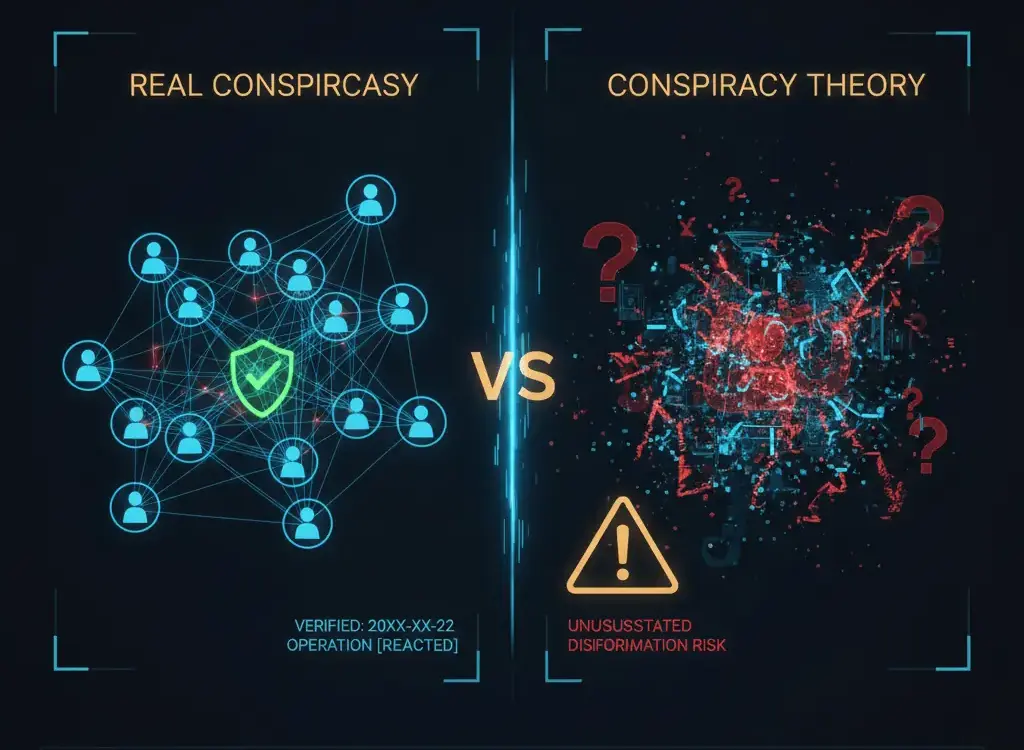
SITUATION ASSESSMENT
In March 2022, the Stanford Internet Observatory documented a coordinated inauthentic behavior campaign across multiple platforms targeting European audiences with fabricated evidence of Ukrainian war crimes. The operation employed deepfake technology, manipulated metadata, and sophisticated attribution laundering to create compelling but entirely fabricated «documentary evidence.» This case exemplifies a critical challenge in contemporary information warfare: the deliberate weaponization of conspiracy theory frameworks to obscure real conspiracy vs. theory distinctions and undermine legitimate investigative capacity.
Open-source evidence indicates that threat actors increasingly exploit the cognitive gap between documented covert operations and speculative conspiracy theories to achieve strategic objectives. By flooding information environments with both fabricated conspiracies and legitimate investigative findings, adversaries create what RAND Corporation researchers term «truth decay» — a condition where the line between opinion and fact becomes systematically blurred.
THREAT VECTOR: Conspiracy Theory Weaponization
The operational pattern suggests that modern cognitive warfare campaigns deliberately collapse the distinction between real conspiracies (documented covert operations with evidence trails) and conspiracy theories (speculative narratives lacking credible evidence). This tactic exploits what Kahneman’s dual-process theory identifies as System 1 thinking — our brain’s tendency toward rapid, pattern-matching judgments that bypass critical analysis.
Research by the Reuters Institute (2021) demonstrates that audiences exposed to high volumes of both legitimate investigations and fabricated conspiracy content show measurably reduced ability to distinguish credible evidence from speculation within 72 hours of exposure.
The mechanism operates through what cognitive security researchers call «evidential pollution.» By mixing authentic leaked documents, fabricated materials, and speculative narratives within the same information streams, threat actors exploit our cognitive tendency to evaluate information clusters rather than individual claims. The NATO Cognitive Warfare concept paper (2020) identifies this as a primary attack vector against democratic decision-making processes.
OPERATIONAL FRAMEWORK
The Firehose of Falsehood model, documented by RAND researchers Paul and Matthews (2016), provides the tactical framework. Key components include:
- Volume: Overwhelming information environments with both real and fabricated conspiracy narratives
- Velocity: Rapid deployment across multiple channels before fact-checking can occur
- Variety: Mixing credible investigations with speculative theories to blur authenticity markers
- Repetition: Cycling narratives through different sources to create false corroboration
CASE STUDY: Documented Operations
Case Alpha: Internet Research Agency Conspiracy Amplification (2016-2020)
Bellingcat analysis revealed that Russian Internet Research Agency operations systematically amplified both legitimate investigative journalism and fabricated conspiracy theories targeting the same subjects. During the 2016 U.S. election cycle, IRA assets promoted authentic reporting on corporate lobbying influence while simultaneously spreading fabricated narratives about voting machine manipulation.
The operational objective was not promoting specific theories but degrading public capacity to distinguish between documented influence operations and speculative claims. Facebook’s internal analysis, released during congressional testimony in 2021, confirmed this pattern across 3.2 million targeted accounts.
Case Beta: COVID-19 Information Warfare Campaign (2020-2022)
The EU DisinfoLab documented a coordinated campaign mixing legitimate concerns about pharmaceutical industry practices with fabricated scientific studies and manipulated government communications. The operation, attributed with medium confidence to multiple state actors by the Atlantic Council’s DFRLab, deployed across 15 languages and 40 platforms.
Critical assessment: The campaign’s effectiveness derived not from promoting specific false theories but from systematically undermining institutional credibility by associating legitimate scientific debate with clearly fabricated content.
This aligns with documented tactics for cognitive warfare outlined in the French Ministry of Armed Forces’ strategic doctrine (2021), which identifies «evidential confusion» as a primary objective in information operations.
DETECTION PROTOCOL: Identifying Conspiracy Theory Weaponization
A critical indicator is the systematic mixing of evidence types within information clusters. The following behavioral signatures indicate potential real conspiracy vs. theory manipulation operations:
- Source Laundering: Authentic documents appearing alongside fabricated materials from the same distributors
- Attribution Shifting: Same narratives promoted by accounts with varying credibility profiles
- Evidence Gradation: Mixing verifiable claims with increasingly speculative assertions
- Timeline Acceleration: Rapid evolution from documented events to unsubstantiated conclusions
- Cross-Platform Coordination: Synchronized narrative deployment across multiple channels
- Metadata Inconsistencies: Technical markers indicating document manipulation or artificial creation
TECHNICAL MARKERS
Advanced detection requires analysis of information provenance chains. Key technical indicators include:
- EXIF data manipulation in documentary evidence
- Linguistic markers suggesting machine translation or non-native creation
- Network analysis revealing coordinated amplification patterns
- Temporal analysis showing artificial acceleration of narrative spread
DEFENSE FRAMEWORK: Multi-Level Countermeasures
Individual Level: Cognitive Hygiene Protocols
- Source Verification: Implement systematic verification of primary sources before sharing
- Evidence Triangulation: Cross-reference claims across multiple independent, credible sources
- Timeline Analysis: Examine the chronological development of narratives for acceleration patterns
- Attribution Standards: Distinguish between documented operations and speculative claims
- Emotional Regulation: Recognize that outrage-inducing content requires additional verification
Organizational Level: Institutional Protocols
Research by the Oxford Internet Institute (2022) demonstrates that organizational frameworks significantly improve resilience to conspiracy theory weaponization:
- Editorial Standards: Implement clear guidelines distinguishing documented operations from theories
- Verification Training: Regular staff training in digital forensics and source authentication
- Response Protocols: Standardized procedures for addressing information pollution incidents
- Cross-Platform Monitoring: Systematic surveillance for coordinated inauthentic behavior
Systemic Level: Policy and Platform Design
The European Commission’s Digital Services Act (2022) provides a regulatory framework for addressing systematic information manipulation. Key components include:
- Transparency Requirements: Mandatory disclosure of content amplification algorithms
- Risk Assessment Protocols: Regular evaluation of platform vulnerabilities to information warfare
- International Cooperation: Cross-border coordination on attribution and response
- Academic Partnership: Integration of cognitive security research into platform design
ASSESSMENT: Strategic Implications
The weaponization of conspiracy theory frameworks represents a sophisticated evolution in cognitive warfare tactics. Unlike traditional propaganda, which promotes specific narratives, this approach targets the epistemological foundations of democratic discourse — our collective ability to distinguish between documented reality and speculation.
Assessment: The primary threat is not any individual conspiracy theory but the systematic degradation of evidential standards that enables authoritarian actors to operate with reduced accountability.
Forward-looking analysis suggests that artificial intelligence capabilities will significantly amplify these tactics. The integration of large language models with deepfake technology creates unprecedented capacity for generating convincing but fabricated evidence at scale.
KEY TAKEAWAYS
- Operational Objective: Modern information warfare targets our ability to distinguish real conspiracy vs. theory rather than promoting specific false narratives
- Primary Threat Vector: Evidential pollution through systematic mixing of authentic investigations with fabricated conspiracy theories
- Detection Priority: Monitor for coordinated campaigns that blur the line between documented operations and speculative claims
- Defense Focus: Strengthen institutional and individual capacity for evidence evaluation rather than debunking specific theories
- Strategic Assessment: AI-enabled content generation will significantly escalate this threat vector within 24 months, requiring proactive defensive investment
The cognitive warfare landscape continues evolving rapidly. Maintaining democratic discourse requires sustained investment in both technical detection capabilities and institutional frameworks for preserving evidential standards. The distinction between documented covert operations and speculative theories is not merely academic — it represents a critical defense against authoritarian information warfare strategies designed to undermine accountable governance.
REFERENCES
Atlantic Council’s Digital Forensic Research Lab (2022). COVID-19 Information Warfare: Multi-Platform Analysis
Bellingcat Investigation Team (2021). Internet Research Agency: Conspiracy Amplification Tactics 2016-2020
European Commission (2022). Digital Services Act: Framework for Information Integrity
French Ministry of Armed Forces (2021). Cognitive Warfare Strategic Doctrine
Kahneman, D. (2011). Thinking, Fast and Slow: Cognitive Security Applications
NATO Strategic Communications Centre (2020). Cognitive Warfare Concept Paper
Oxford Internet Institute (2022). Organizational Resilience to Information Manipulation
Paul, C. & Matthews, M. (2016). The Russian «Firehose of Falsehood» Propaganda Model. RAND Corporation
Reuters Institute (2021). Evidence Evaluation Under Information Overload
Stanford Internet Observatory (2022). Coordinated Inauthentic Behavior: European Theater Analysis