SITUATION ASSESSMENT
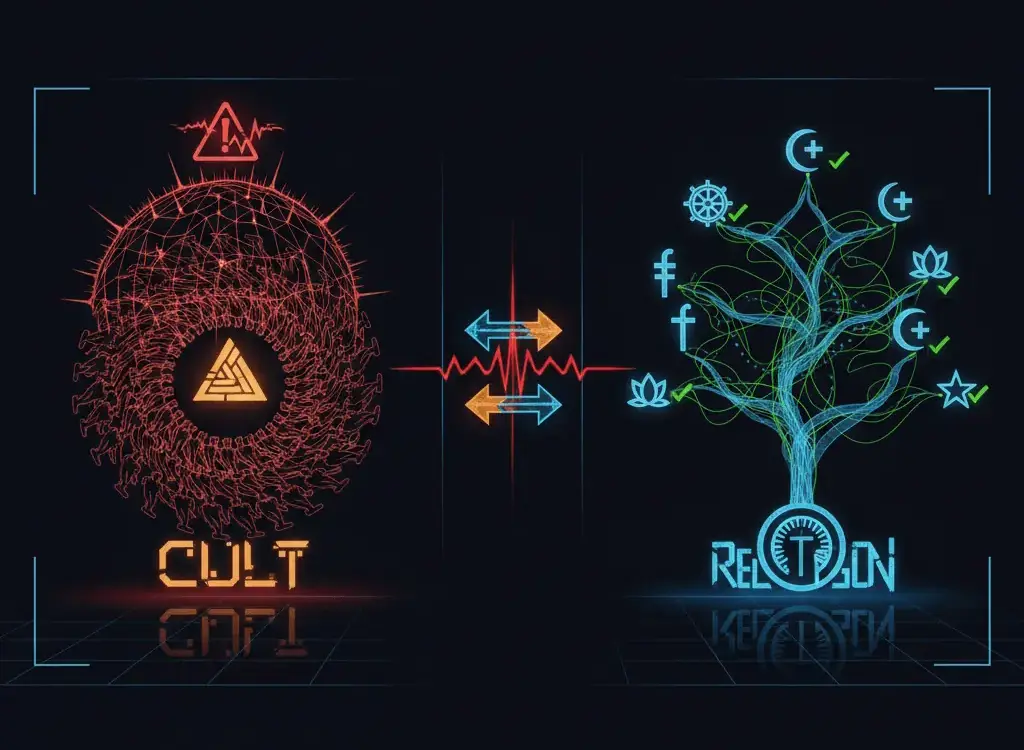
In March 2023, the French Parliamentary Commission on Cults released its annual report documenting a 37% increase in cult-related reports since 2020, with particular concern over groups exploiting pandemic-era vulnerabilities. The commission’s investigation revealed how traditional religious movements, new spiritual organizations, and destructive cults operate along a spectrum of influence and control—a distinction that has become operationally critical as malicious actors increasingly weaponize religious language and spiritual authority for cognitive manipulation campaigns.
Open-source intelligence indicates that understanding the differences between legitimate religious practice, emerging spiritual movements, and coercive cult structures has evolved from an academic exercise to a strategic imperative. The operational challenge lies not in theological debate, but in recognizing when spiritual authority becomes a vector for systematic psychological manipulation and social control.
THREAT VECTOR: The Spectrum of Religious Influence
The cult vs. religion distinction operates along measurable behavioral and structural indicators rather than doctrinal content. Dr. Steven Hassan’s BITE Model (2019) provides the analytical framework, categorizing control mechanisms across Behavior, Information, Thought, and Emotional domains. This model aligns with Robert Jay Lifton’s eight criteria for thought reform, documented in his seminal work on Chinese brainwashing techniques.
Assessment: The operational pattern suggests three distinct categories operate on a continuum:
- Established Religions: Institutional structures with distributed authority, doctrinal transparency, and voluntary participation mechanisms
- New Religious Movements (NRMs): Emerging spiritual organizations with novel practices but maintaining member autonomy and open information flows
- Destructive Cults: High-control groups employing systematic manipulation, information restriction, and coercive influence tactics
The International Cultic Studies Association (ICSA) research indicates that the distinguishing factor is not the age of the organization or unconventional beliefs, but the presence of unethical influence and control mechanisms. This aligns with documented tactics, techniques, and procedures (TTPs) observed in cognitive warfare operations.
CASE STUDY: Operational Deployment in the Wild
Case Alpha: NXIVM’s Corporate Infiltration Model
The NXIVM organization, exposed through FBI investigations culminating in 2018-2019 prosecutions, demonstrated how cult structures can masquerade as Executive Success Programs and self-improvement training. Court documents revealed the systematic deployment of influence techniques including:
Graduated commitment escalation, financial entanglement, shame-based control mechanisms, and information compartmentalization—classic hallmarks of coercive influence operations documented by the FBI’s Behavioral Analysis Unit.
The operational significance: NXIVM recruited high-value targets including celebrities, business executives, and political figures, demonstrating how cult recruitment extends beyond traditional religious contexts into professional and social influence networks.
Case Beta: QAnon’s Pseudo-Religious Framework
Research by the Stanford Internet Observatory (2021) documented how QAnon conspiracy networks adopted religious language, prophecy structures, and community rituals to create cult-like devotion patterns. The movement exhibited several key indicators:
- Infallible leadership («Q» as prophetic authority)
- Special revelation claims (exclusive access to «truth»)
- Us-versus-them mentality with apocalyptic framing
- Demand for absolute faith despite failed predictions
This case demonstrates how cult influence techniques can be deployed through digital platforms without traditional organizational structures, creating distributed networks of psychological control.
DETECTION PROTOCOL: Behavioral Signatures and Warning Indicators
A critical indicator is the organization’s response to questions, criticism, and member autonomy. The following detection framework synthesizes research from the Cult Education Institute and academic literature on high-control groups:
High-Risk Indicators:
- Leadership Structure: Absolute authority concentrated in a single leader or small inner circle with no accountability mechanisms
- Information Control: Prohibition of outside sources, critical thinking, or questioning of doctrine
- Financial Exploitation: Demands for excessive donations, turning over assets, or unpaid labor
- Social Isolation: Pressure to cut ties with family, friends, or outside support systems
- Punishment Systems: Shaming, shunning, or other coercive responses to dissent or departure
- Exclusive Salvation Claims: Assertion that the group provides the only path to spiritual advancement or salvation
- Thought-Stopping Techniques: Repetitive practices, chanting, or activities that inhibit critical thinking
Legitimate Religious Practice Indicators:
- Transparent organizational structure with checks and balances
- Encouragement of education, critical thinking, and outside relationships
- Reasonable financial expectations with transparent accounting
- Respect for member autonomy and voluntary participation
- Openness to questions, dialogue, and constructive criticism
DEFENSE FRAMEWORK: Multi-Layered Countermeasures
Individual Level: Cognitive Hygiene Protocols
- Source Verification: Apply the same critical analysis to spiritual claims as to news sources—check credentials, cross-reference information, seek multiple perspectives
- Autonomy Maintenance: Preserve independent relationships, financial resources, and decision-making authority regardless of group involvement
- Red Flag Recognition: Maintain awareness of influence techniques and trust instincts when pressure tactics emerge
- Exit Strategy Planning: Ensure retention of resources and relationships necessary for independent departure if desired
Organizational Level: Institutional Protocols
Educational institutions, employers, and community organizations can implement screening protocols based on cult education research from groups like the Rick A. Ross Institute:
- Background verification for speakers or workshop leaders
- Awareness training on influence techniques and manipulation tactics
- Clear policies regarding religious accommodation versus coercive influence
- Support resources for individuals affected by high-control group involvement
Systemic Level: Policy and Platform Design
The European Union’s Digital Services Act (2022) provides frameworks for addressing harmful content while preserving religious freedom. Key elements include:
Platform accountability for algorithmic amplification of extremist content, including groups using religious language to mask coercive influence operations.
Assessment: Effective systemic defense requires distinguishing between protecting religious diversity and preventing psychological manipulation—a balance that demands precise policy frameworks and cross-platform coordination.
ASSESSMENT: Key Intelligence Takeaways
- Structural Analysis Trumps Content: The difference between cult vs. religion lies in organizational behavior patterns and control mechanisms rather than belief content or group age
- Influence Techniques Are Universal: Coercive cult tactics documented by researchers like Hassan and Lifton appear across religious, commercial, political, and online contexts
- Detection Requires Multiple Indicators: No single factor definitively identifies a destructive cult—pattern recognition across behavioral, information, and control domains provides reliable assessment
- Defense Demands Proactive Education: Cognitive resilience against cult influence requires understanding of persuasion psychology and maintaining critical thinking skills
- Legal Frameworks Must Evolve: Traditional religious freedom protections require updating to address digital-age manipulation techniques while preserving legitimate spiritual practice
Forward-looking assessment indicates that the convergence of psychological manipulation techniques with digital platforms creates new vectors for cult influence that transcend traditional religious contexts. Organizations across sectors—from corporate training programs to political movements—increasingly adopt cult-like influence mechanisms.
The operational imperative is clear: building societal resilience against coercive influence requires understanding how legitimate spiritual authority differs from psychological manipulation, regardless of the religious language employed. This knowledge serves as a critical component of comprehensive cognitive security in an era of weaponized information and influence operations.
REFERENCES
- Hassan, Steven. (2019). The Cult of Trump: A Leading Cult Expert Explains How the President Uses Mind Control. Free Press.
- International Cultic Studies Association. (2022). Annual Research and Policy Report. ICSA Publications.
- Lifton, Robert Jay. (1961). Thought Reform and the Psychology of Totalism. University of North Carolina Press.
- Stanford Internet Observatory. (2021). The Long Fuse: Misinformation and the 2020 Election. Stanford Digital Repository.
- French Parliamentary Commission on Cults. (2023). Annual Report on Cultic Phenomena. National Assembly Documentation.
- European Union. (2022). Digital Services Act: Regulation on Digital Services in the Internal Market. Official Journal of the European Union.