Confirmation bias and disinformation
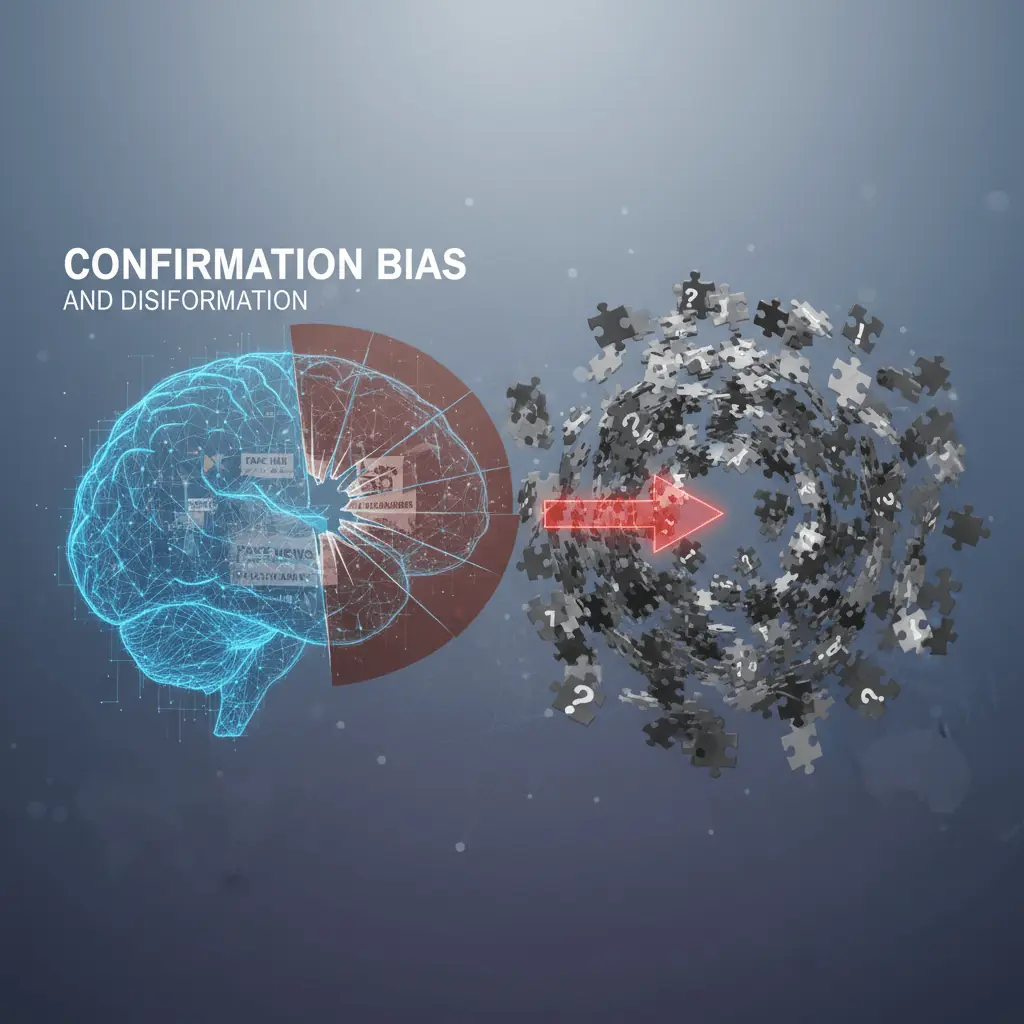
False stories succeed less through technical sophistication than by telling people what they already believe. Countering them means addressing the demand for disinformation, not just its supply.

Key judgments
- Disinformation succeeds mainly by exploiting existing beliefs and identities, not through technical sophistication. When beliefs are tied to group identity, a fact-check can be read as a partisan attack, which limits its persuasive effect among those most committed. Repeating a narrative across several platforms creates a false sense of independent confirmation, and emotionally charged content is shared before it is verified. Prebunking and trusted local messengers are among the most promising responses; corrections generally reduce misbelief, but less so among the most committed audiences.
In 2016, a fabricated story claiming Pope Francis had endorsed Donald Trump spread across social media platforms within hours, garnering hundreds of thousands of shares before fact-checkers could respond. The story succeeded not because of sophisticated technical manipulation, but because it exploited a fundamental cognitive vulnerability: people’s tendency to accept information that confirms their existing beliefs while rejecting contradictory evidence. This incident illustrates how confirmation bias and disinformation operate as force multipliers in contemporary information warfare.
The strategic challenge extends beyond identifying false narratives. Modern disinformation campaigns exploit cognitive biases systematically, creating information environments where audiences self-select into echo chambers that amplify preferred narratives while filtering out disconfirming evidence. This psychological vulnerability transforms ordinary citizens into unwitting participants in information operations, making traditional countermeasures inadequate.
Understanding this intersection requires examining how adversaries weaponize psychological tendencies, the operational frameworks they employ, and the defensive measures available to counter bias-enabled disinformation campaigns.
How confirmation bias amplifies disinformation effectiveness
Cognitive mechanisms in information processing
Confirmation bias operates through several psychological mechanisms that disinformation operators exploit systematically. When individuals encounter information, they unconsciously evaluate it against existing beliefs, spending more cognitive effort scrutinizing contradictory evidence while accepting supporting information with minimal critical analysis.
This selective attention creates what researchers term “motivated reasoning” – the tendency to process information in ways that support desired conclusions rather than accurate ones. For disinformation campaigns, this means fabricated content needs only to align with target audiences’ predispositions to achieve widespread acceptance and viral distribution.
The availability heuristic compounds this vulnerability. People judge the probability of events based on how easily they can recall similar examples. When disinformation narratives repeat frequently across social media feeds, they become more cognitively available, increasing perceived credibility regardless of their factual accuracy.
Social proof and algorithmic amplification
Digital platforms amplify confirmation bias through engagement algorithms that prioritize content generating strong emotional responses. False information often triggers more engagement than accurate reporting, as fabricated stories can be crafted to maximize outrage, fear, or validation without factual constraints.
Social proof mechanisms further accelerate this process. When users observe friends, family members, or perceived opinion leaders sharing content, they interpret this social validation as evidence of credibility. Disinformation campaigns exploit this by using coordinated inauthentic behavior – networks of fake accounts that create artificial social proof around false narratives.
The combination creates feedback loops where biased information processing and algorithmic amplification reinforce each other, making correction increasingly difficult as false beliefs become socially embedded within online communities.
Partisan identity and tribal epistemology
Political identity adds another layer of complexity to confirmation bias exploitation. When information becomes associated with group membership, accepting or rejecting it signals tribal loyalty rather than objective evaluation. This transforms fact-checking from a cognitive exercise into a social and political act.
Adversaries understand this dynamic and craft narratives that appeal to partisan identities rather than factual accuracy. By framing disinformation within existing political divisions, they ensure target audiences will defend false information as expressions of group solidarity, making correction attempts appear like partisan attacks rather than accuracy efforts.
What makes modern disinformation campaigns particularly effective?
Micro-targeting and personalized manipulation
Contemporary disinformation operations leverage data analytics to deliver personalized false narratives tailored to individual psychological profiles. By analyzing social media behavior, search histories, and demographic data, operators can identify specific cognitive vulnerabilities and craft content that exploits personal biases.
This micro-targeting capability transforms mass disinformation from broadcasting false information to precision manipulation at scale. Rather than creating single narratives hoping to appeal broadly, adversaries can simultaneously deploy hundreds of variations optimized for different psychological profiles and political orientations.
The personalization extends beyond content to timing and delivery mechanisms. Advanced campaigns deliver false information when targets are most psychologically receptive – during emotional stress, late at night, or following triggering news events when critical thinking capacity is reduced.
Multi-platform coordination and narrative persistence
Modern disinformation campaigns operate across multiple platforms simultaneously, creating the illusion of independent confirmation. When the same false narrative appears on social media, messaging apps, video platforms, and seemingly legitimate news websites, audiences interpret this apparent consensus as validation.
This coordination exploits the cognitive bias toward believing information encountered repeatedly from different sources, even when those sources are controlled by the same operators. The multi-platform approach also ensures narrative persistence – if content is removed from one platform, it continues circulating elsewhere.
Successful operations embed false information within larger information ecosystems, making correction require dismantling entire networks of interconnected claims rather than addressing single factual errors.
Emotional engagement and outrage optimization
Research demonstrates that false information spreads faster and wider than accurate information on social media platforms, particularly when it triggers strong emotional responses. Disinformation operators exploit this by designing content to maximize emotional engagement rather than factual accuracy.
Fear, anger, and moral outrage prove particularly effective at bypassing critical evaluation. When audiences experience strong emotions, they become more likely to share content immediately without verification, accelerating viral spread before fact-checkers can respond effectively.
The emotional dimension also makes audiences more resistant to correction. When false information aligns with deeply held values or triggers identity-relevant emotions, presenting contradictory evidence can actually strengthen belief in the original falsehood – a phenomenon known as the backfire effect.
A framework for analyzing confirmation bias vulnerabilities
Individual assessment indicators
Identifying confirmation bias susceptibility requires examining both cognitive and behavioral patterns. At the individual level, several indicators suggest heightened vulnerability to bias-enabled disinformation campaigns.
Strong political identity correlates with increased confirmation bias, as does consumption of ideologically homogeneous news sources. Individuals who rely primarily on social media for news show greater susceptibility, particularly when their networks lack ideological diversity.
Emotional investment in specific outcomes or beliefs creates additional vulnerability. People facing personal stress, economic uncertainty, or social isolation become more susceptible to information that provides simple explanations or scapegoats for complex problems.
Community-level risk factors
Communities exhibit collective confirmation bias patterns that disinformation operators target systematically. High social cohesion combined with external perceived threats creates environments where questioning group consensus becomes socially costly, reducing critical evaluation of shared information.
Geographic and demographic isolation compounds these effects. Communities with limited exposure to diverse perspectives develop stronger echo chambers where false narratives can circulate unchallenged for extended periods before encountering factual correction.
Economic grievances and institutional distrust amplify bias effects by creating emotional investment in narratives that explain or justify community frustrations, making residents more receptive to information confirming their suspicions regardless of factual basis.
Analytical assessment framework
| Assessment Level | Key Indicators | Vulnerability Factors | Mitigation Priorities |
|---|---|---|---|
| Individual | Media consumption patterns, social network diversity | Political identity strength, stress levels | Media literacy, critical thinking skills |
| Community | Information ecosystem diversity, institutional trust | Economic grievances, perceived threats | Local fact-checking, trusted messengers |
| Platform | Algorithm engagement patterns, echo chamber formation | Amplification of emotional content | Algorithm transparency, bias interruption |
| Institutional | Response speed, credibility with target audiences | Political polarization, resource constraints | Prebunking, rapid response capabilities |
Countermeasure effectiveness evaluation
Effective responses to confirmation bias-enabled disinformation require understanding which interventions work under specific conditions. Traditional fact-checking proves most effective with audiences lacking strong emotional investment in false claims, but becomes counterproductive when targeting identity-relevant beliefs.
Prebunking – providing warnings about potential disinformation before exposure – shows greater success than post-exposure correction. This approach exploits psychological inoculation effects, building resistance to manipulation by explaining persuasion techniques in advance.
Trusted messenger strategies leverage existing social relationships rather than institutional authority. Community leaders, local officials, and peer networks often prove more effective at correction than external fact-checkers, particularly in high-trust social environments.
The intersection of confirmation bias and disinformation represents one of the most significant challenges in contemporary information warfare. While technological solutions capture headlines, the psychological dimensions require sustained attention to cognitive vulnerabilities and social dynamics that make audiences susceptible to manipulation. Effective countermeasures must address both the supply of false information and the demand created by biased information processing.
Future research should explore how emerging technologies like artificial intelligence might either exacerbate confirmation bias exploitation or provide new tools for bias interruption. Understanding these dynamics will prove crucial as information operations become increasingly sophisticated and personalized. The cognitive battlefield demands strategies as nuanced as the psychological vulnerabilities adversaries exploit.
Sources
- Nickerson, R. S. (1998). Confirmation bias: A ubiquitous phenomenon in many guises. Review of General Psychology, 2(2), 175–220.
- Taber, C. S., & Lodge, M. (2006). Motivated skepticism in the evaluation of political beliefs. American Journal of Political Science, 50(3), 755–769.
- Pennycook, G., & Rand, D. G. (2019). Lazy, not biased: Susceptibility to partisan fake news is better explained by lack of reasoning than by motivated reasoning. Cognition, 188, 39–50.
- Vosoughi, S., Roy, D., & Aral, S. (2018). The spread of true and false news online. Science, 359(6380), 1146–1151.
- Wood, T., & Porter, E. (2019). The elusive backfire effect: Mass attitudes’ steadfast factual adherence. Political Behavior, 41(1), 135–163.
- Silverman, C. (2016, November 16). This analysis shows how viral fake election news stories outperformed real news on Facebook. BuzzFeed News.