Cold War propaganda: America vs the Soviet Union
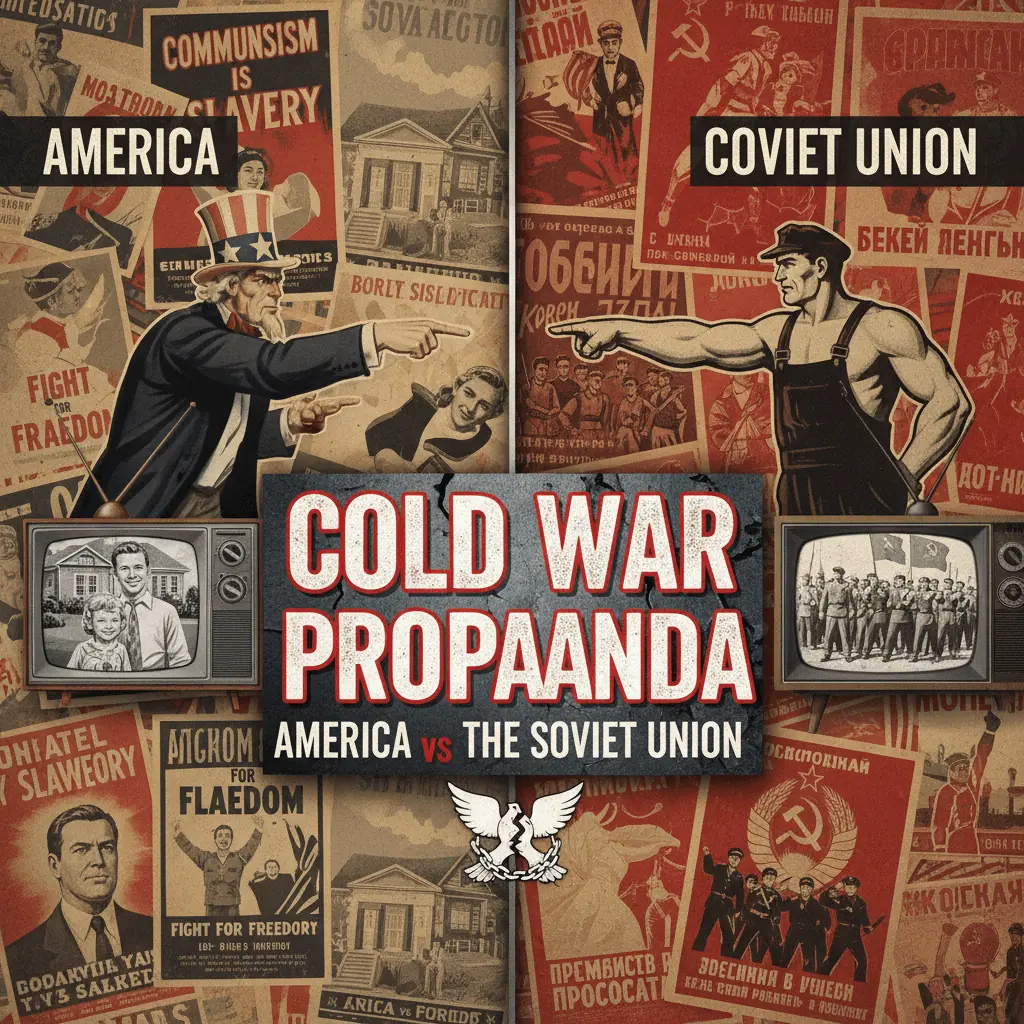
For more than four decades, Washington and Moscow competed for global opinion through radio, culture, education and covert influence. The methods they developed still shape information warfare today.

Key judgments
- The Cold War produced the first sustained, global contest of state influence campaigns, combining open broadcasting, cultural diplomacy and covert operations. Covert influence was most effective when it amplified existing social tensions rather than inventing controversies. Both superpowers tended to overestimate their persuasive impact and underestimate the sophistication of their audiences. Contemporary Russian information operations show clear continuities with Soviet active measures in their methods, although direct institutional lineage is harder to establish.
In 1961, Soviet Premier Nikita Khrushchev stood before the United Nations General Assembly and banged his shoe on the desk while declaring that the Soviet Union would “bury” the capitalist West. This theatrical moment, captured by cameras and broadcast globally, exemplified the performative nature of Cold War propaganda — a decades-long campaign where both superpowers weaponized information to win hearts and minds without firing a shot. The propaganda war between America and the Soviet Union from 1945 to 1991 established the foundational playbook for modern cognitive warfare, creating techniques and frameworks that persist in today’s digital battlefields.
Cold War propaganda represented the first systematic, global deployment of what we now recognize as influence operations — coordinated campaigns designed to shape perception, manipulate behavior, and undermine adversary credibility. Unlike the crude wartime propaganda of earlier conflicts, Cold War information warfare was sophisticated, long-term, and deeply integrated into foreign policy objectives. Understanding these historical campaigns provides critical insight into contemporary state-sponsored disinformation and hybrid warfare tactics.
The Architecture of Ideological Competition
Defining Cold War Propaganda: Beyond Simple Messaging
Cold War propaganda differed fundamentally from traditional wartime information campaigns. Rather than supporting kinetic military operations, it served as the primary weapon in an existential ideological struggle. Both superpowers developed what intelligence analysts now recognize as comprehensive influence ecosystems — coordinated networks of media outlets, cultural programs, academic exchanges, and covert operations designed to project soft power globally.
The United States Information Agency (USIA), established in 1953, exemplified America’s approach to strategic communication. USIA operated Radio Free Europe, Radio Liberty, and the Voice of America — broadcasting to audiences behind the Iron Curtain in local languages with programming that mixed news, entertainment, and subtle ideological messaging. These weren’t merely propaganda outlets but sophisticated psychological operations designed to maintain hope among captive populations while undermining confidence in communist systems.
Soviet Active Measures: The Original Hybrid Warfare
The Soviet Union pioneered what the KGB termed “active measures” — a comprehensive approach combining propaganda, disinformation, forgery, and covert action. According to declassified KGB documents analyzed by the Mitrokhin Archive, Soviet active measures targeted not just enemy populations but also allied governments, international organizations, and domestic opposition movements within adversary states.
Operation CHAOS, revealed in Senate investigations during the 1970s, demonstrated Soviet expertise in exploiting existing social tensions. KGB operatives didn’t create the American civil rights movement or anti-war protests — they amplified existing divisions through planted stories, forged documents, and the strategic funding of extremist groups on both ends of the political spectrum. This approach of exploiting authentic grievances while introducing false narratives became the template for modern Russian influence operations.
The Technology of Persuasion
Cold War propaganda leveraged every available communication technology. The Soviets invested heavily in shortwave radio transmission, building massive broadcasting facilities to reach global audiences. Radio Moscow transmitted in over 60 languages by the 1970s, delivering carefully crafted programming that presented Soviet achievements while highlighting American failures — particularly regarding civil rights and economic inequality.
American counterpropaganda relied heavily on Hollywood and popular culture. The CIA’s covert funding of cultural programs, revealed in congressional investigations during the 1970s, included support for abstract expressionist art exhibitions, literary magazines, and jazz tours. These operations, while controversial, demonstrated sophisticated understanding of cultural influence — promoting American values through authentic artistic expression rather than crude political messaging.
How Did Each Superpower Weaponize Information?
American Strategies: Democratic Values as Strategic Communication
American Cold War propaganda faced a fundamental challenge: promoting democratic values while conducting covert influence operations. The solution involved creating multiple layers of messaging — official government communication through diplomatic channels, semi-official programming through organizations like USIA, and covert operations conducted through front organizations and cultural programs.
The Congress for Cultural Freedom, secretly funded by the CIA from 1950 to 1967, illustrates this layered approach. The organization sponsored intellectual conferences, published influential magazines like Encounter, and funded cultural exchanges — all while maintaining the appearance of independent, grassroots support for Western democratic values. When this covert funding was exposed in 1967, it created a significant credibility crisis for American soft power efforts.
American propaganda also exploited the Soviet Union’s closed information environment. Radio Free Europe’s most effective programming didn’t focus on American achievements but rather on providing accurate information about conditions within communist countries — information that local populations couldn’t obtain through state-controlled media. This approach transformed truthful reporting into a powerful propaganda weapon.
Soviet Dezinformatsiya: The Science of Strategic Deception
Soviet propaganda operations were centrally coordinated through the International Department of the Communist Party Central Committee, working closely with KGB Directorate A (Active Measures). This coordination allowed for sophisticated, multi-year campaigns that combined accurate information with strategic falsehoods — what intelligence analysts now recognize as the original “gray propaganda” methodology.
The AIDS disinformation campaign of the 1980s exemplifies Soviet sophistication. Rather than simply claiming that the United States created HIV as a biological weapon, Soviet operatives planted this story in an obscure Indian newspaper, then gradually amplified it through sympathetic media outlets worldwide. The story eventually appeared in mainstream Western publications, creating the appearance of independent confirmation. This technique of “narrative laundering” through multiple sources became standard practice in modern disinformation operations.
Soviet propaganda also exploited legitimate American policy failures. During the civil rights era, Soviet media extensively covered racial violence in the American South, using authentic imagery and accurate reporting to support broader narratives about capitalist hypocrisy. This approach of highlighting real problems while distorting their context proved more effective than fabricated stories.
The Battleground of Developing Nations
The most intense Cold War propaganda competition occurred in newly independent nations across Africa, Asia, and Latin America. Both superpowers recognized that winning these emerging markets required more than military aid — it demanded convincing local populations that either capitalism or communism offered the superior path to modernization and prosperity.
The United States invested heavily in educational exchanges, bringing thousands of foreign students to American universities through programs like the Fulbright Scholarship. These programs created networks of Western-educated elites who would later occupy positions of influence in their home countries. Soviet counterparts included the Patrice Lumumba People’s Friendship University in Moscow, which educated future leaders from developing nations in Marxist-Leninist ideology alongside technical skills.
Both superpowers also competed through development aid and infrastructure projects, each framed as demonstrations of systemic superiority. The Soviet Union’s construction of the Aswan High Dam in Egypt and America’s Alliance for Progress in Latin America were as much propaganda exercises as economic development programs — highly visible symbols of each system’s capacity to deliver tangible improvements to people’s lives.
A Framework for Analyzing Cold War Influence Operations
Identifying Operational Characteristics
Modern analysts can apply specific criteria to distinguish between legitimate strategic communication and covert influence operations during the Cold War period. These indicators remain relevant for assessing contemporary information warfare:
- Attribution concealment: Genuine propaganda often acknowledged its source, while influence operations obscured sponsorship through front organizations
- Channel exploitation: Effective operations utilized existing media infrastructure rather than creating obvious propaganda outlets
- Narrative amplification: The most successful campaigns amplified existing social tensions rather than creating entirely artificial controversies
- Multi-platform coordination: Sophisticated operations synchronized messaging across diplomatic, cultural, and media channels
- Long-term investment: Strategic influence required sustained commitment over years or decades, not ad hoc responses to immediate events
Measuring Effectiveness: The Evidence Problem
Assessing Cold War propaganda effectiveness remains methodologically challenging. Available evidence suggests that both superpowers significantly overestimated their persuasive impact while underestimating audience sophistication. Declassified CIA assessments from the 1970s acknowledge that Radio Free Europe’s influence on Eastern European political developments was probably minimal, despite massive resource investment.
The most measurable propaganda successes occurred when messaging aligned with existing audience preferences and authentic grievances. Soviet propaganda about American racism gained traction because racial injustice was genuine and visible. American messaging about communist economic failures resonated because Eastern European populations experienced those failures directly.
Contemporary Applications: What Intelligence Analysts Can Learn
Cold War propaganda established operational principles that remain relevant for analyzing modern influence campaigns. The Russian Internet Research Agency’s 2016 operations against American elections directly descended from Soviet active measures — exploiting authentic social divisions while introducing false narratives to amplify conflict.
Key analytical insights from the Cold War period include recognition that effective influence operations require deep cultural knowledge, long-term commitment, and integration with broader policy objectives. Neither superpower achieved decisive propaganda victories through crude messaging or short-term campaigns. Success required sophisticated understanding of target audiences and sustained investment in relationship-building across multiple channels.
The Cold War also demonstrated that defensive measures — counter-propaganda, media literacy, and transparent governance — prove more effective than offensive operations for protecting democratic societies from foreign influence. Nations with open information environments and robust civil society institutions showed greater resilience against both Soviet and American propaganda efforts.
Perhaps most importantly, Cold War propaganda revealed that information warfare succeeds primarily by exploiting existing vulnerabilities rather than creating new ones. Both superpowers achieved their greatest influence when highlighting genuine problems in adversary societies while offering compelling alternatives — a lesson that continues to define effective cognitive warfare in the digital age.
Understanding Cold War propaganda as the foundation of modern influence operations provides essential context for contemporary security challenges. The techniques, technologies, and strategic frameworks developed during this period continue to shape how state and non-state actors conduct information warfare — making historical analysis not merely academic exercise but operational necessity for today’s defense professionals.