Operation Overlord and D-Day deception operations
The Allied deception plan for D-Day convinced German commanders that the main landing would come at Calais. Its methods became a reference for later psychological operations, but its success depended on wartime conditions that are rarely repeated.

Key judgments
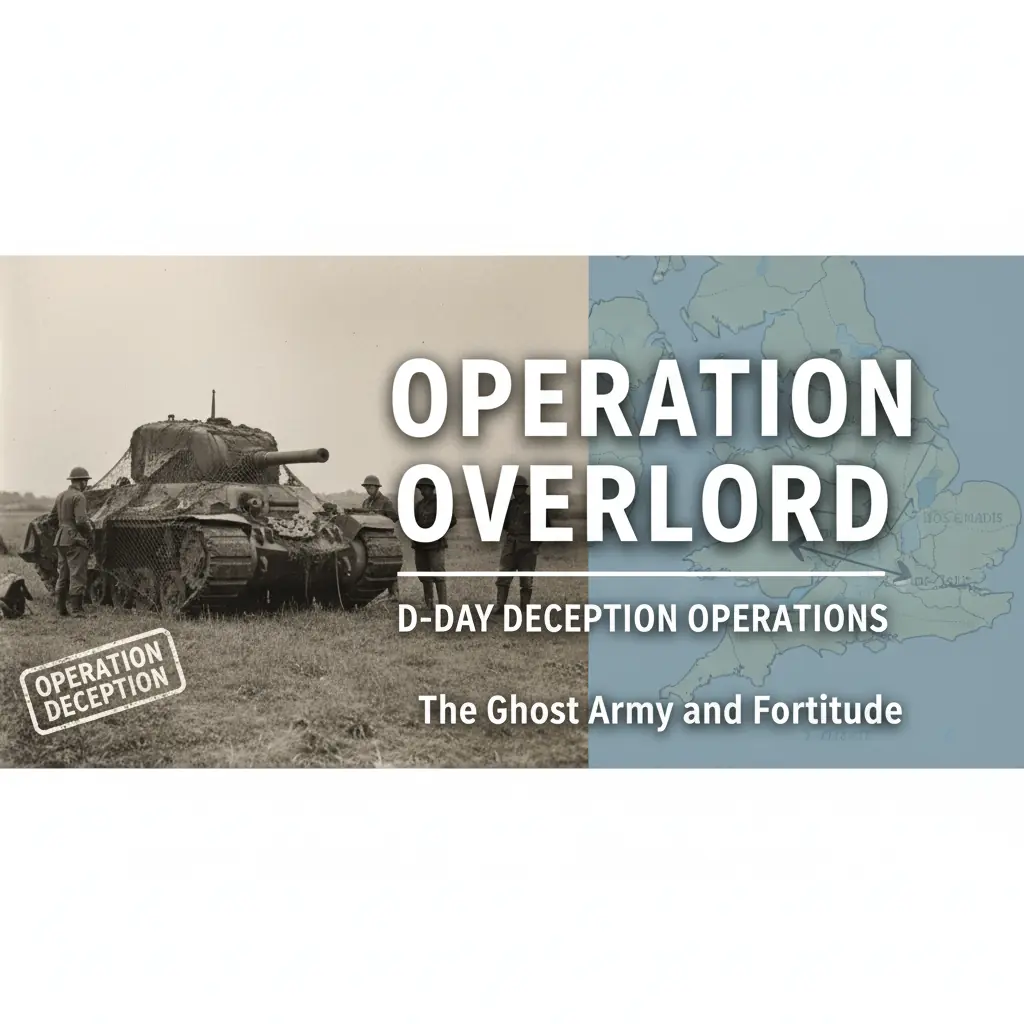
- Operation Fortitude worked because it combined a fictitious army group, controlled double agents and a feedback loop through Ultra intercepts that showed planners what the Germans believed. Its success depended on conditions that are hard to reproduce: control over almost every German agent in Britain, a closed wartime information environment and a single clearly defined decision to influence. Allied deception experience fed into postwar thinking about military deception and psychological operations, although the direct line to later doctrine is often overstated. Measuring the effect of peacetime influence campaigns is far harder than measuring a wartime deception against a specific military decision.
Imagine you’re a Soviet intelligence analyst in 1952, poring over captured German archives about Allied deception operations during World War II. You discover meticulous documentation of Operation Fortitude—the elaborate phantom army that convinced Wehrmacht commanders D-Day would strike at Calais rather than Normandy. The sophistication stuns you: fake radio traffic, inflatable tanks, and coordinated misinformation that fooled an entire military apparatus. What you’re witnessing isn’t just military history—it’s a blueprint for the psychological warfare campaigns that would define the emerging Cold War propaganda era.
The strategic deception operations that enabled D-Day’s success became foundational texts for Cold War information warfare doctrine. Both NATO and Warsaw Pact military theorists studied Overlord’s deception architecture, extracting principles that would reshape how superpowers approached psychological operations targeting foreign audiences. This analysis examines how wartime strategic deception evolved into systematic Cold War psychological warfare doctrine, establishing frameworks that persist in contemporary military information operations.
From Fortitude to PSYOP Doctrine: The Operational Evolution
Strategic Deception as Military Science
Operation Fortitude demonstrated that large-scale deception could achieve strategic objectives through systematic manipulation of enemy decision-making processes. The operation’s success rested on what military theorists now recognize as fundamental PSYOP principles: target audience analysis, coordinated narrative development, and multi-channel information delivery. British Twenty Committee operations coordinator John Masterman’s post-war writings became required reading for emerging psychological warfare units in both the United States and Soviet Union.
The operational framework developed for Overlord deception established three critical components that Cold War psychological warfare doctrine would formalize. First, comprehensive target audience analysis—understanding how enemy commanders processed intelligence and made strategic decisions. Second, coordinated narrative construction across multiple information channels to create consistent deceptive impressions. Third, operational security measures ensuring the deception campaign itself remained concealed from enemy detection.
Institutional Knowledge Transfer
Key personnel from Allied deception operations transitioned directly into Cold War psychological warfare planning. Colonel David Strangeways, who commanded tactical deception for 21st Army Group, became a founding theorist for NATO psychological operations doctrine. His classified reports on Fortitude’s effectiveness informed early US Army PSYOP planning documents, establishing analytical frameworks that remain visible in contemporary FM 3-53 doctrine.
Soviet military intelligence conducted parallel analysis through captured German documentation and interrogated Wehrmacht officers. GRU psychological warfare planners studied Allied deception techniques extensively, developing what became known as aktivnyye meropriyatiya—active measures designed to influence Western decision-making through strategic deception campaigns targeting foreign audiences.
How Did D-Day Deception Shape Cold War Information Operations?
Target Audience Framework Development
Overlord’s success demonstrated the critical importance of understanding enemy cognitive processes and decision-making hierarchies. Allied planners had meticulously mapped German intelligence collection methods, command structures, and analytical biases. This approach became central to Cold War propaganda operations, where both superpowers invested heavily in understanding opponent psychological vulnerabilities and decision-making patterns.
US Army psychological warfare units adopted Overlord’s target audience analysis methodology, developing what became known as the “psychological profile” approach to foreign audience targeting. This framework, documented in early PSYOP planning manuals, emphasized understanding cultural context, institutional biases, and individual psychological characteristics of key decision-makers in adversary organizations.
Multi-Domain Information Coordination
Fortitude’s effectiveness stemmed from coordinating deceptive information across multiple domains: visual (fake equipment), electronic (false radio signatures), human intelligence (double agents), and documentary (planted intelligence materials). Cold War psychological operations institutionalized this multi-domain approach, establishing coordinated information campaigns that leveraged radio broadcasting, printed materials, cultural programs, and diplomatic channels simultaneously.
NATO psychological warfare doctrine, formalized in the 1950s, explicitly referenced Overlord deception techniques as foundational methodology. The alliance developed standardized procedures for coordinating information operations across member states, ensuring consistent messaging while maintaining operational security—direct adaptations of lessons learned from D-Day planning.
The Effectiveness Record: What Evidence Reveals
Documented Successes and Limitations
Declassified CIA and KGB archives reveal mixed results for Cold War psychological operations derived from Overlord principles. Operation Mockingbird, which applied D-Day deception techniques to media influence campaigns, achieved tactical successes in specific regions but failed to produce the strategic-level effects that Fortitude accomplished. The complexity of peacetime information environments proved significantly different from wartime military intelligence contexts.
Soviet active measures campaigns demonstrated similar patterns. While tactical deception operations occasionally succeeded—such as Operation CHAOS targeting Western student movements—the strategic impact remained limited compared to Overlord’s decisive military effects. The target audience analysis frameworks adapted from Allied deception operations often failed to account for the complexity of civilian population psychology versus military command structures.
Methodological Challenges
Cold War psychological warfare planners discovered that Overlord’s success depended on specific conditions difficult to replicate in peacetime operations. German military intelligence suffered from institutional biases, resource constraints, and hierarchical decision-making processes that made them vulnerable to systematic deception. Civilian populations and democratic institutions proved more resistant to coordinated information manipulation, requiring different analytical approaches.
Contemporary researchers, including RAND Corporation analysts studying PSYOP effectiveness, have noted persistent challenges in measuring psychological warfare success. Unlike Overlord, where deception success could be measured through concrete military outcomes, Cold War information operations often produced ambiguous results difficult to distinguish from broader social and political trends.
A Framework for Analyzing Strategic Deception Effectiveness
Core Assessment Criteria
Analysis of both Overlord and subsequent Cold War operations reveals five critical indicators for evaluating strategic deception success:
- Target Audience Penetration: Extent to which deceptive information reaches intended decision-makers
- Cognitive Acceptance: Degree to which targets incorporate false information into their analytical frameworks
- Behavioral Modification: Observable changes in target decision-making consistent with deception objectives
- Operational Security: Maintenance of deception campaign concealment throughout execution
- Strategic Impact: Achievement of broader military or political objectives through deceptive operations
Environmental Factors
Effective strategic deception requires specific environmental conditions that Overlord possessed but Cold War operations often lacked. Military command structures provide clearer target hierarchies than civilian institutions. Wartime information scarcity creates different psychological conditions than peacetime media abundance. Time pressure in military contexts can reduce analytical scrutiny that might detect deception in extended political campaigns.
Contemporary PSYOP doctrine acknowledges these environmental dependencies, emphasizing careful operational planning that accounts for information environment characteristics. FM 3-53 explicitly references historical deception operations as case studies while noting the importance of adapting techniques to contemporary operational contexts.
Contemporary Implications and Future Trajectory
The analytical frameworks developed for Overlord deception operations continue influencing modern information warfare doctrine, though adapted for digital information environments and hybrid threat contexts. NATO Strategic Communications Centers of Excellence study historical deception operations as foundational methodology, while acknowledging the need for new approaches addressing social media manipulation, artificial intelligence-generated content, and cross-platform coordination challenges.
What concerns contemporary analysts is the democratization of strategic deception capabilities. The sophisticated analytical and operational frameworks that required extensive state resources during World War II and the Cold War can now be implemented by smaller actors using commercial technology platforms. This development suggests that while the principles derived from Overlord remain relevant, their application will become increasingly complex as more actors gain access to strategic deception capabilities previously limited to major powers.
Sources
- Masterman, J. (1972). The Double-Cross System in the War of 1939 to 1945. Yale University Press.
- Holt, T. (2004). The Deceivers: Allied Military Deception in the Second World War. Scribner.
- US Army. (2017). FM 3-53: Military Information Support Operations. Department of the Army.
- Rid, T. (2020). Active Measures: The Secret History of Disinformation and Political Warfare. Farrar, Straus and Giroux.
- NATO Strategic Communications Centre of Excellence. (2019). Strategic Communications and Information Environment. NATO StratCom COE.
- Helmus, T. (2018). Russian Social Media Influence. RAND Corporation.