Cialdini’s six principles of influence in hacking
Reciprocity, commitment, social proof, authority, liking and scarcity were described to explain persuasion. Social engineers use them as an operational playbook, and defense has to come from process, not willpower.

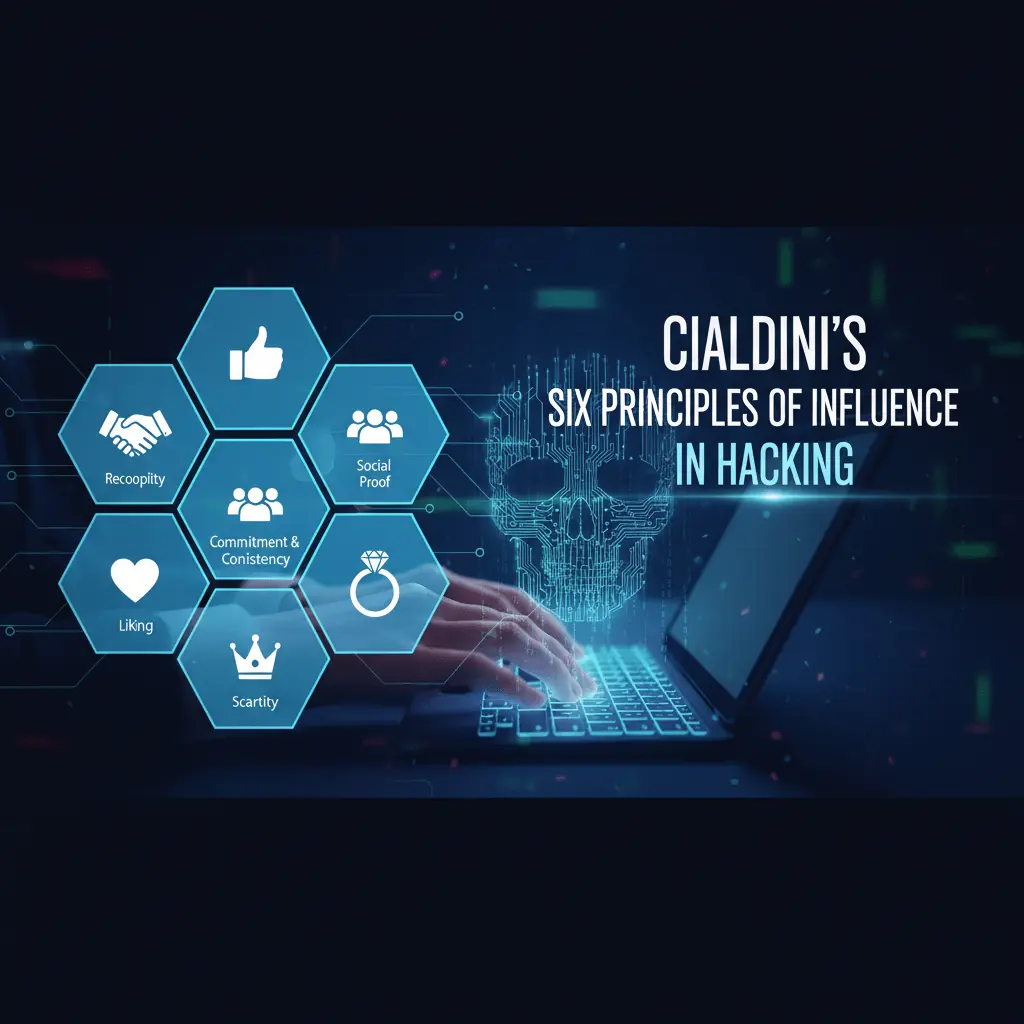
Key judgments
- Exploiting human trust is often more reliable and cheaper for attackers than finding technical vulnerabilities. Authority is the most operationally reliable principle inside organizations, which is why impersonating executives and IT staff underpins most business email compromise. Open-source profiling lets attackers choose which principles will work best on each target, and well-resourced state actors can afford long cultivation campaigns that criminals rarely invest in. Process controls, such as callback verification and mandatory waiting periods, are more effective than relying on individuals to resist psychological pressure.
In December 2019, attackers impersonating a CEO convinced a Hong Kong subsidiary to transfer $35 million to fraudulent accounts through a series of carefully orchestrated voice calls and emails. The operation succeeded not through technical exploitation, but by leveraging Robert Cialdini’s well-documented influence principles as operational weapons. While security professionals invest billions in network defenses and endpoint detection, adversaries continue to exploit the cognitive architecture that makes humans predictably vulnerable to social manipulation.
The Cialdini principles — reciprocity, commitment and consistency, social proof, authority, liking, and scarcity — were originally developed as marketing psychology frameworks. Yet these same mechanisms now constitute the cognitive foundation of industrial-scale social engineering, from Business Email Compromise (BEC) operations generating $43 billion in losses to Advanced Persistent Threat (APT) groups using spear-phishing for initial access. Understanding how adversaries weaponize these psychological principles has become essential for security professionals operating in an environment where human exploitation remains more reliable and cost-effective than zero-day vulnerabilities.
The Psychological Foundations of Social Engineering Attack Systems
Social engineering operates as a structured attack methodology that exploits predictable cognitive biases rather than relying on individual social skills. The Cialdini principles provide the theoretical framework that professional adversaries use to construct reliable influence operations at scale.
Reciprocity as an Opening Gambit
The principle of reciprocity — the psychological pressure to return favors — serves as the foundational element in most social engineering sequences. Attackers establish reciprocal obligations through seemingly helpful actions: providing useful information, solving minor problems, or offering assistance during apparent emergencies. In documented APT operations, adversaries have spent weeks building reciprocal relationships with target employees through professional networking platforms before initiating credential harvest attempts.
The Lazarus Group’s documented campaigns against financial institutions demonstrate sophisticated reciprocity exploitation. Attackers posed as legitimate security researchers, sharing genuine vulnerability information with target organizations before requesting access to “verify patches” — a request that felt reasonable given the value previously provided.
Authority and Organizational Hierarchy Exploitation
Authority represents the most operationally reliable of Cialdini’s principles in organizational contexts. The psychological tendency to comply with perceived authority figures creates predictable attack vectors that adversaries exploit through impersonation and hierarchy manipulation. BEC operations targeting financial controllers routinely impersonate C-level executives, exploiting both the authority principle and organizational process gaps that assume internal communications are authentic.
According to FBI Internet Crime Complaint Center data, authority-based BEC attacks generated over $2.4 billion in losses during 2021, with median individual losses exceeding $120,000. The success rate correlates directly with organizational hierarchy distance — attacks impersonating executives three or more levels above the target demonstrate significantly higher success rates than peer-level impersonation attempts.
OSINT-Enabled Target Profiling: Scaling Personal Manipulation
Modern social engineering campaigns rely on Open-Source Intelligence (OSINT) methodologies to gather detailed target profiles that enable precise application of influence principles. This represents a fundamental evolution from earlier social engineering approaches that relied on generic pretexts and social skills.
Social Media Intelligence Gathering
Professional adversaries systematically harvest target information from LinkedIn, corporate websites, social media platforms, and professional conference materials to construct detailed psychological and organizational profiles. These profiles identify which Cialdini principles will be most effective against specific individuals based on their demonstrated values, relationships, and organizational positions.
The 2020 Twitter compromise — which compromised high-profile accounts including those of Barack Obama and Elon Musk — began with OSINT profiling of Twitter employees active on professional networking platforms. Attackers identified employees with access to administrative tools, then constructed authority-based pretexts specifically designed around those individuals’ documented professional relationships and organizational context.
Organizational Process Mapping
Effective social engineering requires detailed understanding of target organizational processes, communication patterns, and authority structures. Attackers invest significant time mapping organizational charts, identifying process bottlenecks, and understanding approval workflows that can be exploited through authority or urgency manipulation.
The principle of commitment and consistency becomes particularly powerful when attackers understand organizational processes well enough to reference legitimate ongoing projects, recent decisions, or established procedures. This creates cognitive consistency pressure that makes fraudulent requests feel like natural continuations of existing work streams.
How Do State Actors Deploy Social Engineering as Strategic Capability?
Nation-state adversaries treat social engineering as a primary initial access methodology, developing systematic approaches that combine Cialdini’s principles with intelligence tradecraft and operational security practices.
APT Campaign Integration
Advanced Persistent Threat groups consistently demonstrate sophisticated understanding of psychological manipulation within broader campaign frameworks. APT1’s documented operations against intellectual property targets routinely began with months-long relationship building phases designed to establish trust and reciprocal obligations before requesting access to sensitive systems or information.
The principle of liking becomes operationally significant in APT contexts because adversaries have time and resources to invest in authentic relationship building. Unlike criminal operations focused on immediate financial gain, state-sponsored groups can afford extended cultivation periods that create genuine personal connections alongside professional access.
Supply Chain and Third-Party Targeting
State actors increasingly exploit social engineering against supply chain partners and third-party vendors rather than directly targeting primary objectives. This approach leverages the principle of social proof — the assumption that trusted partners have already been properly vetted — to bypass organizational security controls designed for external threats.
The SolarWinds compromise demonstrated how social engineering against software vendors can create massive downstream access across target networks. While the initial access vector remains disputed, the campaign’s success relied on organizational trust assumptions that treated vendor communications and software updates as inherently legitimate.
Criminal Social Engineering: A Mature Industrial Ecosystem
Criminal social engineering has evolved into a sophisticated industry with specialized roles, professional tools, and documented best practices that systematically apply psychological manipulation principles.
Business Email Compromise as Scaled Influence Operations
BEC operations demonstrate industrial application of Cialdini principles with documented success rates exceeding traditional technical attack vectors. Criminal groups maintain detailed playbooks that specify which psychological principles to apply in different organizational contexts, target roles, and cultural environments.
The principle of scarcity — creating urgency through artificial time pressure — appears in approximately 78% of successful BEC attempts according to analysis of reported incidents. Attackers typically combine scarcity with authority by impersonating executives requesting urgent financial transfers for time-sensitive business opportunities or regulatory compliance deadlines.
Vishing and Voice-Based Exploitation
Voice-based social engineering (vishing) leverages multiple Cialdini principles simultaneously through real-time interaction and social presence. Criminal groups increasingly use voice deepfake technology combined with traditional influence techniques to impersonate known contacts and authority figures with unprecedented authenticity.
The 2019 case of fraudsters using AI-generated voice synthesis to impersonate a German CEO and authorize a €220,000 transfer demonstrates how technological capabilities amplify psychological manipulation principles. The attack succeeded because it combined artificial scarcity (urgent deadline), authority (CEO impersonation), and social proof (referencing legitimate business relationships and ongoing projects).
Organizational Defense: What the Evidence Actually Supports
Despite massive investment in security awareness training programs, available evidence suggests limited effectiveness in reducing actual social engineering susceptibility during real-world attacks.
Simulated Phishing Training Effectiveness
Longitudinal studies of simulated phishing training programs demonstrate mixed results at best. While organizations consistently observe reduced click rates on simulated phishing exercises, this improvement does not reliably translate to reduced susceptibility during actual attacks that employ sophisticated psychological manipulation and organizational context.
Research published in IEEE Security & Privacy indicates that traditional awareness training fails to address the cognitive mechanisms that make Cialdini principles effective. Employees may recognize obvious phishing emails while remaining vulnerable to sophisticated authority-based or reciprocity-driven attacks that feel like legitimate business communications.
Process and Technical Controls
The most effective documented countermeasures focus on organizational processes and technical controls rather than individual psychological resistance. Multi-person approval requirements for financial transfers, callback verification procedures for unusual requests, and automated flagging of external emails impersonating internal executives demonstrate measurable effectiveness against social engineering attacks.
Organizations that implement systematic process controls targeting the Cialdini principles — such as mandatory waiting periods to counter artificial scarcity, independent verification requirements for authority-based requests, and explicit external email marking — report significant reductions in successful social engineering incidents.
A Framework for Analyzing Organizational Social Engineering Exposure
Security professionals require systematic approaches for assessing their organization’s vulnerability to social engineering attacks that exploit psychological influence principles.
Cognitive Attack Surface Mapping
Organizations should map their cognitive attack surface by identifying processes and roles that are vulnerable to each of Cialdini’s principles:
- Reciprocity vulnerabilities: Employee roles that regularly receive unsolicited assistance or information from external parties
- Authority exploitation points: Processes that rely on executive communication without independent verification
- Social proof weaknesses: Assumptions about trusted partners, vendors, or industry contacts
- Commitment consistency gaps: Processes where established procedures can be referenced to justify unusual requests
- Liking relationship risks: Professional relationships that could be exploited for access or information
- Scarcity manipulation vectors: Time-sensitive processes that bypass normal verification procedures
Process Control Assessment Matrix
Effective assessment requires evaluating existing controls against documented social engineering techniques:
| Cialdini Principle | Primary Attack Vector | Effective Control | Assessment Criteria |
|---|---|---|---|
| Authority | Executive impersonation | Callback verification | Mandatory for requests above threshold |
| Scarcity | Artificial urgency | Cooling-off periods | No emergency bypasses without dual approval |
| Social Proof | Vendor impersonation | Multi-factor authentication | Technical controls independent of social validation |
Red Team Social Engineering Assessment
Professional red team assessments should specifically test organizational resistance to psychologically sophisticated attacks rather than focusing on obvious phishing recognition. This includes testing responses to authority-based requests that reference legitimate organizational information, reciprocity-based approaches that provide genuine value before making requests, and social proof exploitation through trusted relationship impersonation.
The Persistent Advantage of Cognitive Exploitation
Social engineering remains the preferred initial access method for both criminal and state-sponsored adversaries because it exploits cognitive architecture that cannot be patched through software updates or security awareness training. The Cialdini principles represent documented psychological mechanisms that function reliably across cultural and organizational contexts.
As defensive technologies improve and technical vulnerabilities become more expensive to discover and exploit, adversaries increasingly focus on social engineering approaches that leverage these psychological principles. Organizations that understand social engineering as a structured attack methodology — rather than a collection of individual social skills — can implement systematic defenses that address the underlying cognitive vulnerabilities rather than attempting to train employees to resist psychological manipulation.
The evidence suggests that future security architectures must incorporate explicit defenses against cognitive exploitation, treating social engineering as a technical attack surface that requires systematic engineering controls rather than relying on human judgment to resist professional psychological manipulation.
Sources
Cialdini, R. (2006). Influence: The Psychology of Persuasion. Harper Business.
Federal Bureau of Investigation. (2022). Internet Crime Report 2021. IC3.
Hadnagy, C. (2018). Social Engineering: The Science of Human Hacking. Wiley.
Jensen, M. L., Dinger, M., Wright, R. T., & Thatcher, J. B. (2017). Training to mitigate phishing attacks using mindfulness techniques. Journal of Management Information Systems, 34(2), 597-626.
Mandiant. (2022). APT1: Exposing One of China’s Cyber Espionage Units. FireEye.
Verizon. (2022). 2022 Data Breach Investigations Report. Verizon Enterprise Solutions.