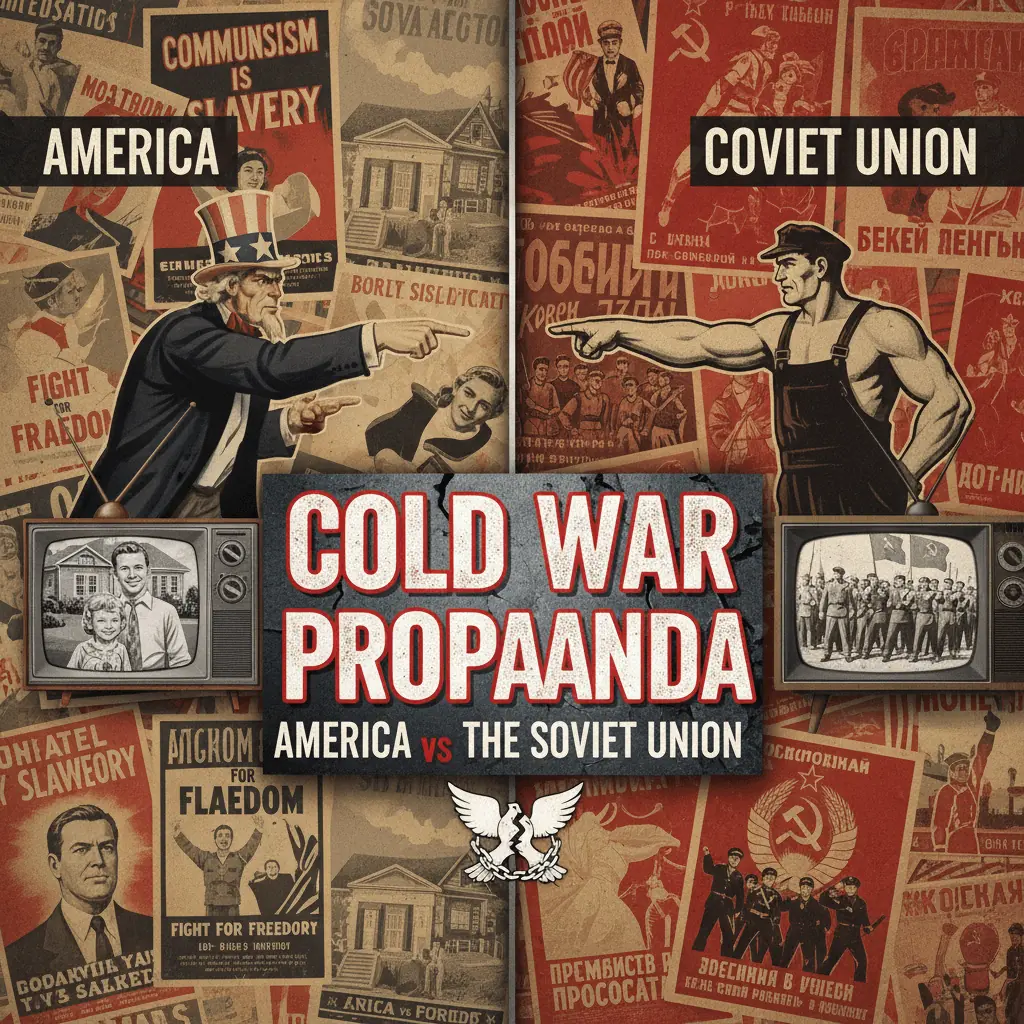
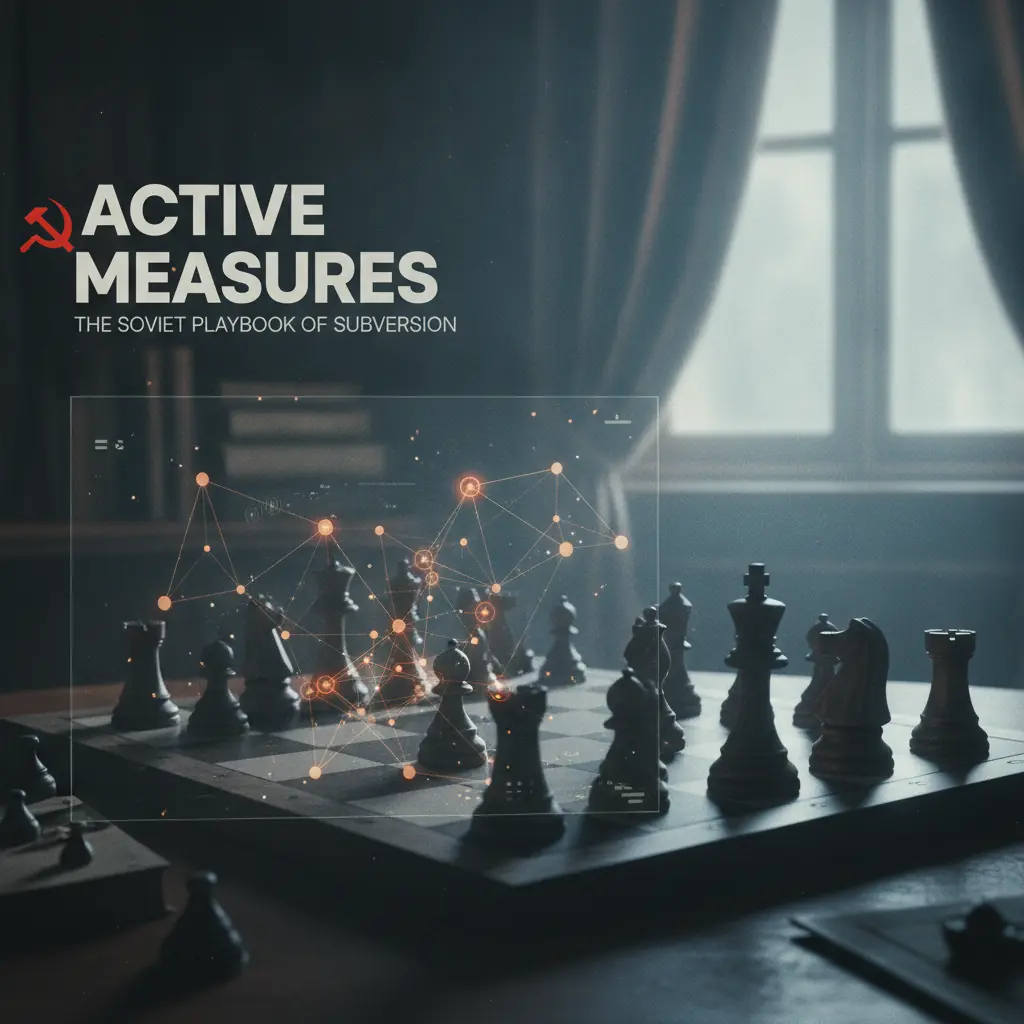
Active measures: the Soviet playbook of subversion

Imagine sitting in a Western newsroom in 1983, holding a document that appears to prove the CIA engineered the AIDS virus as a biological weapon. The letterhead looks credible. The scientific language sounds plausible. A handful of journalists run fragments of it. Within months, the story circulates across dozens of countries, appearing in Indian newspapers, African radio broadcasts, and European left-wing journals. The document was fabricated. The operation — later attributed by U.S. and German intelligence assessments to the KGB’s Service A — was called Operation INFEKTION, and it represents one of the most studied examples of Soviet active measures (Russian: aktivnyye meropriyatiya) at the height of the Cold War.
Active measures, as a formal doctrine, refers to a category of covert influence operations designed not merely to collect intelligence but to shape the adversary’s political environment — to alter perceptions, fracture alliances, and manufacture crises without attributable military action. This article traces the conceptual architecture of that doctrine, examines its operational mechanics, and asks the question that defense analysts cannot afford to dismiss: how much of it is still running?
Defining active measures: doctrine, not metaphor
The Soviet doctrinal framework
The term active measures did not emerge from Western analytical frameworks. It was Soviet doctrine, codified within the KGB’s operational structure and distinct from passive intelligence collection (razvedka). According to former KGB officer and defector Ladislav Bittman, whose account remains one of the most authoritative primary sources on the subject, active measures encompassed a range of techniques: forgeries and disinformation, the manipulation of front organizations, the use of agents of influence, and the orchestration of international propaganda campaigns. The distinguishing feature was operational concealment — the Soviet hand was meant to remain invisible while organic-seeming actors carried the message forward.
This is the crucial definitional point. Active measures are not propaganda in the classical Lasswellian sense of overt persuasion. They are closer to what Jowett and O’Donnell, in their foundational work Propaganda and Persuasion, would classify as black propaganda — communication that conceals or falsifies its origin. The apparatus that executed them within the KGB was Department A of the First Chief Directorate, specifically tasked with what Soviet documents called “special influence operations.”
The taxonomy of tools
Understanding the specific toolkit matters for any contemporary assessment. Soviet active measures typically deployed some combination of the following:
- Forgeries — fabricated documents attributed to Western governments or institutions, designed to discredit or inflame
- Agents of influence — individuals in target societies who advanced Soviet-aligned positions, often without disclosing their relationship to Soviet intelligence
- Front organizations — nominally independent peace, civil rights, or academic bodies that amplified Soviet messaging
- Disinformation (dezinformatsiya) — the strategic injection of false narratives into media ecosystems through proxies
- Reflexive control — a concept articulated by Soviet military theorist Vladimir Lefebvre, involving feeding an adversary information designed to cause them to make decisions favorable to you
Each of these deserves separate treatment, but collectively they describe a system oriented toward cognitive and political effects rather than territorial ones — which is precisely why the doctrine remains analytically relevant today.
How active measures actually worked in practice
Operation INFEKTION as an operational case study
Returning to the AIDS disinformation campaign: what made Operation INFEKTION effective in the short term — and ultimately traceable in the long term — was its exploitation of legitimate grievances. The late Cold War period was marked by real distrust of U.S. military programs, real anxieties about biological weapons, and real inequities in how the AIDS crisis was managed globally. Soviet strategists understood, as contemporary influence practitioners still do, that the most durable disinformation is anchored in a substrate of genuine grievance.
According to a 1992 report by the U.S. State Department’s Active Measures Working Group — one of the few formal Western institutional responses to this doctrine — the KGB had executed over 10,000 active measures operations between 1960 and 1990, with INFEKTION representing a relatively high-sophistication example due to its use of scientific-sounding source material and its multi-country amplification chain. The narrative originated in an Indian newspaper in 1983, was amplified through Soviet media assets, and eventually required a diplomatic intervention by the U.S. government to formally refute in multiple countries.
Front organizations and the peace movement
A less-discussed but operationally significant channel was the manipulation of Western peace movements during the 1970s and 1980s. The World Peace Council, founded in 1949 and headquartered in Helsinki, is the most documented example of a Soviet-funded front organization. This is not a contested claim: the organization’s Soviet funding was confirmed by multiple defectors and later by archival material from the Soviet era. What makes this case analytically interesting is the internal complexity — many participants in affiliated peace campaigns had no knowledge of Soviet backing and held genuinely sincere beliefs. Active measures worked, in part, because they didn’t need to manufacture the movement; they only needed to amplify and steer it.
Does the doctrine survive? Continuity and adaptation in Russian information operations
Structural continuity from KGB to contemporary services
The dissolution of the KGB in 1991 produced successor organizations — most notably the FSB (Federal Security Service) for domestic operations and the SVR (Foreign Intelligence Service) for external operations — but the doctrinal inheritance is not in serious analytical dispute. Thomas Rid, in his 2020 book Active Measures: The Secret History of Disinformation and Political Warfare, traces the operational lineage in considerable detail, arguing that the contemporary Russian information apparatus is best understood as a modernization of Soviet doctrine rather than a rupture from it. The GRU’s Unit 26165 (Fancy Bear) and the Internet Research Agency (IRA), both implicated in the 2016 U.S. election interference documented by the Senate Intelligence Committee, deployed techniques — fabricated personas, amplified fringe narratives, exploitation of social platform algorithms — that are structurally consonant with the active measures framework.
What changed: the role of digital infrastructure
The most significant adaptation is environmental. Soviet active measures required an operational pipeline: manufacture the forgery, insert it into a sympathetic foreign newspaper, wait for organic amplification. The digital information environment compresses that pipeline dramatically. The IRA’s social media operations, as documented in the Senate Intelligence Committee’s bipartisan report released in 2019, demonstrated that a relatively small number of operators could generate content that reached tens of millions of users across Facebook, Twitter, YouTube, and Instagram — without the intermediary step of a pliant foreign journalist. The concealment-of-origin principle remains identical; the distribution architecture is categorically different.
Myth vs. reality: what active measures can and cannot do
The myth of omnipotent subversion
A persistent analytical error — one that benefits both the adversary and domestic political actors seeking to externalize responsibility — is the assumption that active measures are singularly decisive. The historical record does not support this. Operation INFEKTION took nearly a decade to gain wide traction, required multiple amplification events, and ultimately failed to permanently embed itself in mainstream Western discourse once formal refutation campaigns were mounted. Thomas Rid’s own assessment, grounded in archival research, is that Soviet active measures frequently failed to achieve their strategic objectives, even when they succeeded tactically in spreading a specific narrative.
The effectiveness debate in propaganda studies is genuinely contested. Ellul’s influential analysis in Propaganda: The Formation of Men’s Attitudes (1965) emphasized that propaganda is most effective when it reinforces pre-existing dispositions rather than converting adversaries — a finding that aligns with the social science literature on attitude change and that should temper maximalist claims about active measures effectiveness.
The reality: durable but bounded effects
What active measures reliably produce, available evidence suggests, is friction — elevated uncertainty, amplified social divisions, and degraded institutional trust — rather than direct behavioral control. NATO’s StratCom Centre of Excellence in Riga has published multiple assessments making this distinction. The target is rarely the convinced partisan on either side; it is the persuadable middle and the institutional credibility that mediates political decisions. That is a narrower but still strategically significant effect space.
A framework for analyzing active measures in contemporary contexts
Key analytical indicators
When assessing whether an influence operation fits the active measures framework rather than conventional propaganda or organic political communication, analysts working within NATO or OSINT methodologies typically look for convergent indicators across several dimensions:
- Origin concealment — Is the attributed source of the content authentic? OSINT tools including Bellingcat’s digital forensics methodology and DFRLab’s platform analysis have been applied to trace fabricated or amplified content back to coordinated inauthentic behavior networks.
- Narrative targeting — Does the content systematically exploit existing social fault lines (race, immigration, institutional trust) in ways that suggest strategic selection rather than opportunistic commentary?
- Amplification architecture — Is the narrative being boosted by networks with coordinated behavioral patterns, bot-like activity, or implausibly synchronized posting?
- Cross-platform coherence — Does the same core narrative appear simultaneously across multiple platforms, languages, and geographies in ways inconsistent with organic diffusion?
- Adversarial timing — Is the content injected at moments of maximum political sensitivity (elections, crises, alliance negotiations)?
| Propaganda Type | Source Transparency | Attribution | Active Measures Fit |
|---|---|---|---|
| White propaganda | Disclosed | Accurate | Low |
| Gray propaganda | Ambiguous | Uncertain | Moderate |
| Black propaganda | Concealed or falsified | Deliberately misleading | High |
No single indicator is conclusive. The analytical discipline required is pattern recognition across multiple signals over time — which is precisely why both the NATO StratCom COE and the DFRLab emphasize longitudinal tracking over single-event attribution.
Conclusion: the playbook hasn’t closed
Active measures as Soviet doctrine were never simply Cold War artifacts. They were a coherent theory of political warfare — that adversaries can be weakened from within, that truth is a resource to be managed rather than a constraint to be respected, and that the most effective operations are those that never require acknowledgment. In my assessment, the core insight of the doctrine — exploit authentic grievance, conceal origin, amplify through proxies — has proven more durable than the state that originated it. The digital environment didn’t create this problem; it scaled it. Defense professionals and analysts who treat active measures as historical curiosity rather than live operational doctrine are, to put it plainly, working from an outdated threat model.
Actionable takeaways
- Apply source-origin analysis first. Before assessing content on its merits, trace who produced it, where it first appeared, and how it was amplified. OSINT frameworks from DFRLab and Bellingcat provide replicable methodologies for this.
- Distinguish friction from conversion. Active measures rarely convert committed opponents — they target institutional trust and the persuadable middle. Calibrate threat assessments accordingly.
- Track narratives longitudinally. A single piece of content tells you little. Cross-platform narrative coherence over time is the signal. Single-event attribution is almost always premature.
- Treat grievance exploitation as a diagnostic marker. The most effective active measures are anchored in real social tensions. When a narrative seems to perfectly exploit an existing fault line, ask who benefits from that amplification.
- Engage the doctrine literature directly. Rid’s Active Measures, Bittman’s memoirs, and the NATO StratCom COE’s published assessments provide the foundational analytical vocabulary. Operational analysts should know this material as well as they know any technical framework.
Sources
- Rid, T. (2020). Active Measures: The Secret History of Disinformation and Political Warfare. Farrar, Straus and Giroux.
- Bittman, L. (1985). The KGB and Soviet Disinformation: An Insider’s View. Pergamon-Brassey’s.
- Jowett, G. & O’Donnell, V. (2019). Propaganda and Persuasion (7th ed.). SAGE Publications.
- Ellul, J. (1965). Propaganda: The Formation of Men’s Attitudes. Knopf.
- NATO StratCom Centre of Excellence. (2019). Influence Operations: Understanding Hybrid Threats. NATO StratCom COE.
- U.S. Senate Select Committee on Intelligence. (2019). Report on Russian Active Measures Campaigns and Interference in the 2016 U.S. Election. U.S. Government Publishing Office.