The 4th Psychological Operations Group at Fort Liberty

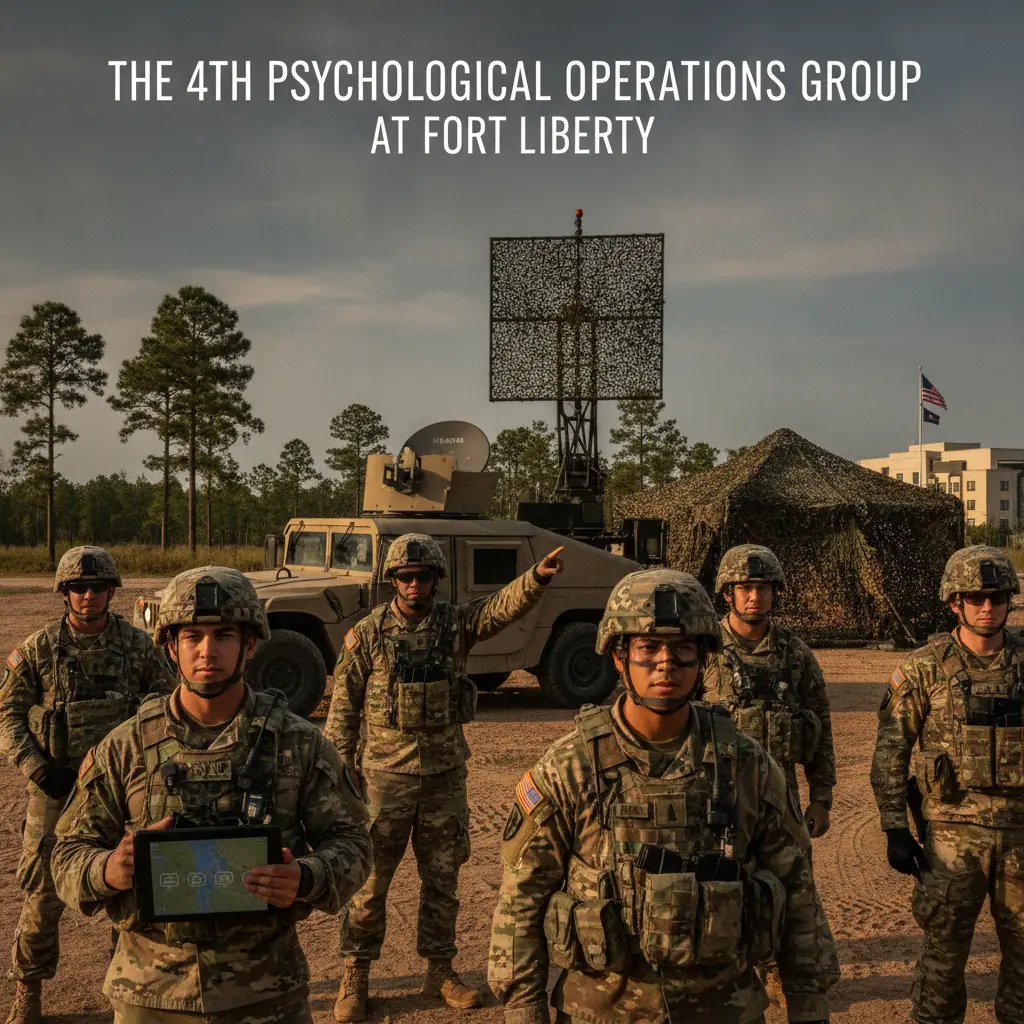
In October 2023, the United States Army formally completed the renaming of Fort Bragg, North Carolina, to Fort Liberty — a change mandated by the Naming Commission established under the National Defense Authorization Act of 2021. For the 4th Psychological Operations Group, the installation’s largest active-duty PSYOP formation, the renaming was administrative. The mission did not change. What has changed, considerably, is the operational environment in which the 4th POG operates — and the doctrinal pressures that environment is generating. Analyzing the 4th Psychological Operations Group at Fort Liberty through a doctrinal and operational lens reveals both the institutional sophistication of U.S. Army PSYOP and the persistent, underacknowledged gap between what influence operations are designed to do and what the operational record suggests they actually accomplish. That tension is worth examining carefully, particularly as great power competition reshapes the demand signal for military information capabilities.
Organizational structure and doctrinal foundation
The 4th POG within the PSYOP regimental structure
The 4th Psychological Operations Group is the U.S. Army’s primary active-duty PSYOP formation and sits within the broader PSYOP Regiment alongside the reserve-component 2nd POG and 6th POG. Fort Liberty hosts the 4th POG’s headquarters and its subordinate battalions, which are organized around regional and functional specializations. The group falls under United States Army Civil Affairs and Psychological Operations Command (Airborne), known as USACAPOC(A), which provides theater-level command and control for both Civil Affairs and PSYOP assets across combatant commands.
Functionally, the 4th POG produces, disseminates, and assesses Military Information Support Operations (MISO) — the renamed institutional designation adopted in 2010 to replace “PSYOP” in formal usage, though the underlying doctrine remained substantively intact. The rename was partly cosmetic, partly strategic: PSYOP carries connotations that complicate interagency coordination and coalition partnerships. FM 3-53, Military Information Support Operations (2013), remains the primary doctrinal reference governing the group’s activities and defines MISO as operations “designed to convey selected information and indicators to foreign audiences to influence their emotions, motives, objective reasoning, and ultimately the behavior of foreign governments, organizations, groups, and individuals.”
Legal and jurisdictional constraints
The legal architecture governing the 4th POG’s activities is not peripheral detail — it is operationally determinative. Under Title 10, U.S. Code, PSYOP is authorized as a military function targeting foreign audiences. The Smith-Mundt Act (1948) and its 2012 modernization established the statutory boundary between foreign-directed information activities and domestic audiences. The 2012 amendments to Smith-Mundt permitted State Department and Broadcasting Board of Governors materials to be made available domestically under specific conditions, but they did not authorize DoD PSYOP units to target American citizens. That distinction is frequently misread in open-source commentary and deserves emphasis: the 4th POG operates under legal constraints that prohibit domestic influence operations, and available evidence does not support claims to the contrary.
What does the 4th POG actually do? Operational functions and deployment history
Target audience analysis and product development
The 4th POG’s operational cycle — as described in FM 3-53 and supplementary PSYOP doctrine — begins with Target Audience Analysis (TAA). TAA is the doctrinal process by which PSYOP planners identify, segment, and profile the specific populations whose behavior a supported commander seeks to influence. This is not a vague exercise in mass persuasion; FM 3-53 specifies that effective PSYOP products must be grounded in verifiable sociocultural, linguistic, and motivational research about defined target audiences. The analytical quality of TAA is, in practice, one of the most significant variables affecting operational effectiveness — and one of the most resource-constrained.
Product development — whether leaflets, radio broadcasts, social media content, or face-to-face messaging through supported civil authorities — flows from TAA findings and must be approved through a command review process that includes legal review. The 4th POG maintains organic production capabilities, including printing, audio, and digital media assets, though significant production has shifted toward contracted and joint capabilities in recent operational cycles.
Documented deployments and the Afghanistan case
The 4th POG contributed PSYOP assets to operations in Afghanistan and Iraq across multiple deployment rotations between 2001 and 2021. In Afghanistan, PSYOP teams distributed millions of leaflets, operated FM radio stations through the Voice of America-adjacent Radio in a Box (RIAB) systems, and conducted loudspeaker operations in support of kinetic and non-kinetic missions. The operational record from Afghanistan is instructive and sobering. A 2010 RAND Corporation study (Counterinsurgency in Afghanistan, Jones) noted that information operations — including PSYOP — frequently suffered from message inconsistency, insufficient cultural grounding, and the corrosive effect of visible civilian casualties on any persuasive messaging effort. When actions contradict words, behavioral influence becomes structurally impossible regardless of message quality. That dynamic repeated itself across multiple Afghan operational phases.
Did you know? During Operation Enduring Freedom, U.S. PSYOP teams distributed over 80 million leaflets across Afghanistan — one of the largest leaflet campaigns in military history. Post-operation assessments nonetheless found measurable behavioral change difficult to attribute specifically to leaflet campaigns, underscoring a core methodological challenge in PSYOP effectiveness research: isolating the information variable from the broader operational environment.
How does the 4th POG integrate with joint and interagency information operations?
The Information Operations cell relationship
Information Operations (IO) as defined in Joint Publication 3-13 is an integrating function that synchronizes multiple related capabilities — electronic warfare, cyberspace operations, MISO, military deception, and operations security — to create information effects in support of commander objectives. The 4th POG’s MISO assets are one component within this broader IO framework; they are not synonymous with IO itself. PSYOP planners embedded in theater or joint task force IO cells coordinate MISO activities with Electronic Warfare Officers, Cyber planners, and Public Affairs Officers — though the latter operate under a distinct legal framework that prohibits coordination of PA and PSYOP messaging, a firewall that has generated persistent friction in practice.
NATO alignment and StratCom coherence
At the alliance level, the 4th POG’s activities interface with NATO Strategic Communications (StratCom) frameworks, which the Alliance has formalized through the NATO StratCom Centre of Excellence in Riga. NATO doctrine distinguishes between PSYOP (a national function contributed by member states) and Alliance-level StratCom, which operates under consensus constraints that slow operational adaptation. In my assessment, the procedural gap between U.S. PSYOP’s relatively streamlined authority chain and NATO’s consensus-dependent StratCom architecture remains a genuine interoperability challenge — particularly in time-sensitive influence environments. The 4th POG’s integration into allied information environments requires constant deconfliction to prevent contradictory messaging across coalition partners.
A framework for analyzing 4th POG operational effectiveness
Assessing PSYOP effectiveness requires a more rigorous framework than institutional reporting typically applies. The following indicators provide a structured basis for analysis:
- Target Audience Fidelity: Does the MISO product accurately reflect the motivations, information environment, and behavioral baseline of the defined target audience? TAA quality is the primary upstream variable.
- Message-Action Coherence: Are the messages being communicated consistent with observable military and political actions in the operational environment? Incoherence at this level is analytically fatal to influence efforts.
- Channel Penetration: Does the dissemination method actually reach the target audience, or does it saturate already-converted populations while missing the intended segment?
- Behavioral Indicator Tracking: Are post-dissemination assessments measuring actual behavioral change (e.g., surrender rates, tip line utilization, population movement) rather than output metrics (leaflets dropped, broadcast hours)?
- Attribution Resilience: In modern information environments, is the MISO effort identifiable as U.S. military-origin, and if so, does that attribution undermine or reinforce credibility with the target audience?
The following table maps these indicators against documented challenges from recent operational cycles:
| Effectiveness Indicator | Doctrinal Standard (FM 3-53) | Documented Challenge |
|---|---|---|
| Target Audience Fidelity | TAA required before product approval | Insufficient cultural research capacity in deployed environments |
| Message-Action Coherence | IO synchronization required | Civilian casualty events repeatedly undermined messaging |
| Channel Penetration | Channel analysis mandatory | Leaflet saturation of non-target populations documented |
| Behavioral Indicator Tracking | Assessment phase required | Output metrics (leaflets distributed) often substituted for outcome data |
| Attribution Resilience | Product approval includes source consideration | U.S. attribution frequently reduced credibility with adversarial audiences |
Great power competition and the 4th POG’s evolving demand signal
Gray zone operations and the MISO adaptation challenge
The post-Afghanistan operational environment has shifted the 4th POG’s primary demand signal from counterinsurgency support to gray zone competition — the space between routine statecraft and open armed conflict where China, Russia, and other state actors operate persistent influence campaigns. This shift creates a genuine doctrinal strain. FM 3-53 was developed primarily with a supported-commander, kinetic-operational context in mind. Gray zone influence operations unfold over years, involve non-military target audiences in third-country environments, and require sustained campaign coherence that the current PSYOP model — built around deployment cycles and operational task organization — does not naturally produce.
Digital environment adaptation
The information environment in which the 4th POG now operates is dominated by algorithmically curated social media platforms, encrypted messaging ecosystems, and adversarial information laundering — the practice of routing state-sponsored content through ostensibly independent intermediaries to obscure origin. U.S. PSYOP doctrine has not yet produced a publicly available, authoritative framework for operating in this environment at scale while maintaining legal compliance with Smith-Mundt constraints and DoD attribution policies. What concerns me here is the risk that doctrinal lag creates pressure to operate in legal gray areas rather than adapting the doctrine itself through appropriate legislative and policy channels. The 4th POG’s institutional adaptation to this environment is ongoing, and the outcomes of that adaptation are not yet assessable from open sources.
Conclusion and forward assessment
The 4th Psychological Operations Group at Fort Liberty represents the most developed institutional expression of U.S. Army MISO capability. Its doctrinal foundation in FM 3-53, its integration within USACAPOC(A) and joint IO structures, and its operational history across two decades of sustained deployment provide a credible analytical baseline. The honest assessment, however, is that the effectiveness record remains mixed, the methodological tools for measuring behavioral influence remain underdeveloped relative to institutional confidence in the function, and the shift toward great power competition creates genuine doctrinal adaptation pressures. The unit’s forward trajectory will depend less on organizational structure than on whether the broader PSYOP enterprise can develop rigorous effectiveness standards and legally coherent doctrine for the digital information environment.
Actionable takeaways
- Apply the message-action coherence test when evaluating any PSYOP or MISO campaign: if observable military or political actions contradict the message, no amount of production quality or channel penetration will produce the intended behavioral effect.
- Distinguish output from outcome metrics in any PSYOP effectiveness assessment — leaflets distributed and broadcast hours are inputs, not evidence of behavioral change.
- Maintain legal precision when discussing U.S. PSYOP: the Smith-Mundt framework and Title 10 constraints are not bureaucratic formalities — they are the boundary conditions that distinguish lawful military influence operations from prohibited domestic manipulation.
- Apply NATO StratCom frameworks as a comparative lens: the Alliance’s consensus-dependent model highlights both the coordination challenge and the strategic communication coherence problem that any multi-actor influence effort must resolve.
- Track doctrinal evolution through official channels — FM 3-53 revisions, USSOCOM publications, and Joint Publication 3-13 updates — rather than relying on journalistic interpretation, which frequently conflates distinct legal and operational categories.
Sources
- U.S. Army. (2013). FM 3-53: Military Information Support Operations. Headquarters, Department of the Army.
- Jones, S.G. (2010). Counterinsurgency in Afghanistan. RAND Corporation.
- Joint Chiefs of Staff. (2014). JP 3-13: Information Operations. U.S. Department of Defense.
- Paul, C. (2011). Whither Strategic Communication? A Survey of Current Proposals and Recommendations. RAND Corporation.
- NATO StratCom Centre of Excellence. (2021). Mapping NATO’s Strategic Communication Architecture. NATO StratCom COE, Riga.
- Rid, T., & Hecker, M. (2009). War 2.0: Irregular Warfare in the Information Age. Praeger Security International.