Gamification of Extremism: How Attacks Become Memes

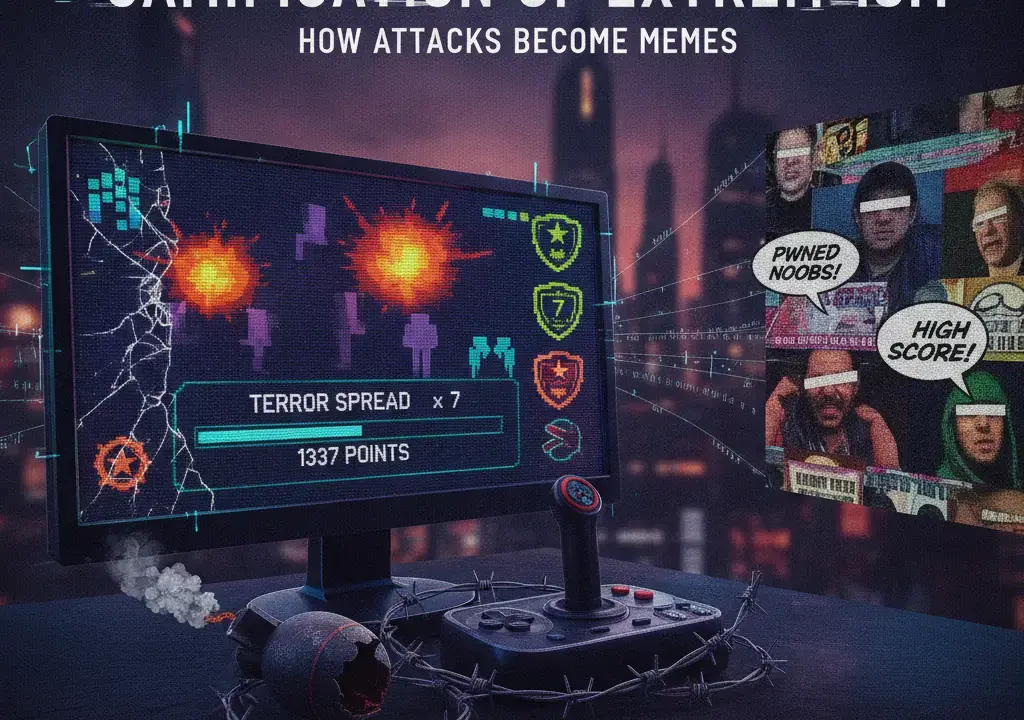
In August 2019, the Dayton shooter left behind a “kill count” framing in his online communications. Weeks earlier, the El Paso attacker posted a manifesto formatted with the visual conventions of internet culture — memes, ironic detachment, in-group references. Neither case emerged from a vacuum. Both reflected a documented pattern that researchers at the International Centre for the Study of Radicalisation (ICSR) and the Institute for Strategic Dialogue (ISD) had been tracking for years: the deliberate framing of mass violence as competitive performance, scored and celebrated within online communities. This is the gamification of terrorism — not a metaphor, but a structural feature of how certain radicalization pathways now operate. The thesis here is not that video games cause violence. It is more precise and more troubling: extremist communities have adopted game mechanics — scoring, ranking, competition, achievement unlocks — as an ideological and social architecture that lowers the psychological distance between radicalized belief and lethal action.
1. What game mechanics actually mean in an extremist context
Defining the mechanics before diagnosing the problem
Gamification, as a design concept, refers to the application of game-design elements — points, leaderboards, challenges, badges — to non-game contexts. In commercial settings, it drives engagement on fitness apps and loyalty programs. In extremist communities, available evidence suggests it functions differently: as a social enforcement mechanism that rewards escalating commitment to violence. The distinction between violent extremism and non-violent political radicalism is critical here. Gamification dynamics appear specifically in communities where mass casualty violence is openly celebrated, not merely in forums with hardline political views.
The “high score” framing of mass shootings
Researchers at ICSR documented cases in which far-right accelerationist communities — particularly those connected to 8chan (later 8kun) and certain Telegram channels — explicitly referenced shooter “body counts” as competitive metrics. The Christchurch attack in March 2019 is the most extensively documented case. The attacker livestreamed the attack on Facebook, framed his manifesto with meme culture, and was subsequently celebrated in these communities with scoreboard-style commentary. According to analysis by J.M. Berger, author of Extremism (MIT Press, 2018), this framing served a dual function: it normalized the act and issued a competitive challenge to others within the community’s social hierarchy.
Achievement structures and identity investment
What makes this dynamic analytically distinct from simple celebration of violence is the identity investment it generates. In game design, achievement systems create what psychologists call “completion motivation” — the drive to finish what has been started. In extremist community contexts, this translates into a progression logic: from passive consumer of violent content, to active propagandist, to potential actor. This is not a deterministic pipeline. Most participants never move beyond consumption. But the social architecture creates an escalation gradient that pathway models of radicalization — as distinct from the binary “radical or not” framing — need to account for.
2. The platform architecture that makes this possible
Recommendation systems and community formation
The gamification of terrorism does not emerge spontaneously. It requires a community infrastructure to sustain itself, and that infrastructure has platform-specific features. Research by the Mozilla Foundation and external analysis by The Markup have documented how YouTube’s recommendation algorithm, prior to significant intervention in 2019, created pathways from mainstream political content toward increasingly extreme material. The key word is “pathways” — not a single exposure event, but a structured sequence of increasingly committed content consumption that mirrors a tutorial-to-advanced-level progression in game design.
Where the causal evidence is genuinely weak
Intellectual honesty requires stating this plainly: the experimental evidence that platform recommendation systems cause radicalization to violence is thin. What the research more robustly supports is that platforms facilitate access to communities where radicalization processes occur. The distinction matters for policy. Algorithmic amplification accelerates community formation and identity investment; it does not manufacture ideology from scratch. Researchers including Moskalenko and McCauley, in their pyramid model of radicalization, locate violent action at the narrow apex of a much larger base of sympathizers — most of whom never act. Platform effects operate across that entire pyramid, not only at the tip.
Telegram as a case study in ungoverned infrastructure
Post-2019 deplatforming of far-right accelerationist communities from mainstream platforms pushed significant activity to Telegram, where moderation is minimal and channel structures allow for both broadcast propaganda and interactive community formation. OSINT analysts tracking these channels have documented the continuation and elaboration of gamified violence framing in this environment — including explicit “challenge” posts encouraging attacks. This represents a documented displacement effect, not elimination, following deplatforming interventions.
3. Does gamification represent a genuinely new radicalization mechanism?
Historical precedents that complicate the “new” narrative
Before treating gamification as a novel threat vector, it is worth noting the historical precedent. Jihadist recruitment materials from the mid-2000s — documented by ICSR researchers including Peter Neumann — used competitive framing: martyrdom as the ultimate achievement, recruitment as a scored contribution to the movement. The Dabiq and Rumiyah magazines produced by ISIS incorporated visual and narrative conventions borrowed from Western media culture, including action-game aesthetics. What has changed is not the underlying psychology but the speed of iteration, the reach of distribution, and the interactive social layer that internet communities add to what was previously a one-directional propaganda mechanism.
Memes as ideological compression and in-group signaling
The memeification of extremist violence is structurally related to gamification but analytically distinct. Memes function as ideological compression — they transmit worldview, group identity, and normative signals in low-effort, high-spread packages. Within far-right accelerationist communities, meme culture serves a specific radicalization function: ironic detachment allows participants to engage with violent content while maintaining plausible deniability, to themselves and to external observers. This is sometimes called “hiding behind irony” — a documented rhetorical strategy that makes community participation psychologically safer in early stages, lowering the barrier to entry while the identity investment deepens.
The specific role of accelerationism as an ideology
Gamified violence framing is not evenly distributed across extremist ideologies. It is most pronounced in accelerationist communities — a term referring to ideologies that advocate triggering societal collapse to precipitate a desired political reorganization. The logic of acceleration is inherently action-oriented and competitive: more attacks, faster collapse. This creates a structural affinity with game mechanics that other extremist ideologies — including most jihadist and ethnonationalist frameworks — do not share in the same form. The gamification of terrorism is, in this sense, a phenomenon most clearly documented within a specific ideological niche.
4. State actor exploitation and the amplification problem
How state-linked information operations exploit gamified content
Available evidence from RAND Corporation research and documented cases from the U.S. Senate Intelligence Committee reports suggests that state-linked information operations — including those attributed to Russian Internet Research Agency activity — have at times amplified domestic extremist content without originating it. In the context of gamified violence, this creates an amplification dynamic: state actors do not need to create radicalization pipelines; they can accelerate community formation and increase the reach of violent framing by targeting algorithmic systems with coordinated engagement. The NATO Strategic Communications Centre of Excellence has documented similar amplification patterns in the European context.
The feedback loop between organic extremism and foreign amplification
This interaction is analytically important because it complicates single-cause explanations. Domestic online radicalization, gamified violence communities, platform architecture, and state-actor amplification interact as a system. Attributing radicalization outcomes to any single variable — whether platform design, foreign interference, or ideology — understates the structural complexity. In my assessment, this is where much public policy discourse fails: it addresses components in isolation rather than the feedback loops between them.
5. A framework for analyzing gamified radicalization pathways
For practitioners conducting OSINT analysis or threat assessment, the following framework organizes the key indicators of gamified radicalization dynamics. It is not a predictive model — the research does not support that level of specificity — but a structured set of observational categories.
- Scoring and ranking language: Explicit use of competitive metrics applied to real-world violence — body counts, geographic spread, media coverage volume treated as achievement scores. Document the specific language, not just its presence.
- Challenge and call-to-action structures: Posts framed as issuing a competitive challenge to community members, referencing past attacks as benchmarks to exceed. Distinguish from general glorification — the challenge structure implies an intended behavioral mobilization function.
- Achievement and identity progression markers: Community roles, titles, or status indicators tied to demonstrated commitment — propagandist, recruiter, “lone wolf” aspirant. Track progression within community hierarchy as a radicalization indicator.
- Irony and deniability layering: Meme framing that encodes violent content within humor or irony. Do not dismiss ironic framing as non-serious — the ICSR and ISD research base documents its function as an entry mechanism, not a safety valve.
- Platform displacement patterns: Track community migration following deplatforming events. Displacement to lower-moderation environments often correlates with escalation of explicit content, as social norms are renegotiated without platform enforcement.
- Amplification signals: Sudden spikes in engagement metrics on violent content, particularly when the engagement pattern is geographically inconsistent with the organic community base. Flag for potential coordinated amplification analysis.
- Ideological framing of violence as necessary action: Distinguish between communities that celebrate violence retrospectively and those that frame it as a required next step — the latter represents a different and more proximate threat indicator.
A practical self-assessment checklist for analysts monitoring communities for gamified violence dynamics:
- Have you confirmed the community explicitly references real-world attacks as competitive benchmarks, not only as inspiration?
- Have you documented challenge posts with specific behavioral calls to action, distinguishing from general propaganda?
- Have you mapped community hierarchy and identified members with elevated status linked to demonstrated operational commitment?
- Have you assessed whether ironic framing is functioning as an entry mechanism by tracking how new member behavior changes over time?
- Have you cross-referenced engagement spikes with known state-linked amplification actor activity?
- Have you documented the community’s platform history and assessed whether displacement has correlated with content escalation?
Conclusion: forward assessment
The gamification of terrorism is a structural feature of a specific subset of online extremist communities — not a universal radicalization mechanism and not reducible to platform design alone. What the available evidence supports is a multi-variable system: accelerationist ideology with an inherent action logic, platform architectures that facilitate community formation and identity investment, meme culture that lowers barriers to entry, and state-actor amplification that extends reach. Policy responses that address only one of these variables will produce displacement effects, not resolution. The research literature on CVE program effectiveness documents this pattern repeatedly. For analysts and practitioners, the priority is understanding the system interactions rather than isolating a single causal agent. Future analytical work on this topic should examine the intersection of gamified radicalization with AI-generated content, where the production cost of personalized challenge material is approaching zero.
Readers interested in extending this analysis might explore the following related areas: the documented effectiveness — and failure modes — of counter-narrative CVE programs; the OSINT methodologies used to track extremist community migration across platforms; and the broader question of how NATO’s cognitive warfare doctrine currently accounts for domestic radicalization amplified by state actors.
Sources
- Berger, J.M. (2018). Extremism. MIT Press.
- Neumann, P. (2013). The trouble with radicalization. International Affairs, 89(4), 873–893. ICSR/King’s College London.
- Moskalenko, S. & McCauley, C. (2011). Measuring political mobilization: The distinction between activism and radicalism. Terrorism and Political Violence, 21(2).
- Institute for Strategic Dialogue. (2019). The Christchurch Attack: Virality, Vectors and the Fight to #StopTheSpread. ISD Global.
- RAND Corporation. (2019). Countering Truth Decay: Supporting Democratic Discourse. RAND.
- NATO Strategic Communications Centre of Excellence. (2020). Influence Operations at the Tactical Level. NATO StratCom COE.