Incel Radicalization: From Forums to Violence

In April 2018, Alek Minassian drove a rented van into a crowd on Yonge Street in Toronto, killing ten people and injuring sixteen more. Minutes before the attack, he posted a Facebook message invoking Elliot Rodger — the perpetrator of the 2014 Isla Vista killings — and declared allegiance to what he called the “Incel Rebellion.” Law enforcement and researchers scrambling to understand the attack found themselves confronting not simply a disturbed individual but a structured online subculture with its own mythology, terminology, and escalating rhetoric of violence. That moment crystallized a question that remains analytically unresolved: how does participation in incel communities translate, for some users, into ideological commitment to mass violence? Incel radicalization is not a simple story of platform exposure producing terrorists. It is a process with identifiable structural stages, contested evidence bases, and significant gaps that analysts should name rather than paper over.
Defining the pathway: what incel radicalization actually describes
The incel subculture as an ideological system
Incel — a portmanteau of “involuntary celibate” — originated in the 1990s as a peer-support label for social isolation. The term has since been colonized by a distinct ideological framework centered on biological determinism, misogyny, and a zero-sum theory of sexual competition. Central concepts include the blackpill (the belief that male sexual failure is immutable and structurally determined), hierarchical typologies such as “Chads” and “Normies,” and a fatalistic worldview that explicitly forecloses social remediation. Understanding this ideological architecture matters because radicalization researchers consistently find that the specificity of an ideology — its capacity to explain grievance, assign blame, and prescribe response — is a stronger predictor of mobilization than mere exposure to extremist content.
Pathway models and their evidence base
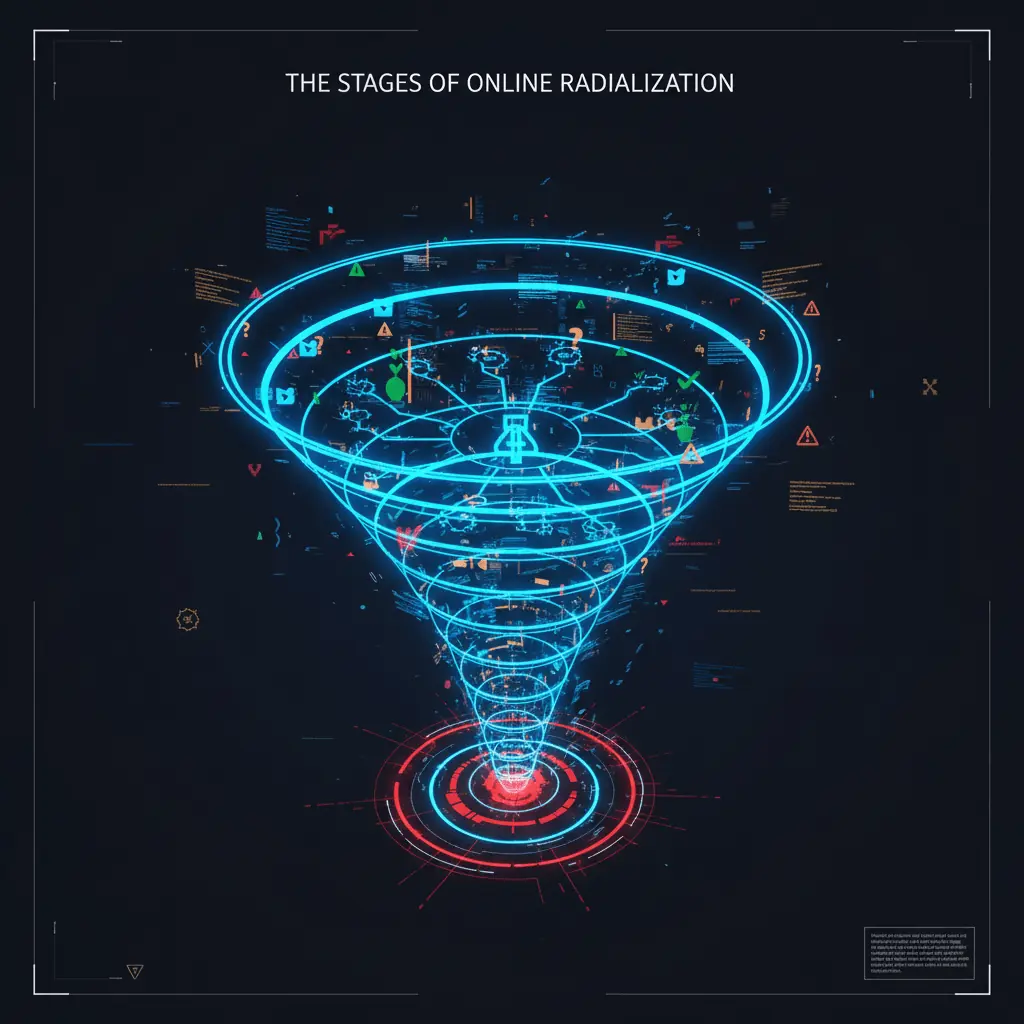
The dominant framework in radicalization research remains some variant of a staged progression model. Moskalenko and McCauley’s pyramid model, developed from social movement research, distinguishes between opinion radicalization (adopting extreme beliefs) and action radicalization (committing or facilitating violence) — a distinction frequently collapsed in public discourse. Applied to incel communities, the pyramid’s utility is real but limited: it maps ideological escalation reasonably well but struggles with the non-linear, network-mediated pathways that characterize online radicalization. More recent pathway models, including work from the International Centre for the Study of Radicalisation (ICSR), treat radicalization as a dynamic and reversible process shaped by social environment, personal biography, and opportunity structures — not a one-way conveyor belt. This matters analytically: most incel forum participants never move toward violence, and treating the subculture as uniformly pre-violent misrepresents the evidence and produces poor policy.
The importance of distinguishing facilitation from causation
A recurring failure in public analysis is conflating online facilitation of offline radicalization with direct platform causation. Available evidence suggests that forums like 4chan’s /r9k/ board, Incels.is, and predecessor sites such as Lookism.net function as social environments that reinforce pre-existing grievances, provide ideological vocabulary, and create conditions for competitive escalation — but the experimental evidence that platform participation causes radicalization independent of prior social conditions is methodologically weak. This is not a minor caveat. It has direct implications for how analysts model intervention points.
Platform architecture as radicalization infrastructure
Community formation and identity investment
Incel forums operate as high-coherence communities with strong identity boundaries. Sociologically, they exhibit what researchers describe as encapsulation: progressively narrowing social networks in which the forum becomes the primary source of identity validation, social comparison, and information. Users who spend significant time in these spaces adopt a shared lexicon — “looksmaxxing,” “hypergamy,” “cope” — that functions simultaneously as in-group signal and cognitive frame. The deeper the identity investment, the higher the psychological cost of disengagement, a dynamic documented across disparate extremist communities by researchers including J.M. Berger in his work on extremism and identity fusion.
Algorithmic amplification: what the evidence actually shows
Claims that recommendation algorithms systematically funnel users toward incel content are frequently made with more confidence than the evidence warrants. Research by the Mozilla Foundation and external audits of platform recommendation systems have documented that YouTube’s algorithm has historically recommended progressively more extreme content in adjacent ideological spaces — particularly in the broader manosphere ecosystem connecting pickup artist communities, men’s rights content, and incel forums. However, methodologically rigorous studies isolating algorithmic effects specifically on incel radicalization remain scarce. What the available data does support is that platform design choices — frictionless migration between communities, engagement-maximizing recommendation, and slow content moderation — create structural conditions conducive to ideological escalation without deterministically producing it.
The role of heroization and competitive martyrdom
A documented mechanism specific to incel radicalization is the elevation of mass-casualty perpetrators to mythologized status. Elliot Rodger’s manifesto, circulated extensively across incel forums following the 2014 Isla Vista attack, functions as a founding text. Posts celebrating subsequent attackers — Minassian, and others who have cited incel ideology — create a competitive martyrdom dynamic that researchers at the Global Network on Extremism and Technology (GNET) have described as accelerationist in structure, even when not explicitly affiliated with accelerationist ideology. This is a meaningful analytical distinction: the mechanism operates through social contagion logic rather than top-down organizational recruitment.
What does the research literature actually support?
Methodological limits in the existing evidence base
In my assessment, the incel radicalization literature has several significant gaps that analysts should acknowledge openly. First, most empirical work relies on forum content analysis — a method that captures expressed ideology but cannot reliably measure behavioral intent or distinguish genuine violence endorsement from performative transgression. Second, interview-based studies of former incel community members are small-sample and subject to selection bias. Third, the absence of longitudinal data makes it extremely difficult to establish temporal sequencing between forum participation and attitudinal change. These limitations do not invalidate the research; they calibrate how confidently we should speak about causal mechanisms.
What the evidence does support
Despite methodological constraints, several findings recur with sufficient consistency to merit analytic weight. Social isolation, experienced rejection, and mental health vulnerability appear as convergent risk factors across multiple case studies of incel-adjacent violence. The ideological framework of the blackpill specifically reduces perceived agency and forecloses prosocial exit pathways — a cognitive dynamic with documented parallels in research on hopelessness and violent ideation. And the celebratory community response to past attacks demonstrably increases the visibility and apparent social reward of violence as a behavioral script, even if it does not mechanically produce imitators.
Myth vs. reality: the most damaging misconceptions
Myth: all incels are potential mass attackers
The conflation of incel community participation with imminent violence risk is both empirically wrong and operationally counterproductive. The overwhelming majority of people who engage with incel forums — whether as participants or passive consumers — never commit violence. Treating an entire subculture as a threat population degrades analytical precision, alienates individuals who might respond to non-punitive interventions, and directs scarce counter-extremism resources toward the wrong targets. The ICSR’s work on violent extremist pathways consistently emphasizes that ideological affiliation is a necessary but far from sufficient condition for political violence.
Myth: deplatforming eliminates the radicalization pipeline
When Reddit banned r/Incels in 2017, the community did not dissolve — it migrated to dedicated forums with fewer moderation constraints and higher concentrations of the most extreme content. Available evidence from analogous cases in far-right and jihadist communities suggests that deplatforming disrupts visibility and recruitment reach but often intensifies ideological coherence among those who follow the migration. This does not mean content moderation is futile — disrupting recruitment surface matters — but it means that deplatforming alone is not a radicalization countermeasure.
A framework for analyzing incel radicalization pathways
Analysts assessing incel radicalization dynamics should work from a multi-level framework that distinguishes structural conditions from individual trajectories. The following indicators, drawn from available research, provide an evidence-grounded baseline:
- Ideological commitment markers: Adoption of blackpill framing as immutable truth (rather than rhetorical performance); explicit endorsement of past attackers as role models; escalating dehumanization of women as a category.
- Social encapsulation indicators: Declining offline social network; forum identified as primary community; resistance to non-incel identity claims.
- Behavioral mobilization signals: Explicit statements of intent, even framed as hypothetical; acquisition or research of means; significant operational security behavior (account deletion, encryption adoption).
- Platform structural factors: Migration from mainstream to dedicated incel forums; participation in threads celebrating past attacks; high-volume posting in accelerationist-adjacent content.
A structured analytical assessment should also map the following dimensions:
- Entry pathway: social isolation precursor, prior manosphere engagement, or acute grievance event
- Community position: passive consumer, active participant, or ideological producer
- Ideology stage: grievance framing, blackpill adoption, or violence endorsement
- Social network composition: proportion of social ties within vs. outside the community
- Intervention history: prior contact with mental health, legal, or CVE systems
This framework does not predict violence — no framework does with adequate reliability. Its utility is in structuring information collection and identifying where intervention might create off-ramps before behavioral mobilization occurs.
Forward assessment
Incel radicalization represents a genuine but analytically complex threat. The pathway from forum participation to mass violence involves multiple contingent factors, and the research base, while growing, carries significant methodological limitations that analysts should name rather than obscure. What concerns me most in the current landscape is the widening gap between the sophistication of the academic literature and the bluntness of platform and policy responses. CVE programs focused on incel-adjacent communities remain underdeveloped compared to those targeting jihadist or far-right pathways. The structural conditions — social isolation, algorithmic amplification of grievance content, and heroization of past attackers — are not self-correcting. Understanding them with precision is a precondition for addressing them effectively.
Readers interested in adjacent topics may want to explore the broader manosphere ecosystem and its relationship to far-right recruitment pipelines, the documented effectiveness gaps in CVE programming, and how state actors have exploited domestic radicalization dynamics for information operations purposes — all areas where the evidence is more developed and the analytical stakes are equally high.
Sources
- Moskalenko, S. & McCauley, C. (2011). Friction: How Radicalization Happens to Them and Us. Oxford University Press.
- Berger, J.M. (2018). Extremism. MIT Press.
- Hoffman, B., Ware, J., & Shapiro, E. (2020). Assessing the Threat of Incel Violence. Studies in Conflict & Terrorism, 43(7).
- Moonshot CVE / ICSR. (2020). The Incel Phenomenon and Online Radicalization. International Centre for the Study of Radicalisation, King’s College London.
- Mozilla Foundation. (2021). YouTube Regrets: A Crowdsourced Investigation into YouTube’s Recommendation Algorithm. Mozilla Foundation.
- Ging, D. (2019). Alphas, Betas, and Incels: Theorizing the Masculinities of the Manosphere. Men and Masculinities, 22(4).