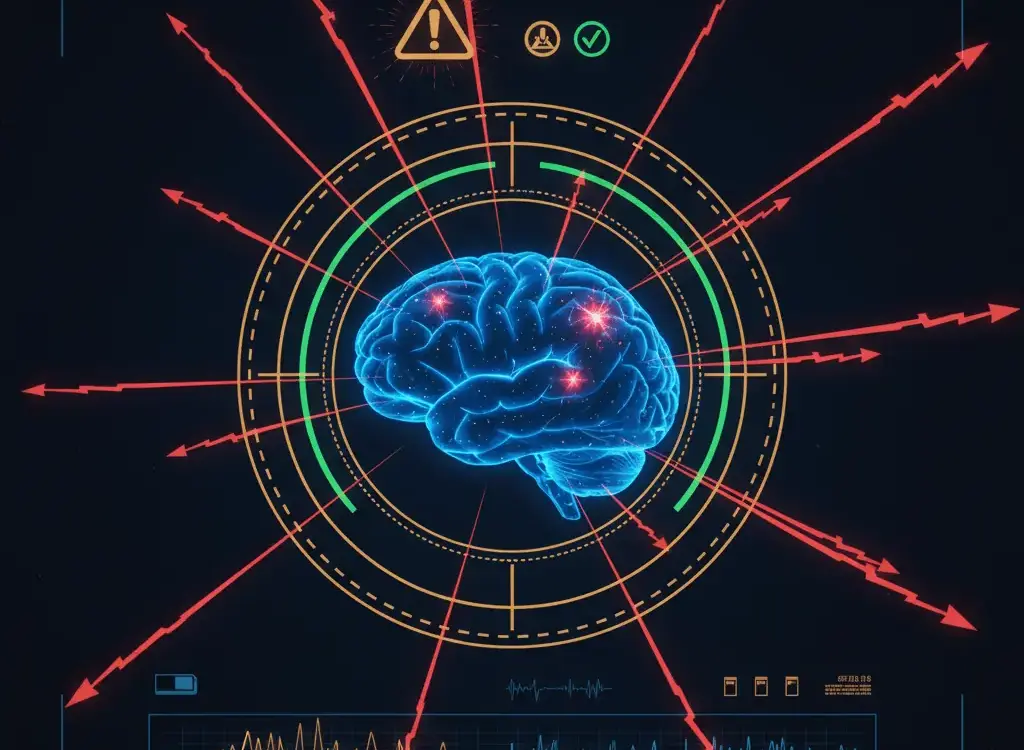
In 2019, a classified NATO StratCom Centre of Excellence assessment noted that cognitive warfare represented «the most advanced form of manipulation» precisely because it exploits fundamental neurological processes rather than merely presenting persuasive content. This marked a doctrinal shift from viewing information operations as external messaging campaigns to recognizing them as systematic attacks on human cognition itself. When we examine the brain as a target in contemporary influence operations, we confront an uncomfortable reality: adversaries increasingly design campaigns around documented cognitive vulnerabilities, attention mechanisms, and decision-making biases embedded in human neurology. This analysis examines how cognitive warfare exploits neurological processes, the implications for Western defense frameworks, and emerging approaches to cognitive resilience that acknowledge the brain’s role as critical infrastructure.
The strategic significance extends beyond traditional information warfare. Where previous influence campaigns relied on persuasive messaging or propaganda techniques, cognitive warfare systematically targets the neural mechanisms underlying perception, memory formation, and decision-making. This represents a qualitative escalation that Western defense establishments are still adapting to address.
How cognitive warfare targets neurological processes
Attention hijacking through designed stimuli
Contemporary influence operations exploit documented neurological responses to specific visual and auditory stimuli. The Internet Research Agency’s 2016-2020 social media campaigns demonstrated sophisticated understanding of how the human brain processes threat-related information. Neuroscientist Dr. Adam Gazzaley’s research on attention networks shows that the brain prioritizes emotionally charged, threat-relevant stimuli over neutral information—a mechanism that information operators systematically exploit through carefully designed content sequences.
Russian information operations, documented by the Stanford Internet Observatory, consistently employed high-contrast imagery, rapid content cycling, and emotionally provocative narratives designed to trigger what neuroscientists term the «orienting network»—the brain’s automatic attention-directing system. This represents targeting of neurological infrastructure rather than conscious reasoning processes.
Memory formation manipulation
The brain’s memory consolidation process creates specific vulnerabilities that sophisticated actors exploit. Research by cognitive scientist Dr. Elizabeth Loftus demonstrates that repeated exposure to false information can create genuine false memories through the brain’s reconstruction processes during memory retrieval. Chinese information operations targeting Hong Kong protesters in 2019-2020, analyzed by the Australian Strategic Policy Institute, employed systematic repetition patterns designed to interfere with accurate memory formation about specific events.
These operations recognized that the brain as a target requires understanding memory as an active reconstruction process rather than passive storage. By flooding information environments with competing narratives during critical memory formation windows, operators can systematically degrade the reliability of target populations’ recall about significant events.
Decision-making circuit exploitation
Neuroscientific research identifies specific brain regions—particularly the prefrontal cortex and anterior cingulate cortex—responsible for evaluating competing information sources. Iranian influence operations documented by FireEye between 2017-2019 demonstrated understanding of cognitive load theory, systematically overwhelming these decision-making circuits through information volume and complexity rather than relying on persuasive content alone.
The strategy exploits the brain’s tendency to rely on mental shortcuts (heuristics) when cognitive resources are depleted. By creating high cognitive load through contradictory information streams, operators can shift target decision-making from analytical processing to more manipulable intuitive judgments.
What makes neurological targeting effective in information environments?
Scalability through digital platforms
Digital information platforms provide unprecedented access to the neurological vulnerabilities that cognitive warfare exploits. Unlike traditional propaganda, which required mass media infrastructure, contemporary operations can deliver precisely calibrated stimuli to individual users based on behavioral profiling. The Cambridge Analytica revelations demonstrated how psychological profiling enables targeting of specific cognitive vulnerabilities at scale.
Facebook’s internal research, disclosed in 2021 congressional testimony, confirmed that platform algorithms amplify content that generates strong emotional responses—effectively weaponizing the brain’s attention and reward systems. This creates an environment where neurologically optimized influence content has systematic advantages over factual information that doesn’t trigger the same neural responses.
Persistence through network effects
Neurological targeting gains effectiveness through social amplification. When influence operations successfully manipulate the cognitive processes of initial targets, those individuals become unwitting distributors of neurologically optimized content to their social networks. The QAnon phenomenon, analyzed extensively by the RAND Corporation, demonstrates how content designed to exploit pattern-recognition biases can achieve viral propagation through social media networks.
This leverages the brain’s social cognition systems—particularly mirror neuron networks that make humans susceptible to emotional contagion from trusted sources. The result is organic amplification of artificially designed cognitive attacks through natural social processes.
Difficulty of conscious recognition
Neurological targeting operates below conscious awareness, making detection and resistance particularly challenging. Traditional counter-propaganda techniques assume targets can recognize and evaluate persuasive attempts. However, when operations target unconscious neural processes—attention mechanisms, emotional responses, memory formation—conscious reasoning provides limited protection.
Research by Dr. Sander van der Linden at Cambridge University demonstrates that even individuals trained in media literacy remain vulnerable to influence techniques that exploit automatic cognitive processes. This suggests that treating the brain as a target requires defensive approaches beyond traditional critical thinking education.
How should defense frameworks adapt to neurological targeting?
Cognitive security as critical infrastructure
NATO’s emerging cognitive security framework, developed through the Innovation Hub, recognizes that protecting cognitive processes requires treating them as critical infrastructure rather than individual responsibility. This represents a fundamental shift from viewing information security as primarily technological to recognizing it as neurological and psychological.
The UK’s National Cyber Security Centre has begun developing cognitive security standards that parallel existing cybersecurity frameworks. These standards acknowledge that the brain’s information processing systems have specific vulnerabilities that require systematic protection measures rather than relying solely on individual media literacy.
Early warning systems for cognitive attacks
Effective defense against neurological targeting requires detection systems that identify influence operations before they achieve cognitive impact. The European Union’s Digital Services Act includes provisions for monitoring «coordinated inauthentic behavior»—but detecting cognitive warfare requires more sophisticated indicators that identify neurologically optimized content patterns rather than merely fake accounts or misleading information.
Research institutions including the Oxford Internet Institute are developing machine learning systems trained to identify content designed to exploit specific cognitive vulnerabilities. These systems analyze features like emotional intensity patterns, attention-hijacking techniques, and memory interference strategies rather than focusing primarily on factual accuracy.
Cognitive resilience through neural training
Emerging research suggests that sustained training can improve resistance to neurological targeting. Dr. Michael Posner’s work on attention training demonstrates that specific cognitive exercises can strengthen the prefrontal control networks that regulate automatic responses to emotionally provocative stimuli.
The U.S. military’s Research and Development Command has initiated programs exploring «cognitive fitness» training designed to enhance resistance to influence operations that target neural vulnerabilities. These programs represent a shift from passive media literacy education to active cognitive conditioning designed to strengthen the neural circuits that cognitive warfare exploits.
A framework for assessing neurological targeting in influence operations
Professional analysis of cognitive warfare requires systematic assessment criteria that identify when operations specifically target neurological processes rather than employing traditional persuasion techniques. The following framework provides operational indicators for security professionals evaluating potential cognitive attacks.
Primary indicators of neurological targeting
- Emotional intensity optimization: Content designed to trigger maximum emotional response rather than convey specific information
- Attention hijacking techniques: Rapid content cycling, high-contrast imagery, and sensory overload patterns
- Memory interference: Systematic flooding of information environments during critical events to disrupt memory consolidation
- Cognitive load manipulation: Overwhelming information volume designed to force reliance on mental shortcuts
- Repetition patterns: Content repetition schedules optimized for memory formation rather than message reinforcement
Assessment methodology
- Content analysis: Evaluate whether materials prioritize neurological impact over informational content
- Timing analysis: Assess whether information release patterns target specific memory formation or attention windows
- Distribution pattern analysis: Determine whether targeting focuses on cognitive vulnerabilities rather than demographic or ideological factors
- Behavioral impact assessment: Measure whether operations produce behavioral changes consistent with neurological manipulation rather than persuasion
Defensive response protocols
| Threat Level | Indicators | Response Measures |
|---|---|---|
| Low | Isolated neurologically optimized content | Enhanced monitoring, media literacy advisories |
| Moderate | Coordinated campaigns using cognitive targeting | Public awareness campaigns, platform engagement |
| High | Systematic neurological targeting during critical events | Emergency information protocols, cognitive security measures |
| Severe | Large-scale cognitive infrastructure attacks | National security response, international coordination |
This framework enables security professionals to distinguish between traditional influence operations and those specifically designed to exploit the brain as a target, facilitating appropriate defensive measures scaled to the nature of the threat.
Forward assessment: implications for cognitive security
Recognition that cognitive warfare specifically targets neurological processes rather than merely presenting persuasive content represents a paradigm shift with significant implications for Western defense frameworks. Available evidence suggests that adversaries possess increasingly sophisticated understanding of cognitive vulnerabilities and the technical capabilities to exploit them at scale through digital platforms.
The trajectory indicates continued evolution toward more precise neurological targeting as advances in neuroscience research become available to influence operators. This creates an ongoing challenge for defense establishments that must adapt cognitive security measures to address threats that operate below conscious awareness and exploit fundamental aspects of human neural architecture.
In my assessment, the most critical gaps remain in detection capabilities and cognitive resilience training. Current approaches focus heavily on content analysis while giving insufficient attention to the neurological impact patterns that distinguish cognitive warfare from traditional information operations. Security professionals require analytical frameworks that identify when the brain itself has become the target rather than merely the recipient of influence attempts.
Sources
Gazzaley, A., & Rosen, L. (2016). The Distracted Mind: Ancient Brains in a High-Tech World. MIT Press.
Loftus, E. F. (2019). Eyewitness testimony and memory biases. In Cognitive Psychology and its Applications (pp. 145-167). Academic Press.
NATO StratCom COE. (2020). Cognitive Warfare: An Attack on Truth and Thought. NATO Strategic Communications Centre of Excellence.
Posner, M. I., & Rothbart, M. K. (2018). Attention training and the executive brain. Current Opinion in Psychology, 29, 45-50.
Stanford Internet Observatory. (2021). The Long Fuse: Misinformation and the 2020 Election. Stanford University.
van der Linden, S. (2022). Misinformation immunity: A cognitive approach to building resistance. Journal of Applied Research in Memory and Cognition, 11(2), 178-184.