Fatigue as a risk factor in cybersecurity
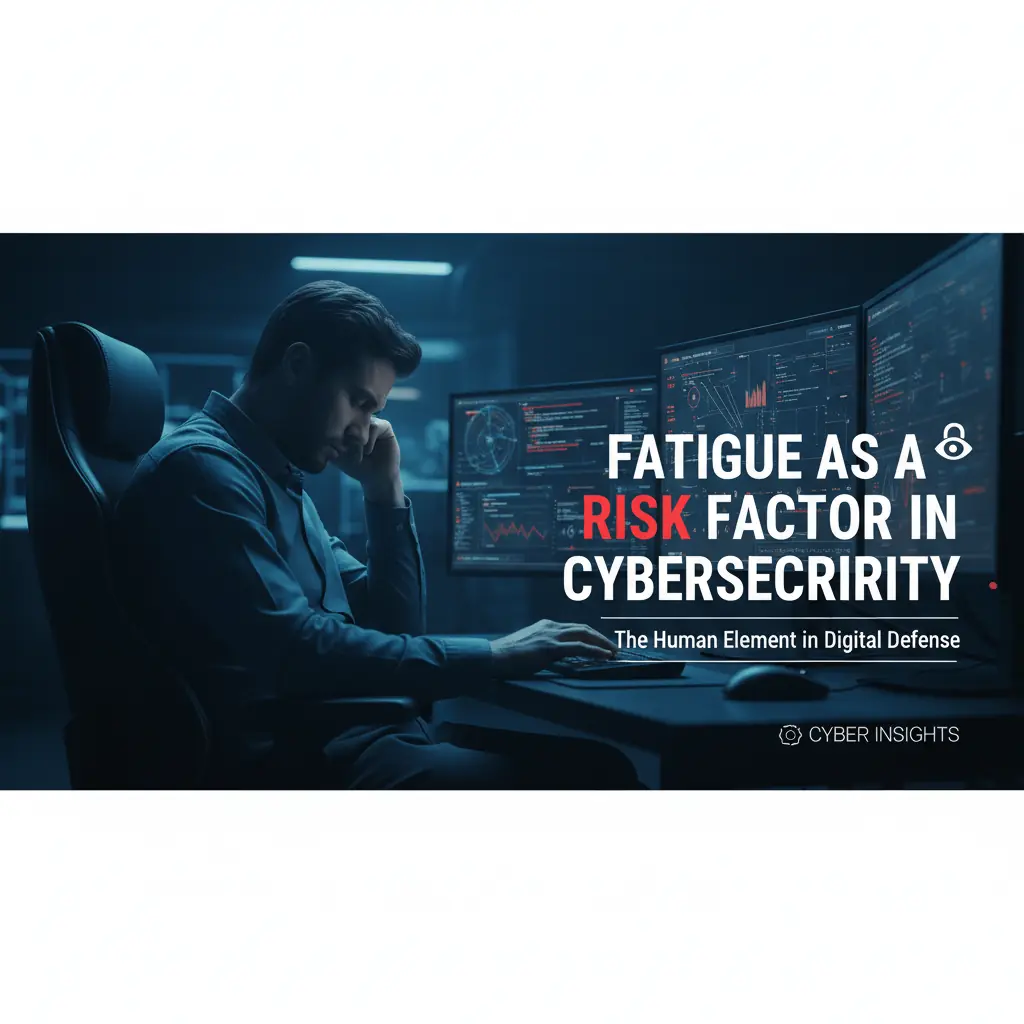
Tired people make worse security decisions, and fatigue is a predictable feature of how organizations operate. It should be designed around, not trained away.

Key judgments
- Fatigue impairs people's ability to apply security knowledge they already have, which is why it is an organizational design issue rather than a training gap. Training completion rates and quiz scores say little about behavior under realistic conditions of workload, overtime and time pressure. Security-critical workflows should build in verification that does not depend on an alert individual, such as dual approval for off-hours financial requests. Workload, staffing levels and overtime are security-relevant indicators that organizations should monitor alongside technical threats.
In 2020, during the height of pandemic-driven remote work, a senior financial analyst at a Fortune 500 company approved a wire transfer for $2.3 million after working fourteen consecutive days managing emergency cash flow operations. The transfer was fraudulent—part of a business email compromise (BEC) campaign that had been targeting the company for weeks. The analyst later told investigators that the approval email “looked off” but admitted being too exhausted to follow normal verification procedures. This incident represents more than an individual failure; it exemplifies how fatigue in cybersecurity creates systemic vulnerabilities that adversaries actively exploit.
Fatigue operates as a force multiplier for cyber threats, degrading the cognitive resources that underpin effective security decision-making. Unlike technical vulnerabilities that can be patched, human fatigue is an inherent organizational condition that fluctuates based on workload, stress, and operational tempo. The available evidence suggests that fatigued personnel demonstrate measurably reduced threat detection capabilities, compromised judgment in security protocols, and increased susceptibility to social engineering attacks—yet organizational cybersecurity frameworks consistently underestimate fatigue as a risk factor.
The scope and scale of fatigue-related security failures
According to the Verizon 2023 Data Breach Investigations Report, human error continues to be a factor in approximately 74% of all breaches, with social engineering attacks comprising 50% of incidents. However, these statistics mask the role that fatigue plays in degrading human decision-making capacity. Research from the CERT Insider Threat Center at Carnegie Mellon indicates that security incidents involving fatigued personnel are significantly more likely to escalate into major breaches, primarily because exhausted employees bypass established verification procedures.
Documented patterns in fatigue-driven incidents
Analysis of publicly disclosed breach reports reveals several consistent patterns when fatigue contributes to security failures. First, incidents cluster around periods of high operational stress—quarterly financial closes, major system migrations, or crisis response operations. Second, the time-of-day distribution shows elevated risk during extended shift work, particularly in the 2-6 AM window when circadian rhythms naturally degrade cognitive performance. Third, organizations with chronic understaffing report higher rates of fatigue-related security incidents, suggesting that systemic resource constraints create persistent vulnerability.
The cognitive mechanisms under attack
Fatigue specifically degrades what cognitive scientists term “executive function”—the mental processes responsible for working memory, cognitive flexibility, and inhibitory control. These are precisely the capabilities that effective cybersecurity decision-making requires. A fatigued employee must simultaneously maintain awareness of current threats, evaluate the legitimacy of incoming communications, and inhibit automatic responses to urgent-seeming requests. When fatigue compromises executive function, the cognitive shortcuts that normally improve efficiency become security vulnerabilities.
How adversaries exploit organizational fatigue
Advanced persistent threat (APT) groups demonstrate sophisticated understanding of how fatigue affects target organizations. APT29 (Cozy Bear) and APT28 (Fancy Bear) have both been observed timing spear-phishing campaigns to coincide with periods of elevated organizational stress, such as earnings announcements or regulatory deadlines. This timing is not coincidental—it reflects operational intelligence about when target organizations are most vulnerable to social engineering.
Timing-based exploitation strategies
Cybercriminal groups engaged in BEC operations frequently conduct reconnaissance to identify organizational patterns that correlate with reduced security vigilance. Financial services firms report elevated BEC attempts during tax season, when accounting personnel are managing extended hours and compressed deadlines. Similarly, healthcare organizations see increased ransomware targeting during flu season, when IT support staff are managing higher system loads while potentially dealing with personal health stressors.
Social engineering amplification effects
Fatigue amplifies the effectiveness of established social engineering techniques. Pretexting attacks that might normally trigger skepticism become more successful when targets are cognitively depleted. The emotional manipulation tactics used in vishing campaigns—urgency, authority, and fear—bypass rational evaluation more easily when executive function is compromised. Research from the University of Cambridge suggests that fatigue can reduce skeptical thinking by up to 40%, making even sophisticated professionals vulnerable to relatively basic social engineering approaches.
Why does traditional security awareness training fail against fatigue?
The security awareness training industry has built a $2.5 billion market around the assumption that security failures result from knowledge gaps rather than cognitive limitations. This fundamental misdiagnosis explains why organizations can invest heavily in training while continuing to experience fatigue-related security incidents. Traditional training focuses on recognition and recall—teaching employees to identify phishing indicators or memorize security procedures. However, fatigue primarily affects not what people know, but their capacity to apply knowledge under stress.
The habituation problem in security training
Repeated security training creates habituation effects that can actually increase vulnerability to fatigue-based attacks. When employees complete monthly phishing simulations or annual security awareness modules while cognitively fresh, they develop confidence in their ability to detect threats. This confidence does not necessarily transfer to real-world conditions where fatigue, time pressure, and competing priorities degrade cognitive performance. The result is a false sense of security that masks underlying vulnerability.
Measuring effectiveness versus managing risk
Most security awareness programs measure completion rates and quiz scores rather than behavioral change under realistic conditions. A 95% pass rate on a security awareness module administered during normal business hours tells us nothing about how those same employees will respond to a sophisticated social engineering attack at 11 PM during a system outage. The disconnect between training conditions and real-world threat scenarios creates measurement artifacts that obscure the true effectiveness of awareness programs.
Systemic approaches to fatigue-aware cybersecurity
Addressing fatigue in cybersecurity requires moving beyond individual training to systemic design changes that account for cognitive limitations. Organizations with mature cybersecurity programs increasingly recognize that human factors must be engineered into security systems rather than trained around. This shift reflects a fundamental realization: fatigue is not a personal failing but an organizational design challenge.
Workflow design and verification protocols
Effective fatigue mitigation requires redesigning security-critical workflows to reduce cognitive load and build verification steps into routine processes. For high-value financial transactions, some organizations now require dual approval for any request initiated outside normal business hours, regardless of apparent urgency. Others have implemented automatic delays for large wire transfers requested during periods of high organizational stress. These approaches recognize that fatigued personnel cannot reliably distinguish legitimate urgency from manufactured pressure.
Technology-assisted decision support
Artificial intelligence and machine learning systems can provide decision support that compensates for fatigue-related cognitive degradation. Email security solutions that flag messages with unusual timing patterns, urgent language, or requests for unusual actions can serve as cognitive prosthetics for fatigued users. However, these systems must be carefully calibrated to avoid alert fatigue—the phenomenon where excessive security warnings are ignored or disabled due to false positive overload.
A framework for assessing organizational fatigue vulnerability
Organizations need systematic approaches for identifying when fatigue creates elevated cybersecurity risk. The following framework provides indicators and assessment criteria for evaluating fatigue-related vulnerability across multiple organizational dimensions.
Operational tempo indicators
Several measurable factors correlate with increased fatigue-related cybersecurity risk:
- Extended work periods: Teams working more than 10 hours daily for extended periods show measurably degraded threat detection
- Compressed project timelines: Security incidents increase by 35% during periods of accelerated delivery schedules
- Staffing gaps: Departments operating below 85% of authorized strength report higher rates of human error
- Crisis response operations: Emergency response periods create windows of elevated vulnerability lasting 48-72 hours post-incident
Environmental stress factors
Broader organizational conditions that amplify fatigue effects include:
- Regulatory pressure: Compliance deadlines correlate with increased social engineering success rates
- Financial stress: Organizations under economic pressure show increased susceptibility to BEC attacks
- Technology transitions: Major system changes increase cognitive load and reduce security vigilance
- Leadership changes: Organizational uncertainty affects risk assessment and decision-making quality
Measurement and monitoring approaches
Effective fatigue assessment requires both quantitative metrics and qualitative indicators. HR data on overtime hours, sick leave usage, and voluntary turnover provide quantitative baselines. Security incident patterns—timing, severity, and human factor involvement—offer additional quantitative measures. Qualitative indicators include employee reports of decision-making difficulty, increased reliance on shortcuts, and reduced confidence in security assessments.
Forward assessment: Building resilient security cultures
The cybersecurity profession must evolve beyond the individual responsibility model that has dominated security awareness training. Fatigue represents a fundamental human limitation that cannot be trained away but must be designed around. Organizations that acknowledge fatigue as an inherent risk factor can build more resilient security cultures by implementing systemic controls, decision support technologies, and organizational policies that maintain security effectiveness even when personnel are cognitively compromised.
Looking ahead, the most effective cybersecurity programs will likely integrate fatigue monitoring into their threat assessment processes, treating cognitive depletion as seriously as they treat technical vulnerabilities. This evolution requires collaboration between cybersecurity professionals, organizational psychologists, and human factors engineers to develop security systems that remain effective under realistic operational conditions.
Sources
- Verizon Enterprise. (2023). 2023 Data Breach Investigations Report. Verizon Communications.
- Cappelli, D., Moore, A., & Trzeciak, R. (2012). The CERT Guide to Insider Threats. Carnegie Mellon University Software Engineering Institute.
- Schneier, B. (2008). The Psychology of Security. Communications of the ACM, 51(3), 34-40.
- NIST. (2003). SP 800-50: Building an Information Technology Security Awareness and Training Program. National Institute of Standards and Technology.
- Cambridge University Computer Laboratory. (2021). Fatigue and Cybersecurity Decision Making. Cambridge Security Research Initiative.
- IBM Security. (2023). X-Force Threat Intelligence Index. IBM Corporation.