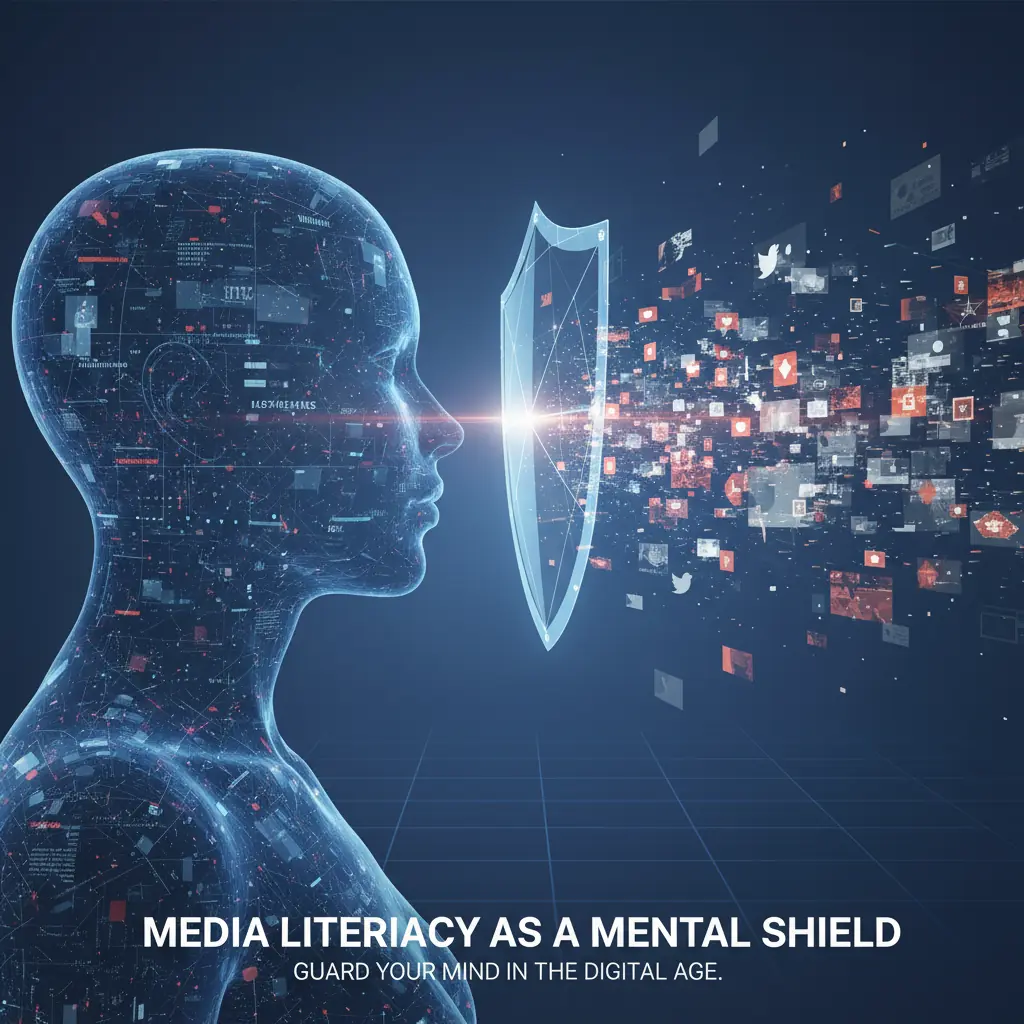
Information hygiene: managing your content diet


Imagine starting your morning the way millions of analysts, journalists, and defense professionals do: coffee in hand, phone already alive with notifications. Within twelve minutes, you have skimmed six news alerts, two Telegram forwarded screenshots, a thread on X attributing a quote to a senior NATO official, and a substack post claiming to expose a classified operation. By the time you sit at your desk, your threat picture has already been shaped — and not entirely by you. That is the operational reality of the modern information environment, and it is precisely where information hygiene — the deliberate, structured management of one’s content intake to preserve analytical clarity and cognitive integrity — either becomes a professional discipline or collapses into reactive noise consumption. The thesis here is straightforward but uncomfortable: most practitioners who work in cognitive defense, intelligence analysis, or strategic communication do not practice the discipline they preach. The structural gaps are individual and institutional. And the adversarial actors exploiting those gaps know it.
The threat environment that makes information hygiene operationally necessary
Cognitive load as an attack surface
Information overload is not a modern complaint — it dates at least to the printing press — but the adversarial exploitation of cognitive load is a distinctly contemporary problem. Russian information operations doctrine, as documented in Keir Giles’s work published by Chatham House, explicitly targets the decision-making cycle of adversary institutions. The goal is rarely to convince; it is to exhaust, confuse, and delay. When an analyst or policymaker cannot distinguish signal from noise quickly, their tempo slows. That slowness is a tactical victory for the actor generating the noise.
NATO’s Strategic Communications Centre of Excellence (StratCom COE) has documented this dynamic in multiple publications examining Russian influence campaigns. The firehose of falsehood model — a term popularized in RAND Corporation research by Christopher Paul and Miriam Matthews — operates precisely on this principle: volume and speed matter more than individual credibility. The sheer quantity of competing narratives forces consumers toward cognitive shortcuts, and those shortcuts are exploitable.
Algorithmic amplification and the curated information silo
Platform architecture compounds the problem. Recommender systems, optimized for engagement rather than accuracy, systematically surface emotionally activating content. This is not a conspiracy; it is an openly documented design choice. The practical consequence for the professional analyst is that passive consumption of algorithmically curated content will systematically over-represent outrage, novelty, and conflict — which happen to be the same signals that foreign influence operations are designed to amplify. The analyst who does not actively manage their information sources is, in effect, outsourcing their threat picture construction to an engagement-maximizing algorithm. In my assessment, this represents a more pervasive vulnerability than most institutional security frameworks acknowledge.
What does current institutional guidance actually say?
NATO StratCom COE frameworks and their practical limits
NATO StratCom COE has produced substantive guidance on cognitive resilience and information environment awareness, including work on detecting coordinated inauthentic behavior and understanding narrative ecosystems. The Centre’s contributions to OSINT methodology — particularly around source verification and network analysis — are genuinely useful. However, these frameworks are primarily oriented toward institutional communication strategy, not individual analyst hygiene. There is a gap between strategic-level doctrine and the daily practice of the practitioner sitting in front of multiple open browser tabs.
The EU’s East StratCom Task Force, operating under the European External Action Service, has similarly focused on identifying and labeling disinformation at the campaign level through the EUvsDisinfo database. Valuable work. But campaign-level identification does not tell an individual analyst how to structure their daily information intake to preserve independent judgment. These are different problems requiring different solutions.
OSINT tradecraft as a partial analog
Open-source intelligence methodology offers the closest existing professional analog to individual information hygiene. OSINT tradecraft — as codified in resources from organizations like Bellingcat and in training curricula developed by the FIRST network — emphasizes source triangulation, provenance tracing, and the disciplined separation of confirmed facts from inference. These are, at their core, hygiene practices. The problem is that OSINT methodology is applied in bounded, task-specific investigations. Most practitioners do not apply the same rigor to their ambient, daily information consumption. The discipline is situational rather than habitual.
Does media literacy actually work? An honest assessment of the evidence
Prebunking versus debunking: what the research supports
The most credible experimental evidence on cognitive defense at the individual level comes from inoculation theory research, particularly the work of Sander van der Linden and colleagues at Cambridge University. Their prebunking approach — exposing people to weakened forms of manipulative techniques before they encounter them at full force — has demonstrated measurable effects on resistance to specific manipulation strategies in controlled settings. The methodology is sound. The limitation is scalability and durability: laboratory effects attenuate in messy real-world information environments, and there is limited evidence on how long the protective effect lasts under sustained adversarial pressure.
Debunking — correcting false claims after exposure — has a more contested evidence base. The continued influence effect, well-documented in cognitive psychology literature, shows that corrections often fail to fully dislodge initial misinformation, particularly when the false claim is emotionally resonant or consistent with prior beliefs. For the practitioner, this has a direct implication: the appropriate posture is prophylactic, not reactive. Building structured intake habits before cognitive contamination occurs is significantly more effective than attempting correction afterward.
Institutional media literacy programs: effectiveness and gaps
Government-sponsored media literacy programs — including those supported by the UK Government Communication Service counter-disinformation unit and CISA’s election security communication efforts — have faced consistent methodological challenges in demonstrating impact. Studies frequently measure self-reported confidence in identifying misinformation rather than actual behavioral change. These are not the same thing, and conflating them overstates program effectiveness. Available evidence suggests that short-format media literacy interventions produce modest, short-term improvements in critical evaluation of specific content types, but have limited transferability across contexts. That is a structural gap the field has not honestly confronted.
Why is the gap between threat sophistication and individual cognitive defense so persistent?
Political and institutional constraints on honest assessment
Part of the answer is institutional. Agencies tasked with countering foreign information manipulation and interference (FIMI — the term now preferred in EU policy documents) operate under political constraints that make honest public acknowledgment of cognitive vulnerability difficult. Admitting that your own analysts, communicators, or policymakers are susceptible to the same manipulation techniques being studied creates political liability. The result is a public posture of confidence that does not reflect internal assessments. This is not unique to any single government; it is a structural feature of how democratic institutions communicate about cognitive threats.
The professional identity problem
There is also a professional identity dimension that deserves naming. Analysts and security professionals often operate under the implicit assumption that expertise confers immunity. The cognitive psychology literature does not support this. Research on expert judgment, including work documented by Philip Tetlock in his studies of forecasting accuracy, consistently shows that domain expertise does not reliably protect against motivated reasoning, confirmation bias, or anchoring effects. If anything, high confidence in one’s own analytical judgment can reduce the metacognitive vigilance that effective information hygiene requires.
A framework for evaluating individual information hygiene practice
What follows is a practitioner-oriented framework for assessing and improving information hygiene at the individual level. It draws on OSINT tradecraft, inoculation theory, and cognitive bias mitigation principles. It is not a wellness checklist. It is an operational assessment tool.
- Source diversity audit: Map your actual daily sources for one week. Identify what percentage come from algorithmically curated feeds versus deliberately selected primary sources. If more than 60% are algorithm-mediated, the intake architecture is vulnerable.
- Provenance discipline: Apply OSINT-grade provenance checks to high-stakes claims before acting on them, regardless of source reputation. Reputation laundering — attaching false claims to credible outlets through partial citation — is a documented technique in influence operations.
- Emotional activation flag: Treat strong emotional responses to information — particularly outrage or urgency — as a signal for additional scrutiny, not as confirmation of importance. Emotional activation is a known vector for cognitive bypass.
- Update lag management: Build intentional delay into your information intake. Real-time consumption of breaking information systematically increases exposure to unverified claims. A 4–6 hour lag on non-time-critical information allows the verification ecosystem to function.
- Adversarial source inclusion: Deliberately include sources that challenge your analytical priors. Not as a gesture toward balance, but as a structural defense against confirmation bias. This is standard in competitive intelligence methodology and should be standard here.
- Saturation awareness: Recognize information saturation states — periods when intake volume exceeds processing capacity — and reduce input rather than accelerating consumption. Saturation degrades judgment quality measurably.
| Hygiene dimension | Low readiness indicator | High readiness indicator |
|---|---|---|
| Source architecture | Predominantly algorithm-curated feeds | Deliberate primary source selection with diversity |
| Provenance practice | Accepts outlet reputation as sufficient verification | Traces claims to primary documentation routinely |
| Emotional regulation | Treats emotional resonance as signal of truth | Flags emotional activation for additional scrutiny |
| Intake pacing | Real-time, continuous consumption | Structured intake windows with deliberate delays |
| Adversarial exposure | Avoids challenging sources | Actively includes adversarial perspectives |
Forward assessment: where this discipline needs to go
Information hygiene as a professional discipline remains underdeveloped relative to the threat environment that makes it necessary. The institutional frameworks — NATO StratCom COE guidance, EU FIMI policy, CISA communication strategy — address the adversarial supply side with increasing sophistication. The demand side, meaning the cognitive practices of individual analysts, communicators, and decision-makers, receives far less rigorous attention. The prebunking research from van der Linden and colleagues suggests that structured cognitive defense is trainable, but durable implementation requires institutional commitment that most organizations have not made. What needs to change is the professional norm: information hygiene should be treated as an operational competency, assessed and maintained like any other, not left to individual initiative. The realistic trajectory, absent that institutional shift, is continued vulnerability at precisely the level that matters most — the individual judgment of the people on whom strategic communication and analysis depend.
The uncomfortable conclusion is this: the most sophisticated adversarial influence architecture in the world does not need to penetrate a classified network. It needs to shape the information diet of the analyst reading the open-source reporting. If that analyst has not built deliberate hygiene practices, the work is already done for them.
Sources
- Giles, K. (2016). Russia’s ‘New’ Tools for Confronting the West. Chatham House.
- Paul, C. & Matthews, M. (2016). The Russian ‘Firehose of Falsehood’ Propaganda Model. RAND Corporation.
- van der Linden, S., Roozenbeek, J. & Compton, J. (2020). Inoculating Against Fake News About COVID-19. Frontiers in Psychology.
- Tetlock, P. & Gardner, D. (2015). Superforecasting: The Art and Science of Prediction. Crown Publishers.
- NATO Strategic Communications Centre of Excellence. (2020). Cognitive Security and the Information Environment. NATO StratCom COE.
- European External Action Service. (2023). FIMI Threat Landscape Report. EEAS Task Force East.