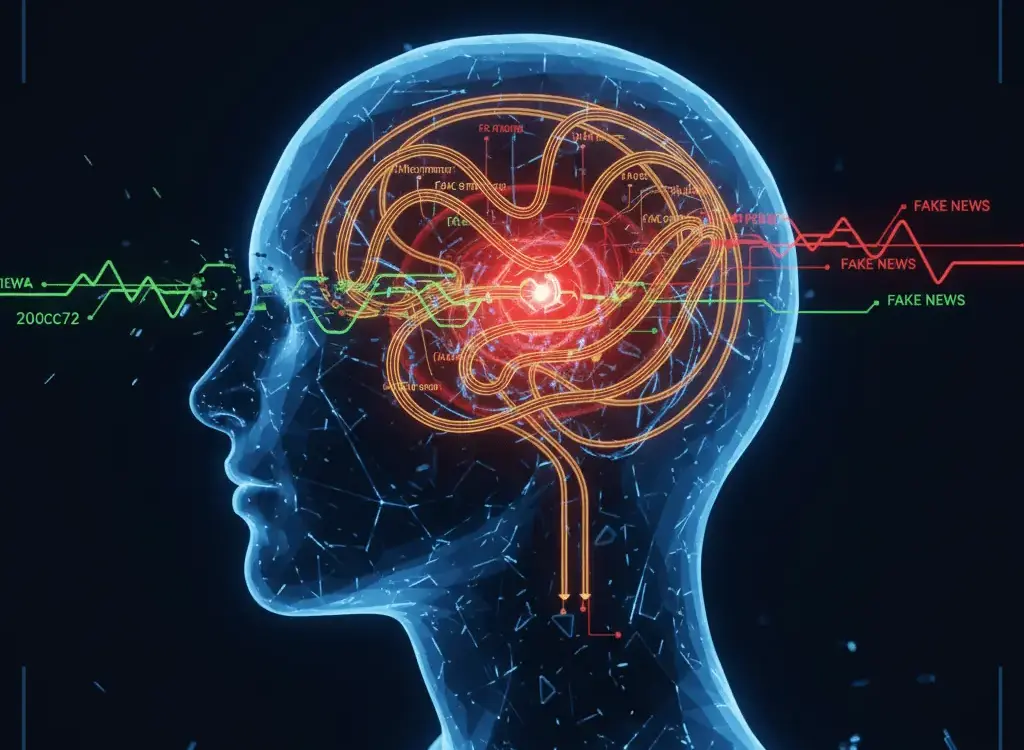
The psychological foundations of why we believe fake news
In October 2016, a fabricated story claiming Pope Francis had endorsed Donald Trump spread across social media platforms, accumulating over 960,000 Facebook engagements—more than the top-performing factual election stories from major news outlets combined. This wasn’t an isolated incident of gullible users sharing obvious nonsense. The story’s success revealed something more troubling: why we believe fake news isn’t primarily about media literacy or critical thinking skills. It’s about how our cognitive architecture makes us vulnerable to information that confirms our existing beliefs while bypassing our analytical defenses.
According to the European External Action Service’s Foreign Information Manipulation and Interference (FIMI) taxonomy, disinformation operates as «false or misleading information that is spread deliberately to deceive.» But understanding the technical definition misses the more strategic question: why does disinformation work so consistently across different populations, educational backgrounds, and cultural contexts? The answer lies in the intersection of evolutionary psychology, social cognition, and the structural characteristics of digital information environments.
The evidence suggests that our susceptibility to false information isn’t a bug in human reasoning—it’s a feature that served us well for millennia but now creates exploitable vulnerabilities in complex information ecosystems. This analysis examines the cognitive, social, and technological factors that make disinformation campaigns effective, moving beyond content-level fact-checking to understand the systemic reasons why we believe fake news persists as a strategic threat.
How our brains process information in the digital age
The evolutionary mismatch between brain and technology
Human cognitive systems evolved in small groups where information came from known sources with traceable reputations. Our ancestors didn’t need sophisticated verification mechanisms for claims like «there are lions near the water hole»—the cost of disbelief was potentially fatal, while the cost of overcaution was minimal. This created what researchers call a «better safe than sorry» bias in information processing.
Modern information environments invert this evolutionary logic. We encounter thousands of claims daily from sources we’ll never meet, about events we can’t directly verify, with consequences that may not manifest for months or years. Yet our brains still apply Stone Age heuristics: information that triggers emotional responses feels more credible, familiar-looking sources appear more trustworthy, and repeated exposure increases perceived accuracy regardless of actual truth value.
NATO StratCom Centre of Excellence research indicates that this evolutionary mismatch becomes particularly pronounced during periods of social stress or political uncertainty. When anxiety levels rise, cognitive shortcuts become more dominant, making populations more susceptible to information that provides simple explanations for complex problems—a core principle exploited by state-sponsored disinformation campaigns.
Confirmation bias and motivated reasoning
The term «confirmation bias» understates the actual psychological dynamics at work. Research by the Yale Cultural Cognition Project demonstrates that people don’t just seek information that confirms their beliefs—they actively resist information that threatens their social identity or group membership. This isn’t intellectual laziness; it’s protective reasoning designed to maintain social bonds and status within important communities.
Consider how this operates in practice: when individuals encounter information that contradicts their political beliefs, brain imaging studies show increased activity in areas associated with physical threat responses. The brain treats ideological challenges similarly to personal attacks, triggering defensive mechanisms that prioritize group loyalty over factual accuracy. Disinformation campaigns exploit this by framing false narratives as tribal markers—making belief in specific claims a test of group membership rather than an empirical question.
What concerns me most about current counter-disinformation efforts is their assumption that providing accurate information will overcome motivated reasoning. The available evidence suggests the opposite: corrective information can actually strengthen false beliefs when those beliefs serve important psychological or social functions for the believer.
The illusion of knowledge and social proof
Digital platforms create what cognitive scientists call «the illusion of explanatory depth»—users feel they understand complex issues because they can quickly access superficial information about them. This pseudo-understanding makes people more confident in their opinions while reducing their motivation to seek deeper knowledge. The result is increased susceptibility to simple narratives that appear to explain complicated phenomena.
Social proof mechanisms amplify this effect exponentially. When users see content with high engagement metrics—likes, shares, comments—they interpret this as evidence of the content’s credibility and social acceptance. Platform algorithms optimize for engagement, not accuracy, creating feedback loops where emotionally provocative content (including disinformation) receives more visibility and social validation than measured, factual reporting.
Why emotional triggers bypass critical thinking
The neuroscience of emotional hijacking
Neuroscientific research reveals that emotional processing occurs faster and with greater intensity than analytical thinking. When information triggers strong emotional responses—fear, anger, disgust, or moral outrage—it activates the amygdala before reaching the prefrontal cortex areas responsible for critical evaluation. This creates a window of several hundred milliseconds where emotional content can establish credibility before rational analysis begins.
Sophisticated disinformation campaigns exploit this timing gap systematically. Content designed to provoke immediate emotional responses bypasses analytical defenses and establishes what researchers call «truth defaults»—initial impressions that subsequent fact-checking struggles to dislodge. The DFRLab’s analysis of Russian information operations shows consistent use of emotionally charged imagery, inflammatory language, and moral framing designed to trigger these rapid emotional assessments.
The practical implication is sobering: by the time users engage their critical thinking faculties, they’re often defending an emotionally-established position rather than evaluating information neutrally. This explains why fact-checking efforts frequently fail to change minds—they’re attempting to use logic against conclusions that weren’t reached through logical processes.
Moral foundations and identity-protective cognition
Research by Jonathan Haidt and others demonstrates that political beliefs rest on different moral foundations: care/harm, fairness/cheating, loyalty/betrayal, authority/subversion, sanctity/degradation, and liberty/oppression. Disinformation campaigns succeed by activating multiple moral foundations simultaneously, making false narratives feel morally urgent rather than factually questionable.
For example, conspiracy theories about vaccine safety don’t just challenge medical authority—they activate moral concerns about protecting children (care), resisting government overreach (liberty), and maintaining community bonds (loyalty). This multi-layered moral framing makes disbelief feel like moral failure, not intellectual rigor. Users who reject these narratives risk appearing to abandon their moral commitments, creating powerful psychological pressure to maintain belief regardless of contradictory evidence.
The European Union’s Code of Practice on Disinformation recognizes this dynamic but struggles to address it effectively. Current approaches focus on content removal and fact-checking, which may actually strengthen the moral framing of disinformation by making believers feel persecuted for their moral convictions.
The role of social networks in belief formation
Human beliefs form primarily through social processes, not individual reasoning. We adopt the beliefs of people we trust, respect, or want to emulate—a mechanism that worked effectively when social networks were small and geographically constrained. Digital platforms create unprecedented opportunities for belief formation through parasocial relationships with influencers, commentators, and online communities.
This creates what researchers call «distributed cognition»—users outsource fact-checking and verification to trusted social networks rather than primary sources. If someone’s trusted network shares information consistently, that repetition creates credibility independent of the information’s actual accuracy. State-sponsored disinformation campaigns leverage this by building authentic-seeming social networks over months or years before introducing false narratives through trusted community voices.
The computational propaganda research at Oxford Internet Institute documents how this process operates at scale. Automated accounts and coordinated inauthentic behavior create artificial social proof, while human influencers provide authentic emotional validation for false claims. Users aren’t being deceived by obvious propaganda—they’re being influenced by what appears to be genuine social consensus within their trusted networks.
Can we build resistance to disinformation?
The limits of traditional fact-checking approaches
Current counter-disinformation strategies rest on what researchers call the «information deficit model»—the assumption that false beliefs result from insufficient access to accurate information. This model underlies most fact-checking initiatives, media literacy programs, and platform content moderation policies. However, mounting evidence suggests these approaches may be necessary but insufficient to address the structural factors that make disinformation effective.
Studies of fact-checking effectiveness show mixed results at best. Corrections can reduce belief in false claims among politically neutral audiences, but they often fail to change minds when false information aligns with strong prior beliefs or group identities. More troubling, corrective information sometimes triggers «backfire effects»—strengthening false beliefs by making them feel more personally meaningful or socially important.
Platform content moderation faces similar limitations. Removing false content can reduce its immediate spread, but it doesn’t address the underlying demand for information that serves specific psychological or social functions. Users whose false beliefs are challenged or removed often seek alternative sources that provide the same cognitive and emotional benefits, potentially leading them toward more extreme or less mainstream information sources.
Inoculation theory and prebunking strategies
More promising approaches draw from inoculation theory—the idea that exposing people to weakened forms of false arguments can build resistance to stronger disinformation later. Cambridge University’s research on «prebunking» shows that teaching people about manipulation techniques makes them more resistant to disinformation, even when the content aligns with their political beliefs.
Effective inoculation requires several components: warning people that they may encounter attempts at persuasion, explaining the techniques used to manipulate opinion, and providing practice recognizing these techniques in realistic contexts. This approach addresses the cognitive mechanisms that make disinformation effective rather than focusing solely on specific false claims.
The challenge is implementation at scale. Inoculation requires personalized approaches that account for individual differences in political beliefs, cognitive styles, and social contexts. Mass media campaigns struggle to achieve this level of customization, while educational institutions often lack the resources and expertise to develop effective programs.
Building cognitive and social resilience
The most effective long-term approaches may focus on building general cognitive and social resilience rather than addressing specific disinformation campaigns. This includes developing what researchers call «intellectual humility»—the ability to hold beliefs tentatively and update them based on new evidence—and strengthening social bonds that don’t depend on shared beliefs about contested political issues.
Research suggests that people with strong social connections and diverse information networks show greater resistance to disinformation, even when false information aligns with their political preferences. This resilience appears to result from having multiple sources of social validation and identity, reducing dependence on any single belief system for psychological or social needs.
In my assessment, this points toward community-based approaches that strengthen local social bonds, encourage cross-cutting group memberships, and create opportunities for constructive dialogue across political differences. Such approaches may be more effective than top-down content moderation or fact-checking, though they require longer time horizons and more complex measurement criteria.
A framework for analyzing disinformation vulnerability
Understanding why we believe fake news requires systematic analysis of the cognitive, social, and technological factors that create vulnerability to false information. The following framework synthesizes research from cognitive psychology, political science, and computational social science to provide practical assessment tools for security professionals, journalists, and policy analysts.
Individual vulnerability factors
Assessment of individual susceptibility to disinformation should examine multiple psychological and social dimensions:
- Cognitive style preferences: Reliance on intuitive versus analytical thinking, tolerance for uncertainty and ambiguity, need for cognitive closure
- Motivated reasoning patterns: Strength of political identity, involvement in politically-engaged social networks, history of belief persistence despite contradictory evidence
- Information consumption habits: Diversity of news sources, fact-checking behavior, susceptibility to social proof and authority cues
- Social network characteristics: Homogeneity of political beliefs within personal networks, strength of parasocial relationships with media figures, dependence on social media for news
These factors interact in complex ways that resist simple prediction. However, individuals showing multiple vulnerability markers—particularly strong political identity combined with homogeneous social networks and high social media use—demonstrate greater susceptibility to false information across different content domains.
Content design indicators
Effective disinformation campaigns share structural characteristics that exploit known cognitive vulnerabilities:
- Emotional activation: Content designed to trigger immediate emotional responses before analytical thinking can engage
- Identity alignment: Framing that makes belief in specific claims a marker of group membership or moral commitment
- Confirmation of existing beliefs: Information that validates prior opinions while providing new «evidence» for established positions
- Social proof manipulation: Artificial or amplified engagement metrics that suggest widespread acceptance
- Authority borrowing: Use of legitimate-seeming sources, official-looking graphics, or scientific language to establish credibility
Content exhibiting multiple design indicators should trigger enhanced scrutiny, particularly when it appears during periods of social stress or political tension when cognitive vulnerabilities are heightened.
System-level amplification mechanisms
Individual and content factors operate within technological and social systems that can amplify or suppress disinformation effects. Key system-level indicators include:
- Algorithmic amplification: Platform recommendation systems that prioritize engagement over accuracy, creating filter bubbles and echo chambers
- Coordinated inauthentic behavior: Networks of automated or fake accounts that create artificial social proof and trending effects
- Cross-platform coordination: Synchronized campaigns that appear as organic grassroots activity across multiple information environments
- Institutional response capacity: Speed and effectiveness of fact-checking, content moderation, and corrective messaging from authoritative sources
Effective counter-disinformation strategies must address all three levels simultaneously. Individual-focused approaches like media literacy education may fail without corresponding changes to platform design and content moderation policies. Similarly, technological solutions that ignore psychological and social factors may reduce the spread of specific false claims without addressing underlying vulnerabilities that make populations susceptible to future campaigns.
The path forward: building information resilience
The question of why we believe fake news reveals fundamental tensions between human cognitive evolution and modern information environments. Our psychological mechanisms for processing social information served us well in small-group contexts but create systematic vulnerabilities in complex, mediated ecosystems where bad actors can exploit cognitive shortcuts at unprecedented scale.
Effective responses require acknowledging these vulnerabilities without falling into technological determinism or cognitive elitism. The available evidence suggests that disinformation succeeds not because people are irrational or poorly educated, but because it exploits rational psychological mechanisms in irrational information environments. This points toward systemic solutions that address platform design, social network dynamics, and institutional response capabilities rather than focusing primarily on individual behavior change.
In my assessment, the most promising approaches combine technological interventions that reduce the reach and impact of false information with social interventions that strengthen community resilience and cognitive diversity. However, these approaches require sustained commitment across multiple sectors and longer time horizons than current policy cycles typically support. The cognitive vulnerabilities that make us susceptible to disinformation aren’t design flaws to be fixed—they’re features of human social cognition that require careful management in increasingly complex information environments.
Perhaps the most unsettling conclusion is that there may be no perfect solution to disinformation that doesn’t also threaten legitimate democratic discourse. The same cognitive mechanisms that make us vulnerable to false information also enable rapid belief updating, social coordination, and collective action in response to genuine threats. Building resistance to disinformation while preserving the cognitive flexibility that democratic societies require represents one of the defining challenges of the information age.