Russian interference in the 2020 US election: what was documented

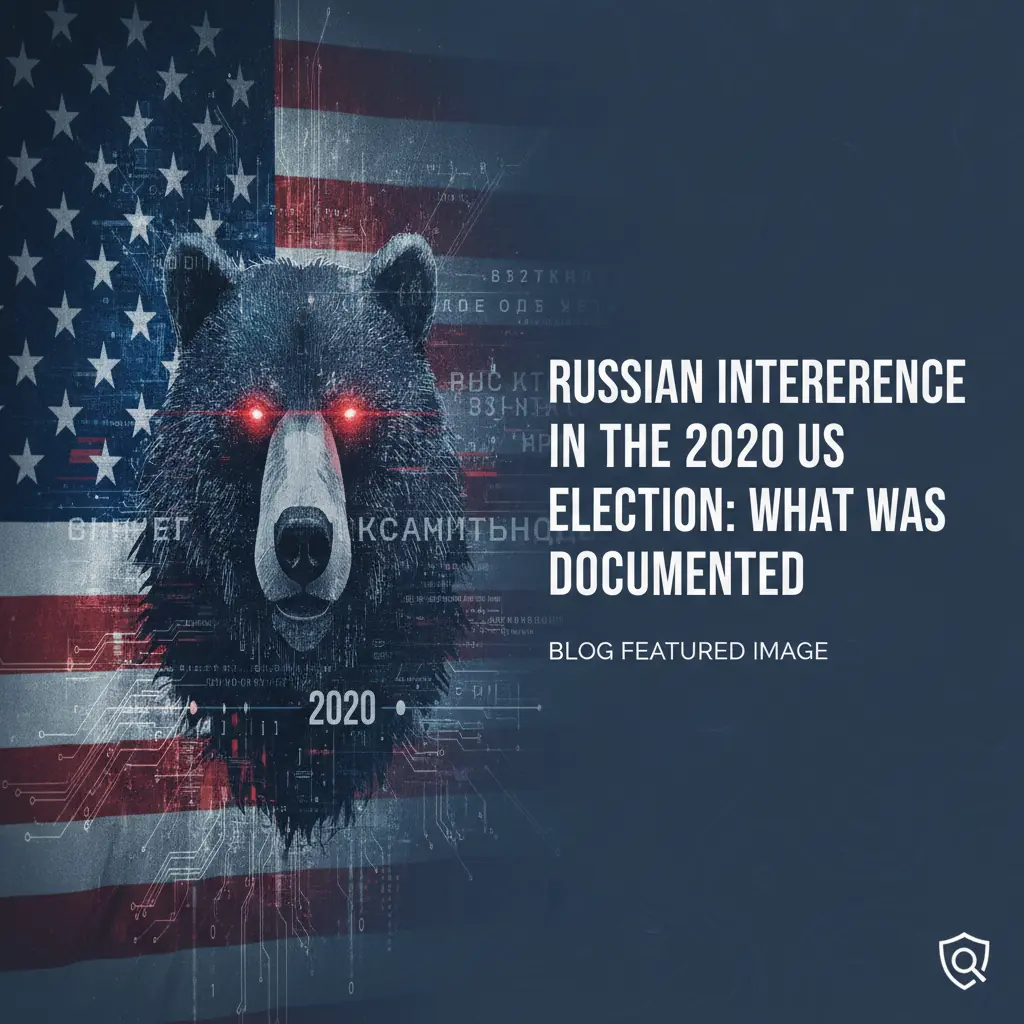
In August 2020, the Office of the Director of National Intelligence released a public threat assessment warning that Russia was actively working to “denigrate” Democratic presidential candidate Joe Biden while amplifying narratives favorable to the Trump campaign. It was not a leak, not a partisan allegation — it was a formal intelligence community judgment, declassified and published. That document, alongside the Senate Intelligence Committee’s bipartisan five-volume report and subsequent reporting from the DFRLab and Stanford Internet Observatory, constitutes the empirical foundation for any serious analysis of Russian interference 2020. The operational picture that emerges is less dramatic than 2016 in some respects, but structurally more sophisticated. Russia did not need to hack email servers a second time. It had learned to work through proxies, laundered narratives, and information ecosystems it had spent four years helping to cultivate. This article reconstructs what is documented, how the mechanisms operated, and what the defender’s failure modes reveal about ongoing institutional vulnerabilities.
The operational architecture: from GRU to ecosystem manipulation
What the Senate Intelligence Committee documented
The Senate Intelligence Committee’s Volume 5 report, released in August 2020, remains the most comprehensive bipartisan accounting of Russian interference in U.S. elections spanning both 2016 and the run-up to 2020. For the 2020 cycle specifically, the Intelligence Community Assessment (ICA) published in March 2021 — reflecting analytical work completed before the January 20 transition — concluded with high confidence that Russian President Vladimir Putin authorized influence operations targeting the election. The ICA identified two primary objectives: undermining confidence in U.S. electoral processes and denigrating Biden while supporting Trump’s prospects. These are not novel goals; they are consistent with what Russian military doctrine calls aktivnyye meropriyatiya (active measures) — a term describing the full spectrum of political warfare tools employed to weaken adversary states from within.
Konstantin Kilimnik and the campaign data transfer
One of the most consequential documented elements of Russian interference 2020 concerns Konstantin Kilimnik, a Ukrainian political consultant assessed by the U.S. Treasury Department as a Russian intelligence officer. The Senate report confirmed that Paul Manafort, Trump’s 2016 campaign chairman, shared internal polling data and campaign strategy with Kilimnik during the 2016 cycle — data that the Senate committee assessed could have been used to assist Russian targeting operations. While the direct operational use of that data in 2020 remains difficult to establish through open-source analysis, the structural link between the campaign’s internal architecture and Russian intelligence services is not contested. What concerns me analytically is that this case illustrates a recurring vulnerability: the interface between legitimate political consultancy and foreign intelligence services is structurally opaque, and U.S. counterintelligence frameworks were not designed to monitor it in real time.
The Internet Research Agency’s diminished but persistent role
The Internet Research Agency (IRA), the St. Petersburg-based troll farm indicted by Robert Mueller in 2018, operated at reduced capacity in 2020 compared to its peak in 2016. Platform enforcement actions by Facebook, Twitter, and Google, combined with U.S. Cyber Command’s reported offensive operations against the IRA infrastructure in November 2018, disrupted some of its reach. However, Stanford Internet Observatory research published in 2020 documented continued IRA-linked activity, including attempts to recruit unwitting American intermediaries to run social media accounts — a significant tactical evolution. Direct attribution was harder; the fingerprints were cleaner. The shift toward using Americans as cutouts represents a meaningful adaptation, one that complicates both legal prosecution and public attribution.
Narrative laundering: how disinformation traveled in 2020
The Burisma operation and the Hunter Biden story
In January 2020, Microsoft’s Threat Intelligence Center reported that a hacking group designated Sandworm — attributed to Russia’s GRU military intelligence — had targeted Burisma Holdings, the Ukrainian energy company where Hunter Biden had served on the board. The timing was precise: it coincided with Senate investigations into Biden family business dealings. The 2021 ICA assessed that Russian intelligence used Ukrainian politicians and networks to spread narratives that reached U.S. media outlets, including a Senate Republican-led report published in September 2020 that amplified some of those narratives. This is what disinformation researchers call narrative laundering — the process by which foreign-origin material enters legitimate domestic political and media ecosystems, losing its provenance in transit. The DFRLab documented this pathway in detail, tracing how content moved from fringe platforms to mainstream media amplification chains.
The role of amplification networks and domestic proxies
A recurring finding across the Graphika, Stanford Internet Observatory, and DFRLab analyses of 2020 influence operations is the centrality of inauthentic amplification networks — coordinated clusters of accounts that boost content to give it the appearance of organic popularity. In 2020, these networks increasingly used American domestic political communities as their operational terrain. Rather than creating content, many of these networks simply amplified existing divisive narratives on issues including racial justice protests, COVID-19 origins, and mail-in ballot security. The distinction matters operationally: amplification is harder to attribute than content creation, harder to moderate at scale, and harder to prosecute under existing U.S. law. NATO StratCom COE (the Strategic Communications Centre of Excellence) has documented this shift toward amplification-first strategies across multiple European election cycles.
What did U.S. institutions do — and where did they fall short?
The CISA response and whole-of-government coordination failures
The Cybersecurity and Infrastructure Security Agency (CISA), led in 2020 by Christopher Krebs, mounted what is widely assessed as a more robust election security infrastructure defense than in 2016. The “Rumor Control” initiative directly rebutted electoral disinformation in near-real-time. Krebs was fired by President Trump in November 2020 after CISA declared the election “the most secure in American history” — a politically significant act that itself became part of the information environment. The institutional lesson here is that organizational resilience against influence operations cannot depend on the political insulation of individual officials. That vulnerability — a single point of institutional failure at the leadership level — is precisely the kind of structural weakness that adversary operations are designed to exploit.
Platform governance and the Section 230 problem
Social media platforms made unprecedented interventions in 2020: labeling disputed election claims, removing IRA-linked accounts, and — most controversially — restricting sharing of the New York Post’s October 2020 reporting on Hunter Biden’s laptop. That last decision generated significant criticism from across the political spectrum and was later revisited by platform leadership. From a cognitive warfare analysis standpoint, the episode illustrates what I would call the moderation dilemma: interventions intended to slow disinformation spread can themselves become the story, generating second-order effects that undermine platform credibility and feed narratives of censorship. This is not an argument against content moderation — it is an argument for transparent, consistently applied criteria, which platforms demonstrably lacked in 2020.
How should we read the Iran and China dimensions?
Iran’s parallel interference operation
The 2021 ICA also assessed that Iran conducted interference operations in 2020, primarily aimed at undermining Trump rather than assisting Biden. Iranian actors sent threatening emails to Democratic voters in Florida, falsely claiming to be from the Proud Boys, in an apparent attempt to intimidate and suppress votes. This was a clumsy operation by comparison to Russian efforts — it was detected quickly and publicly attributed within days by ODNI and FBI. The contrast is analytically useful: Iranian operations in 2020 were reactive and tactically unsophisticated relative to Russian operations, which operated across longer time horizons with greater strategic patience.
China’s more limited and ambiguous role
The ICA assessed that China did not conduct significant interference operations in 2020, though Chinese actors did engage in social media influence activities. Beijing’s calculus appeared to weigh the risks of detected interference — particularly given the trade war context — as exceeding the potential benefit. This restraint is itself an analytical data point: the absence of Chinese interference in 2020 should not be read as a permanent strategic choice, but as a situational calculation. The structural capacity for interference clearly exists, as documented by Australian Security Intelligence Organisation (ASIO) reporting on Chinese influence operations in the Australian context.
A framework for analyzing documented electoral interference operations
Reconstructing what actually happened in 2020 requires applying a structured analytical lens rather than relying on media framing, which tends to oscillate between under- and over-statement. The following indicators, drawn from OSINT methodology and NATO StratCom COE guidance, provide a replicable framework for assessing documented interference operations:
- Attribution confidence level: Distinguish between high-confidence assessments (corroborated by signals intelligence, platform forensics, and human intelligence) and assessments based primarily on behavioral patterns or technical indicators alone.
- Operational objective: Identify whether the primary goal is behavioral change (suppressing turnout, shifting votes), narrative insertion (introducing new themes into the information environment), or institutional erosion (undermining trust in electoral systems).
- Amplification pathway: Map how content travels from origin (state actor, proxy, front account) through intermediary amplifiers to mainstream media or political discourse.
- Domestic vulnerability exploitation: Identify which pre-existing social or political divisions the operation targets — interference is most effective when it finds genuine fault lines rather than trying to create new ones.
- Defender response timeline: Assess whether institutional countermeasures were reactive or proactive, and whether they addressed the mechanism or only the surface manifestation.
| Actor | Primary method | ICA confidence level | Strategic objective |
|---|---|---|---|
| Russia (GRU/IRA) | Narrative laundering, proxy networks, hacking | High | Denigrate Biden; undermine electoral confidence |
| Iran | Voter intimidation emails, disinformation | High | Undermine Trump |
| China | Limited social media activity | Moderate | Situational; no decisive interference assessed |
Forward assessment and conclusion
The documented record of Russian interference 2020 reveals an operation that was in some ways more mature and harder to counter than its 2016 predecessor. The shift from overt content creation to amplification and narrative laundering through proxies represents a meaningful tactical evolution — one that exploits the structural weaknesses of both platform governance and domestic political polarization. In my assessment, the most consequential vulnerability exposed is not technical but institutional: the absence of durable, politically insulated mechanisms for detecting and communicating about foreign influence operations in real time, without those communications becoming political weapons themselves.
Looking forward, the 2020 cycle established operational templates that are likely to recur. Analysts and practitioners should monitor for similar amplification-through-proxies patterns in future election cycles, in allied democracies, and in non-electoral contexts including crisis narratives and public health emergencies. Comments from practitioners with additional open-source attribution data are welcome.
Sources
- Office of the Director of National Intelligence. (2021). Foreign Threats to the 2020 US Federal Elections. ODNI.
- U.S. Senate Select Committee on Intelligence. (2020). Russian Active Measures Campaigns and Interference in the 2016 U.S. Election, Volume 5. U.S. Senate.
- Gleicher, N., et al. / Stanford Internet Observatory. (2020). Unheard Voice: Evaluating Five Years of Pro-Western Covert Influence Operations. Stanford Internet Observatory.
- Nimmo, B. / DFRLab. (2020). Secondary Infektion: A Large-Scale Russian Information Operation. Atlantic Council Digital Forensic Research Lab.
- NATO StratCom COE. (2020). Hybrid Threats: A Strategic Communications Perspective. NATO Strategic Communications Centre of Excellence.
- Rid, T. (2020). Active Measures: The Secret History of Disinformation and Political Warfare. Farrar, Straus and Giroux.