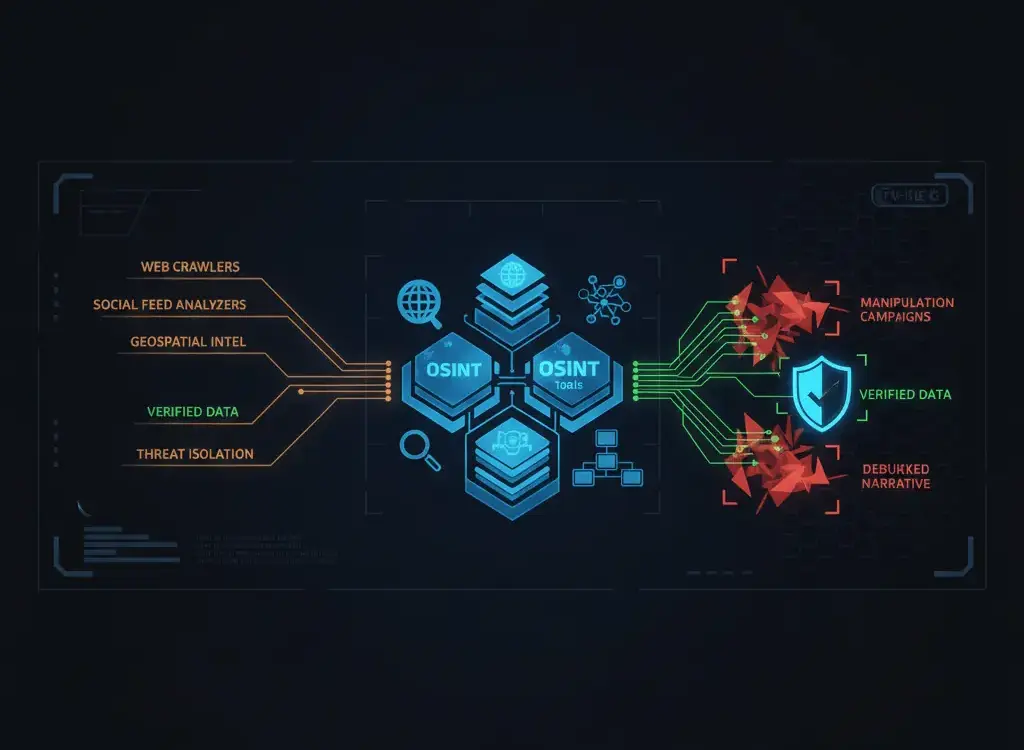
SITUATION ASSESSMENT: The Information Integrity Crisis
In October 2023, researchers at the Stanford Internet Observatory documented a sophisticated manipulation campaign targeting European audiences through coordinated inauthentic behavior across 147 Facebook pages and 91 Instagram accounts. The operation, which pushed narratives favorable to Russian foreign policy objectives, demonstrated the evolution of information manipulation tactics from crude bot networks to sophisticated, human-operated influence operations that required advanced analytical capabilities to detect and attribute.
This incident underscores a critical intelligence gap: traditional cybersecurity tools are insufficient for investigating modern cognitive warfare operations. OSINT tools have emerged as the primary analytical framework for mapping, tracking, and attributing manipulation campaigns that operate across the cognitive domain.
THREAT VECTOR: The OSINT Investigation Imperative
Open-source evidence indicates that manipulation campaigns now operate as hybrid information-technical operations, combining technical infrastructure (domains, social media accounts, advertising spend) with psychological influence tactics designed to exploit cognitive biases. The RAND Corporation’s 2016 analysis of Russian information operations identified key characteristics that make these campaigns particularly suitable for OSINT investigation: high-volume messaging, multiple channels, rapid adaptation, and disregard for consistency.
Assessment: Modern manipulation campaigns leave extensive digital forensic trails that can be mapped and analyzed using specialized OSINT tools, but only when investigators understand both the technical and cognitive operational patterns.
The operational pattern suggests three primary investigation vectors: technical attribution (infrastructure analysis, account behavior), content analysis (narrative mapping, temporal patterns), and network analysis (coordination detection, amplification patterns). Each requires specific OSINT tools and methodologies developed by researchers like Thomas Rid (2020) and institutions including Bellingcat and the Digital Forensic Research Lab.
CASE STUDY: Documented OSINT Investigations
Operation Secondary Infektion
The most comprehensive demonstration of OSINT tools in manipulation campaign investigation comes from the Secondary Infektion research published by the Atlantic Council’s Digital Forensic Research Lab in 2019. Investigators used a combination of reverse image searches, domain registration analysis, and social network mapping to trace a seven-year Russian influence operation across 300+ platforms.
Key OSINT tools employed included:
- TinEye and Google Images for tracking visual content across platforms
- Whois databases and DomainTools for infrastructure attribution
- Gephi for network visualization and cluster analysis
- CrowdTangle for social media engagement pattern analysis
COVID-19 «Infodemic» Tracking
During 2020-2021, the Reuters Institute and Oxford Internet Institute deployed OSINT tools to investigate health misinformation campaigns. Their methodology, published in the Harvard Kennedy School Misinformation Review, demonstrated how tools like Hoaxy, Botometer, and custom Twitter API analysis could identify coordinated inauthentic behavior promoting false COVID-19 treatments.
This aligns with documented TTPs for computational propaganda identified by researchers at the Oxford Internet Institute, where authentic-appearing accounts amplify misleading health information during crisis periods to exploit heightened cognitive vulnerability.
DETECTION PROTOCOL: Technical and Behavioral Indicators
A critical indicator of manipulation campaigns is the convergence of technical anomalies with behavioral patterns that suggest coordination rather than organic engagement. Open-source evidence indicates several key detection signatures:
Technical Indicators
- Domain clustering: New domains registered in batches with privacy protection services
- IP geolocation inconsistencies: Account activities originating from locations inconsistent with claimed identities
- Temporal synchronization: Mass account creation or content publication within narrow time windows
- Infrastructure recycling: Shared hosting, email providers, or payment processors across seemingly unrelated campaigns
Behavioral Signatures
- Narrative convergence: Identical or near-identical messaging across multiple accounts or platforms
- Engagement anomalies: High-engagement content with low-quality metrics (comments, shares disproportionate to likes)
- Amplification patterns: Rapid, coordinated amplification of specific content within minutes of publication
- Profile inconsistencies: Account metadata, posting patterns, or language use inconsistent with claimed demographics
DEFENSE FRAMEWORK: Multi-Level OSINT Countermeasures
Individual Level: Cognitive Verification Protocols
- Source verification: Use Whois databases and archive.org to verify website legitimacy and history
- Reverse image searching: Check visual content through TinEye, Google Images, and Yandex Images
- Cross-platform verification: Confirm information across multiple independent sources using Google Alerts and social media monitoring
- Metadata analysis: Examine image EXIF data and document properties using tools like Jeffrey’s Image Metadata Viewer
Organizational Level: Institutional OSINT Capabilities
- Establish monitoring protocols: Deploy tools like Mention, Brand24, or custom API monitoring for brand/topic surveillance
- Train personnel: Develop internal capability using OSINT frameworks from organizations like the SANS Institute
- Create response procedures: Establish escalation protocols for suspected manipulation targeting organizational interests
- Build analytical infrastructure: Invest in tools like Maltego, i2 Analyst’s Notebook, or open-source alternatives like OSINT Framework
Systemic Level: Platform and Policy Integration
The operational pattern suggests that effective defense requires coordination between platform transparency initiatives, academic research, and government oversight mechanisms.
Critical systemic measures include enhanced platform APIs for researchers, mandatory transparency reports on influence operations, and international cooperation frameworks like the EU’s East StratCom Task Force. The Bellingcat methodology demonstrates how citizen journalists and professional investigators can collaborate when platforms provide appropriate data access.
ASSESSMENT: Strategic Intelligence Summary
Key Takeaways
- OSINT tools have become the primary investigative framework for manipulation campaigns, requiring both technical and cognitive analytical capabilities
- Modern influence operations leave extensive digital forensic trails that can be systematically investigated using established OSINT methodologies
- Detection requires understanding both technical infrastructure patterns and behavioral coordination indicators
- Effective defense operates across individual verification habits, organizational monitoring capabilities, and systemic transparency mechanisms
- The investigative methodology pioneered by organizations like Bellingcat and DFRLab provides scalable frameworks for detecting and attributing information manipulation
Forward Assessment
The cognitive domain will continue to be contested space, with manipulation tactics evolving in response to improved detection capabilities. However, the fundamental principle remains constant: systematic application of OSINT tools and methodologies provides the analytical foundation for maintaining information integrity in an adversarial information environment.
The strategic advantage lies not in perfect detection, but in raising the operational costs for manipulation campaigns while building institutional resilience through improved analytical capabilities and public understanding of information warfare tactics.