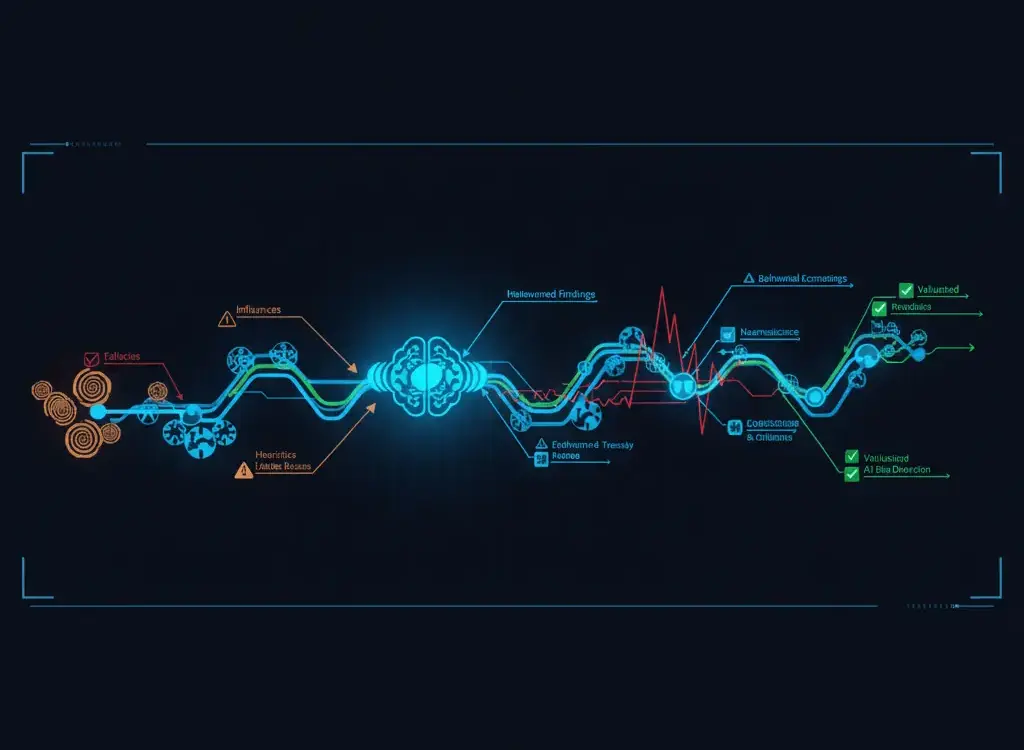
The history of the study of cognitive biases extends far beyond academic psychology—it has become a cornerstone of modern information operations and cognitive warfare doctrine. When the NATO Strategic Communications Centre of Excellence published its 2017 handbook on cognitive security, it drew extensively on decades of bias research that began with Daniel Kahneman and Amos Tversky’s prospect theory in the 1970s. What concerns me here is how this foundational psychological research has been systematically weaponized by both state and corporate actors, transforming insights about human cognitive limitations into operational tools for influence campaigns.
The trajectory from laboratory experiments on decision-making errors to operational frameworks for narrative manipulation represents one of the most significant intellectual migrations in modern security studies. Available evidence suggests that understanding this evolution is essential for security professionals attempting to counter contemporary information operations, as adversaries increasingly exploit well-documented cognitive vulnerabilities with precision targeting.
This analysis traces how cognitive bias research evolved from experimental psychology into a strategic asset, examining key institutional developments, operational applications, and the frameworks that now guide both defensive and offensive information operations across NATO and Five Eyes contexts.
Foundational research and early military adoption patterns
Kahneman-Tversky legacy in operational psychology
The systematic study of cognitive biases emerged from Daniel Kahneman and Amos Tversky’s work on prospect theory and heuristics in the 1970s. Their research on availability heuristic, anchoring bias, and loss aversion provided the first rigorous framework for understanding predictable deviations from rational decision-making. The Defense Advanced Research Projects Agency (DARPA) recognized the operational implications early, funding behavioral economics research through the 1980s that would later inform military deception doctrine.
Kahneman’s 2002 Nobel Prize in Economics legitimized cognitive bias research within policy circles, but the operational applications had already begun. According to RAND Corporation reports from the late 1990s, U.S. military planners were incorporating bias-based influence techniques into information operations planning, particularly exploiting confirmation bias and in-group favoritism in targeted populations.
Institutionalization within defense establishments
The formal integration of cognitive bias research into Western defense doctrine accelerated after 2001. The U.S. Army’s Training and Doctrine Command (TRADOC) established behavioral analysis units that drew directly on Kahneman’s framework, while the UK’s Defence Science and Technology Laboratory began systematic studies of cognitive vulnerabilities in decision-making under stress.
By 2010, NATO’s Allied Command Transformation had incorporated bias awareness into its strategic communication guidelines, recognizing that adversaries were already exploiting cognitive shortcuts in target populations. The institutionalization process transformed academic insights into operational doctrine, creating standardized approaches to both exploiting and defending against cognitive vulnerabilities.
Corporate research acceleration and dual-use implications
Silicon Valley’s adoption of cognitive bias research created a parallel track of development outside traditional defense channels. Companies like Google, Facebook, and Cambridge Analytica invested heavily in behavioral psychology research, developing micro-targeting capabilities that exploited the same cognitive vulnerabilities identified in academic literature.
This corporate research created significant dual-use concerns, as techniques developed for advertising optimization proved readily adaptable to political influence operations. The 2016 U.S. election interference campaigns demonstrated how commercial insights about cognitive biases could be weaponized at scale, forcing a reconsideration of the relationship between academic research, corporate application, and national security.
How did cognitive warfare doctrine incorporate bias research?
Integration into information operations frameworks
The formal incorporation of cognitive bias research into warfare doctrine represents a fundamental shift in how military planners conceptualize influence operations. NATO’s 2021 Cognitive Warfare exploratory concept explicitly references availability heuristic and confirmation bias as exploitable vulnerabilities in target decision-making processes.
U.S. Army Field Manual 3-13.4 on Army Support to Military Deception incorporates bias-based techniques throughout its planning methodologies. The manual specifically addresses how anchoring bias can be exploited through initial information exposure, and how loss aversion can amplify the impact of threat-based messaging. These applications demonstrate the direct translation of laboratory findings into operational practice.
Russian and Chinese adaptations of Western research
Russian information operations doctrine shows clear influence from Western cognitive bias research, adapted through their own institutional frameworks. The Internet Research Agency’s social media campaigns systematically exploited confirmation bias and social proof mechanisms identified in American behavioral research, suggesting direct incorporation of published findings.
Chinese cognitive warfare approaches, as documented in PLA strategic communications doctrine, similarly draw on Western bias research while developing indigenous theoretical frameworks. Their concept of zhengduo huayu quan (争夺话语权, competing for discourse power) incorporates insights about cognitive shortcuts and emotional reasoning derived from decades of Western psychological research.
Defensive applications and cognitive security frameworks
The defensive applications of bias research have lagged behind offensive implementations, but recent developments show increasing sophistication. The European Union’s Rapid Alert System incorporates bias awareness into disinformation detection protocols, training analysts to recognize when cognitive vulnerabilities are being systematically exploited.
Finland’s hybrid threat preparedness programs explicitly train citizens to recognize cognitive bias exploitation, representing one of the most comprehensive attempts to operationalize defensive applications of bias research. These programs demonstrate how academic insights can be translated into practical resilience-building measures at population scale.
Contemporary applications in hybrid warfare environments
Social media exploitation of cognitive shortcuts
Contemporary influence operations exploit cognitive biases through sophisticated social media targeting that would have been impossible without decades of foundational research. The Russian Internet Research Agency’s Facebook operations systematically exploited availability heuristic by flooding target audiences with emotionally charged content that became easily retrievable from memory.
The use of algorithmic amplification to exploit confirmation bias represents a significant evolution from traditional propaganda techniques. By leveraging users’ existing beliefs and feeding them increasingly extreme content that confirms their worldview, influence operators can achieve behavioral change without the target audience recognizing external manipulation.
Micro-targeting and personalized cognitive exploitation
The convergence of big data analytics with cognitive bias research has enabled unprecedented precision in influence operations. Cambridge Analytica’s targeting models, while controversial, demonstrated how personality profiling combined with bias exploitation could achieve measurable behavioral outcomes in political contexts.
Current Chinese and Russian operations show similar sophistication in exploiting individual cognitive patterns. Intelligence assessments suggest that state actors are developing psychological profiles of key decision-makers and tailoring influence attempts to exploit specific cognitive vulnerabilities, moving beyond mass influence toward precision targeting of high-value individuals.
Deepfakes and the manipulation of visual processing biases
The emergence of deepfake technology represents a new frontier in exploiting cognitive biases, particularly the tendency to trust visual evidence over other information sources. Early deepfake influence operations have exploited the availability heuristic by creating vivid, memorable false experiences that become more believable through repetition.
Defense establishments across NATO are developing detection capabilities, but the underlying challenge remains cognitive: humans are poorly equipped to distinguish authentic from synthetic media without technological assistance. This vulnerability represents a fundamental shift in how cognitive bias research intersects with emerging technologies in information warfare.
Indicators of systematic cognitive bias exploitation in information operations
Operational signatures and detection frameworks
Systematic cognitive bias exploitation in influence operations displays characteristic patterns that can be identified through behavioral analysis. The NATO Strategic Communications Centre of Excellence has developed detection frameworks based on these indicators:
- Emotional amplitude escalation: Content designed to exploit availability heuristic through increasingly extreme emotional triggers
- Confirmation feedback loops: Algorithmic systems that reinforce existing beliefs while gradually introducing new narrative elements
- Social proof manipulation: Artificial amplification of content to exploit bandwagon effects and perceived popularity
- Authority figure impersonation: False expertise claims designed to exploit deference to authority cognitive shortcuts
- Loss aversion messaging: Threat-based framing that exploits the tendency to overweight potential losses versus gains
Measurement and assessment methodologies
Intelligence analysts use several metrics to assess the scale and sophistication of cognitive bias exploitation in detected influence campaigns. The U.S. Cybersecurity and Infrastructure Security Agency’s election security protocols include behavioral indicators derived directly from cognitive bias research:
- Content velocity analysis: Measuring the speed at which emotionally charged content spreads to identify artificial amplification
- Cognitive load assessment: Evaluating whether target audiences are being overwhelmed with conflicting information to exploit cognitive shortcuts
- Narrative coherence tracking: Identifying when multiple information sources begin reinforcing identical talking points to exploit confirmation bias
- Emotional gradient measurement: Assessing whether content is designed to progressively escalate emotional responses over time
Institutional vulnerability assessments
Organizations can assess their vulnerability to cognitive bias exploitation through structured evaluation of decision-making processes and information consumption patterns. The UK’s National Cyber Security Centre has developed assessment frameworks that identify institutional blind spots where cognitive biases create security vulnerabilities.
These assessments examine whether organizations have adequate diversity of information sources, whether decision-making processes incorporate bias awareness training, and whether leadership teams recognize their own cognitive limitations. The framework represents a practical application of decades of bias research to institutional security practices.
Forward assessment: implications for cognitive security
The evolution of cognitive bias research from academic psychology to operational doctrine represents an irreversible shift in how information warfare is conducted. As artificial intelligence and machine learning capabilities advance, the precision and scale of bias exploitation will continue to increase, requiring more sophisticated defensive measures.
The institutional challenge facing Western democracies is developing cognitive security capabilities that protect against bias exploitation without restricting legitimate information flows. This balance requires continued collaboration between academic researchers, technology companies, and security institutions to stay ahead of adversary innovation cycles.
In my assessment, the next phase of this evolution will involve real-time bias exploitation through AI-powered influence systems that adapt their approaches based on individual psychological profiles and behavioral responses, making traditional defensive measures increasingly insufficient.
Sources
Kahneman, D. (2011). Thinking, Fast and Slow. Farrar, Straus and Giroux.
NATO Strategic Communications Centre of Excellence. (2021). Cognitive Warfare: An Attack on Truth and Thought. NATO StratCom COE.
RAND Corporation. (2019). The Russian ‘Firehose of Falsehood’ Propaganda Model. RAND Corporation.
Tversky, A., & Kahneman, D. (1974). Judgment under Uncertainty: Heuristics and Biases. Science, 185(4157), 1124-1131.
U.S. Army. (2019). Field Manual 3-13.4: Army Support to Military Deception. Department of the Army.
UK National Cyber Security Centre. (2020). Cognitive Security: Misinformation and Influence Operations. NCSC.