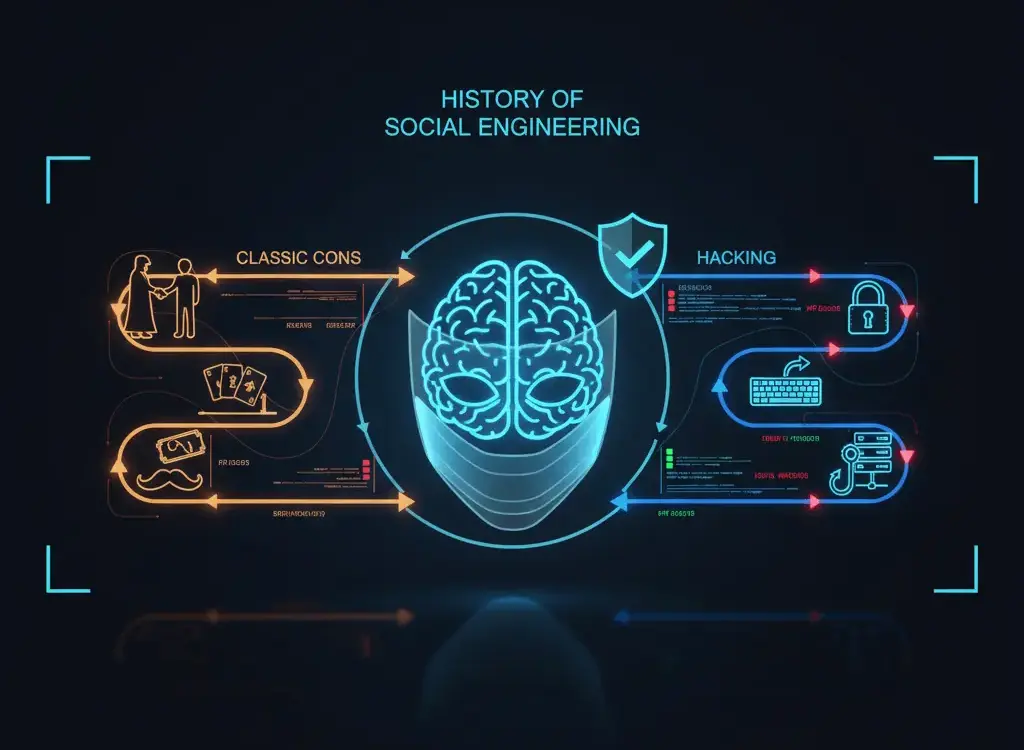
SITUATION ASSESSMENT: The Great Modern Con
In March 2020, researchers at Carnegie Mellon University documented a striking convergence: the same psychological principles that enabled Depression-era con artists to bilk victims out of their life savings were being weaponized at scale through digital platforms. Their analysis of COVID-19 disinformation campaigns revealed that history of social engineering techniques, refined over centuries of human manipulation, had evolved into sophisticated cognitive warfare operations capable of reaching millions simultaneously.
Open-source evidence indicates that what began as individual grifters exploiting trust and authority has transformed into a systematic discipline spanning cybercriminal syndicates, state-sponsored influence operations, and corporate manipulation campaigns. The operational pattern suggests we’re witnessing the industrialization of deception—a threat vector that requires urgent analysis and defensive preparation.
THREAT VECTOR: Evolution of Social Engineering Doctrine
Social engineering represents the systematic exploitation of human psychology to bypass technical and procedural security measures. The term itself was coined by sociologist Daniel Bell in the 1960s, but the underlying tactics trace back millennia. Assessment: Modern social engineering operates on Cialdini’s six principles of influence—reciprocity, commitment, social proof, authority, liking, and scarcity—weaponized through technological force multipliers.
Classical Foundations
Historical records document sophisticated confidence schemes as early as ancient Greece. The «Spanish Prisoner» scam—promising victims a share of hidden treasure in exchange for advance fees—appeared in 16th-century Europe and remains operationally viable today as the «Nigerian Prince» email. This tactical longevity indicates fundamental psychological vulnerabilities that transcend technological change.
The Pinkerton Detective Agency’s 1886 manual «Thirty Years a Detective» catalogued social engineering techniques that remain relevant to modern cybersecurity professionals: establishing false trust relationships, exploiting reciprocity obligations, and leveraging authority figures to bypass critical thinking.
Technological Force Multiplication
The digital revolution transformed social engineering from artisanal craft to industrial operation. Kevin Mitnick’s documented infiltration techniques in the 1980s-90s demonstrated how traditional con artistry could compromise sophisticated technical systems. His approach—combining phone-based pretexting with technical reconnaissance—established the modern social engineering methodology still taught in cybersecurity programs today.
The emergence of social media platforms created unprecedented attack surfaces. Researchers at the Stanford Internet Observatory have documented how platforms designed to facilitate human connection became optimized for psychological manipulation, enabling threat actors to deploy classic social engineering at unprecedented scale and precision.
CASE STUDY: Operation Ghost Stories to Cambridge Analytica
Deep Cover Social Engineering: Operation Ghost Stories
The FBI’s 2010 exposure of the «Illegals Program»—Russian deep-cover agents operating under false identities for decades—revealed social engineering as a cornerstone of modern espionage doctrine. Anna Chapman and her co-conspirators spent years building authentic social relationships, professional networks, and community standing to access sensitive information through human sources rather than technical intrusion.
This aligns with documented TTPs for state-sponsored social engineering: establishing legitimate social presence, cultivating long-term trust relationships, and leveraging personal connections to bypass institutional security measures. The operation’s decade-long timeline demonstrates the strategic patience required for sophisticated social engineering campaigns.
Industrial-Scale Psychological Manipulation
The Cambridge Analytica scandal, exposed through Bellingcat-style investigative reporting in 2018, revealed how classical social engineering principles had been systematized for political influence operations. The company’s «psychographic profiling» methodology combined traditional personality assessment with digital behavioral analysis to craft individualized manipulation campaigns.
Christopher Wylie’s testimony to the UK Parliament revealed that Cambridge Analytica’s approach was «military-grade information warfare» applied to civilian populations—using social engineering techniques developed for intelligence operations in commercial political contexts.
The operational pattern suggests a critical evolution: social engineering had transformed from individual criminal activity to systematic psychological warfare capable of influencing democratic processes at national scale.
DETECTION PROTOCOL: Behavioral Signatures and Technical Markers
A critical indicator of social engineering attacks is the artificial acceleration of normal human decision-making processes. Intelligence analysts have identified consistent behavioral signatures across both classical cons and modern digital operations:
- Artificial urgency creation—Manufactured time pressure to bypass critical thinking («limited time offer,» «account will be closed,» «urgent security update required»)
- Authority figure impersonation—False claims of official status, technical expertise, or institutional affiliation to trigger compliance responses
- Emotional state manipulation—Deliberate triggering of fear, excitement, guilt, or curiosity to override rational analysis
- Information asymmetry exploitation—Claiming access to exclusive or insider information that victims cannot independently verify
- Trust relationship acceleration—Unnaturally rapid progression from initial contact to requests for sensitive information or actions
- Verification resistance—Discouraging independent fact-checking or consultation with trusted advisors
Digital-Specific Indicators
Technical analysis reveals additional markers specific to digital social engineering campaigns:
- Profile authenticity gaps—Inconsistent biographical details, limited historical posts, or artificially generated profile photos
- Network analysis anomalies—Coordinated account creation dates, shared linguistic patterns, or synchronized posting behaviors
- Cross-platform coordination—Simultaneous messaging across multiple channels to create false consensus or social proof
DEFENSE FRAMEWORK: Multi-Layer Countermeasures
Effective defense against social engineering requires coordinated responses across individual, organizational, and systemic levels. Assessment: No single countermeasure provides adequate protection—layered defensive strategies based on verified research findings offer the most robust approach.
Individual Cognitive Hygiene
- Implement verification protocols—Establish personal procedures for confirming identities and claims through independent channels before taking requested actions
- Practice emotional regulation techniques—Develop habits for recognizing manipulated emotional states and creating decision-making delays
- Maintain information hygiene—Limit public sharing of personal details that could be used for social engineering reconnaissance
- Cultivate healthy skepticism—Question unsolicited contacts, verify «too good to be true» opportunities, and seek second opinions on significant requests
Organizational Security Protocols
The SANS Institute’s research indicates that organizations with formal social engineering defense programs reduce successful attacks by 60-80%. Critical elements include:
- Regular awareness training—Simulated social engineering exercises to build recognition capabilities
- Verification procedures—Multi-channel confirmation requirements for sensitive requests
- Incident reporting systems—Clear protocols for employees to report suspected social engineering attempts without penalty
- Technical controls—Email filtering, caller ID verification, and access controls to limit attack surface
Systemic Defense Measures
The European Union’s Digital Services Act represents a systemic approach to social engineering defense, requiring platforms to implement transparency measures and rapid response capabilities for coordinated inauthentic behavior.
Platform-level defenses include automated detection of coordinated inauthentic behavior, identity verification systems, and user education initiatives. Regulatory frameworks like the EU’s approach create accountability structures for platforms to maintain defensive capabilities.
ASSESSMENT: Key Intelligence Takeaways
Analysis of the complete history of social engineering reveals consistent operational patterns and defensive requirements:
- Psychological exploitation techniques remain constant across technological changes—Classical influence principles identified by researchers like Cialdini continue to form the foundation of modern social engineering
- Scale and precision have increased exponentially through digital platforms—What once required individual artistry can now be automated and deployed at population scale
- State and non-state actors have weaponized social engineering for strategic objectives—From espionage operations to election interference, social engineering has become a cornerstone of modern information warfare
- Detection requires technical and behavioral analysis capabilities—Effective defense combines human judgment with automated detection systems
- Multi-layered defense strategies provide the most robust protection—Individual awareness, organizational protocols, and systemic safeguards must operate in coordination
Forward assessment: The convergence of artificial intelligence capabilities with traditional social engineering techniques represents the next evolutionary phase. Deep fake technology, AI-generated personas, and algorithmic targeting systems will likely enhance the precision and scale of social engineering operations while making detection more challenging.
The strategic imperative is clear: understanding the complete historical arc of social engineering—from ancient confidence schemes to modern digital manipulation—provides the analytical foundation necessary for building effective cognitive resilience in an increasingly complex threat environment.
REFERENCES
- Bell, Daniel (1973). The Coming of Post-Industrial Society. Basic Books.
- Cialdini, Robert (2006). Influence: The Psychology of Persuasion. Harper Business.
- DiResta, Renee et al. (2018). «The Tactics & Tropes of the Internet Research Agency.» Stanford Internet Observatory.
- Hadnagy, Christopher (2018). Social Engineering: The Science of Human Hacking. Wiley.
- Mitnick, Kevin (2002). The Art of Deception. Wiley.
- SANS Institute (2021). «Social Engineering Survey Results.» SANS Security Awareness Report.