SITUATION ASSESSMENT
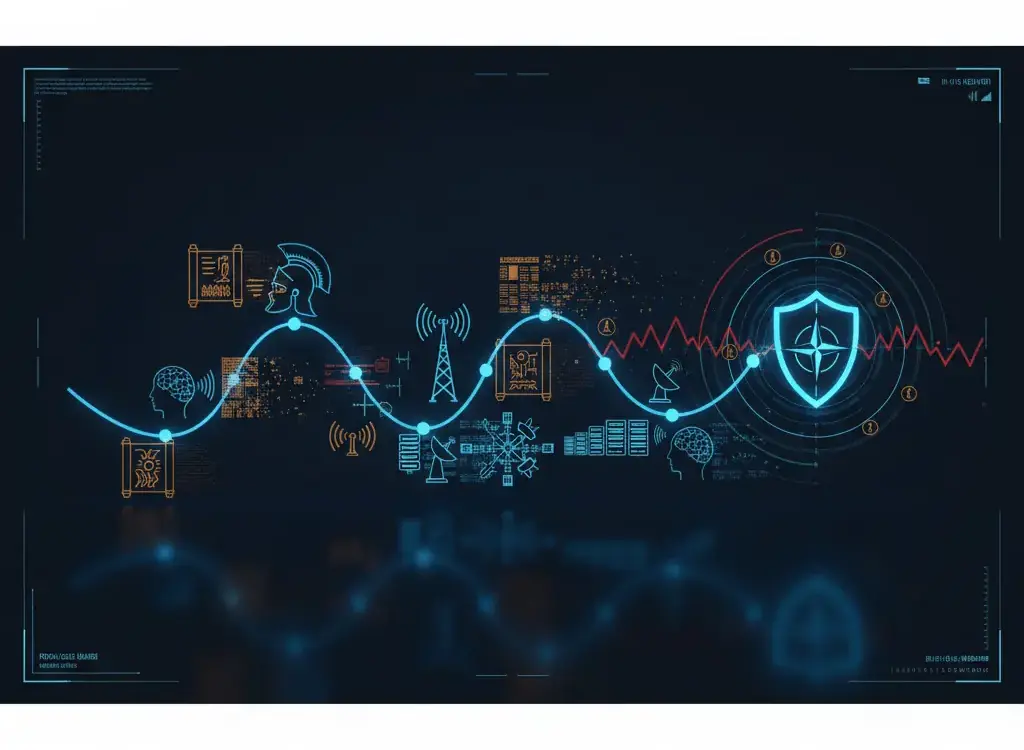
In March 2022, researchers at the Stanford Internet Observatory documented a coordinated inauthentic behavior network that deployed Ancient Chinese military philosophy alongside modern algorithmic amplification to influence Western audiences regarding the Ukraine conflict. The operation, designated «Spamouflage Dragon» by Meta’s security team, demonstrated how the history of psychological warfare creates a continuous thread from classical strategic deception to contemporary cognitive warfare campaigns.
Open-source evidence indicates this network leveraged principles first codified by Sun Tzu in «The Art of War» circa 500 BCE—specifically the concept that «all warfare is based on deception»—while executing through TikTok algorithms and Facebook’s engagement mechanisms. This convergence illustrates how psychological warfare has evolved from battlefield tactics to societal-scale influence operations targeting democratic institutions.
THREAT VECTOR: Evolution of Psychological Warfare Doctrine
The operational pattern suggests psychological warfare represents humanity’s longest-running arms race in information dominance. Sun Tzu’s strategic deception principles established foundational concepts that NATO’s 2021 cognitive warfare framework now categorizes as «attacks against the human domain» designed to «change not only what people think, but how they think and act.»
Classical psychological warfare focused on morale degradation and command disruption in kinetic conflicts. Roman legions used coordinated horn calls to simulate larger forces, while Byzantine emperors deployed «Greek fire» partially for its psychological terror effect. The Mongol Empire systematically cultivated a reputation for brutality to encourage enemy surrenders without siege warfare.
Assessment: Modern cognitive warfare operations demonstrate tactical continuity with historical psychological operations while exploiting digital-age vulnerabilities in information processing and social cohesion.
The industrial age introduced mass communication vectors. Nazi Germany’s propaganda apparatus, analyzed extensively by the RAND Corporation’s 2016 report «The Russian ‘Firehose of Falsehood’ Propaganda Model,» established templates for volume-based disinformation that contemporary state actors have digitized and scaled. The BBC’s wartime broadcasts and the Voice of America represented democratic counter-operations employing similar mass-reach methodologies.
The Cold War period witnessed institutionalized psychological warfare through organizations like the CIA’s Congress for Cultural Freedom and the Soviet Union’s active measures campaigns. Former KGB officer Yuri Bezmenov’s documented techniques from the 1970s—ideological subversion, demoralization, destabilization, and crisis—align directly with contemporary Russian information operations assessed by the EU DisinfoLab and Atlantic Council’s Digital Forensic Research Lab.
Modern Cognitive Warfare Framework
NATO’s cognitive warfare doctrine identifies five operational domains: physical, informational, cognitive, social, and cyber. This framework recognizes that contemporary psychological warfare targets not individual psychology but collective cognitive processes through algorithmic manipulation and social network exploitation.
Research by Cialdini (2006) and Kahneman (2011) on cognitive biases and influence principles provides the scientific foundation modern adversaries exploit. The dual-process theory of human cognition—System 1 (fast, intuitive) versus System 2 (slow, deliberate)—explains why high-velocity disinformation campaigns can bypass critical thinking defenses.
CASE STUDY: Russian Information Operations Evolution
The 2016 U.S. election interference campaign, documented by the Mueller investigation and Senate Intelligence Committee, demonstrates psychological warfare modernization. The Internet Research Agency operated 470 Facebook accounts reaching 126 million users while deploying classical influence techniques through digital platforms.
Open-source analysis by Bellingcat and the Oxford Internet Institute revealed the operation’s psychological warfare components:
- Audience segmentation using Facebook’s advertising tools to target specific demographic and psychographic profiles
- Emotional amplification of existing social divisions, particularly around race and immigration
- Authority impersonation through fake accounts posing as legitimate news sources and activist groups
- Social proof manipulation via coordinated likes, shares, and comments to simulate grassroots support
This aligns with documented TTPs for Soviet-era active measures while exploiting platform-specific vulnerabilities. The operation’s effectiveness derived from combining traditional psychological warfare principles with algorithmic amplification.
Chinese Cognitive Operations: Spamouflage Evolution
Stanford Internet Observatory research identified the «Spamouflage» network as China’s primary cross-platform influence operation. Unlike Russian operations focused on divisive content, Chinese psychological warfare emphasizes narrative replacement—substituting alternative interpretations of events rather than creating controversy.
The network demonstrates Sun Tzu’s influence in its operational approach: «Supreme excellence consists of breaking the enemy’s resistance without fighting.» Chinese operations avoid direct confrontation, instead gradually shifting information environments to favor Chinese policy positions on Hong Kong, Xinjiang, and Taiwan.
A critical indicator is the operation’s focus on long-term narrative environment modification rather than immediate behavioral influence, reflecting classical Chinese strategic patience principles.
DETECTION PROTOCOL: Identifying Psychological Warfare Indicators
Intelligence analysis reveals consistent behavioral signatures across historical and contemporary psychological warfare operations:
- Volume asymmetry: Sudden increases in content volume around specific topics or events
- Emotional consistency: Messages designed to trigger identical emotional responses across different audience segments
- Authority mimicry: Accounts or sources impersonating legitimate institutions or experts
- Timing coordination: Synchronized posting patterns suggesting centralized campaign management
- Narrative convergence: Multiple ostensibly independent sources promoting identical talking points
- Platform hopping: Content appearing simultaneously across multiple social media platforms
- Engagement manipulation: Artificial amplification through coordinated likes, shares, and comments
Technical indicators include metadata anomalies, linguistic patterns suggesting machine translation or template usage, and network analysis signatures revealing coordinated inauthentic behavior.
DEFENSE FRAMEWORK: Multi-Layer Cognitive Protection
Evidence-based defensive countermeasures operate across three operational levels:
Individual Cognitive Hygiene
- Source diversification: Consuming information from multiple, ideologically diverse outlets
- Emotional awareness: Recognizing when content triggers strong emotional responses before sharing
- Verification protocols: Cross-checking claims through primary sources and fact-checking organizations
- Pause-and-reflect procedures: Implementing deliberate delays between consuming and sharing information
Organizational Defense Protocols
Institutional countermeasures based on NATO’s cognitive security framework include:
- Media literacy training incorporating psychological warfare awareness
- Information verification procedures for public communications
- Crisis communication protocols designed to counter disinformation campaigns
- Social media monitoring systems to detect coordinated inauthentic behavior
Systemic Policy Response
Research by the Atlantic Council and EU DisinfoLab supports platform-level interventions:
- Algorithmic transparency requirements for content amplification systems
- Account verification standards for high-reach accounts
- International cooperation frameworks for cross-border disinformation response
- Public-private intelligence sharing mechanisms for threat detection
Assessment: Effective defense requires understanding psychological warfare as a continuous historical phenomenon rather than a novel digital-age threat.
KEY TAKEAWAYS
- Historical continuity: Modern cognitive warfare operations demonstrate direct tactical lineage from classical psychological warfare principles established by Sun Tzu and refined through centuries of conflict
- Technical evolution: Digital platforms provide unprecedented scale and precision for psychological influence operations while maintaining foundational deception and manipulation techniques
- Democratic vulnerability: Open information environments create inherent susceptibility to psychological warfare campaigns targeting cognitive processes and social cohesion
- Defense imperative: Effective countermeasures require multi-layer approaches combining individual awareness, institutional protocols, and systemic policy responses
- Ongoing threat: The history of psychological warfare suggests continuous adaptation and escalation, requiring sustained defensive innovation and international cooperation
Forward assessment: As artificial intelligence capabilities mature, psychological warfare operations will likely achieve greater sophistication in audience targeting and content personalization. Understanding historical precedents provides essential context for anticipating and countering evolving cognitive threats to democratic institutions and social stability.
REFERENCES
- Atlantic Council Digital Forensic Research Lab (2020). «The Long Fuse: Misinformation and the 2020 Election«
- Bellingcat Investigation Team (2021). «The GRU’s MH17 Disinformation Operations«
- Cialdini, Robert (2006). «Influence: The Psychology of Persuasion«
- EU DisinfoLab (2022). «Annual Report on Foreign Information Manipulation and Interference«
- Kahneman, Daniel (2011). «Thinking, Fast and Slow«
- NATO Strategic Communications Centre of Excellence (2021). «Cognitive Warfare«
- RAND Corporation (2016). «The Russian ‘Firehose of Falsehood’ Propaganda Model«
- Stanford Internet Observatory (2022). «Spamouflage Network Analysis»