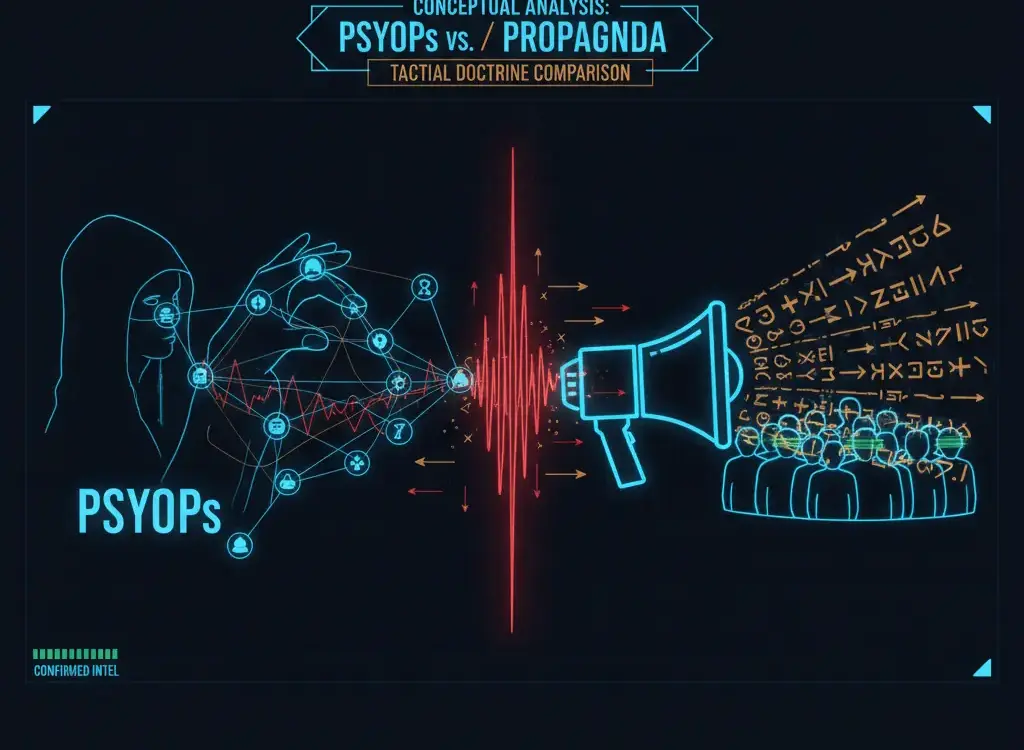
In December 2023, Meta’s Threat Intelligence team disclosed the takedown of a network of coordinated inauthentic behavior targeting Ukrainian refugees across Europe. The operation combined traditional propaganda narratives with sophisticated psychological targeting—demographic segmentation, emotional manipulation, and behavioral conditioning techniques that extended far beyond simple message amplification. This case illustrates a critical analytical challenge facing Western security institutions: the operational distinction between psyops vs propaganda has become increasingly blurred in contemporary cognitive warfare, yet maintaining this distinction remains essential for developing effective countermeasures and policy responses.
The conflation of psychological operations and propaganda in both academic literature and policy discourse obscures fundamental differences in methodology, targeting, and strategic intent. While both constitute forms of cognitive influence, their operational frameworks, institutional deployment, and defensive requirements differ substantially. This analysis examines the doctrinal boundaries between psyops and propaganda, assesses how adversary actors exploit these distinctions, and proposes a framework for classification that supports both operational planning and strategic assessment.
Doctrinal foundations: Military psyops versus information influence
U.S. military doctrine defines psychological operations through Joint Publication 3-13.2 as «planned operations to convey selected information and indicators to audiences to influence their emotions, motives, and objective reasoning.» This definition emphasizes behavioral modification as the primary objective, distinguishing psyops from broader information operations that may seek awareness, understanding, or attitude change without necessarily targeting specific behaviors.
Institutional frameworks and command structures
Military psychological operations operate within established command hierarchies, typically under Special Operations Command (SOCOM) or theater-specific psychological operations groups. The 4th Military Information Support Group (Airborne) exemplifies this institutional approach—targeting specific populations with measurable behavioral objectives, operating under strict rules of engagement, and maintaining clear chains of accountability.
Propaganda, by contrast, emerges from diverse institutional sources: state media organs, political parties, advocacy groups, and increasingly, commercial platforms with algorithmic amplification capabilities. The Russian International Affairs Council and RT network represent state-directed propaganda infrastructures, while commercial entities like Cambridge Analytica demonstrated how private actors can conduct propaganda-adjacent operations using psychological targeting methodologies.
Targeting methodologies and audience segmentation
Psychological operations employ systematic audience analysis derived from military intelligence collection and behavioral assessment protocols. The NATO Strategic Communications Centre of Excellence has documented how adversary psyops campaigns utilize detailed demographic profiling, psychological trait mapping, and behavioral prediction models to achieve specific population responses.
Traditional propaganda relies more heavily on broad demographic categories and ideological alignment. The Internet Research Agency’s documented operations against U.S. electoral processes demonstrate this distinction: while the organization employed sophisticated digital targeting tools, its fundamental approach remained propagandistic—seeking to amplify existing divisions rather than create new behavioral patterns through psychological conditioning.
What differentiates modern cognitive influence from traditional information warfare?
Contemporary cognitive warfare has introduced operational capabilities that transcend traditional psyops-propaganda categories, creating hybrid approaches that combine elements of both while introducing novel attack vectors.
Algorithmic amplification and behavioral conditioning
Platform-mediated influence operations leverage machine learning algorithms to create personalized influence pathways that adapt in real-time based on user responses. This capability represents a qualitative shift from both traditional propaganda broadcast models and conventional psyops targeting frameworks.
The documented case of computational propaganda during the 2016 Brexit referendum illustrates this evolution. Analysis by the Oxford Internet Institute revealed how vote-leave campaigns employed micro-targeting algorithms that combined propaganda messaging with psychological operations methodologies, creating individualized influence experiences that adapted based on user engagement patterns.
Cognitive exploitation versus narrative dominance
Modern adversary operations increasingly focus on cognitive exploitation—targeting psychological vulnerabilities and decision-making processes rather than simply promoting specific narratives. This approach draws from established psyops principles while operating through propaganda distribution channels.
Chinese influence operations in Taiwan exemplify this hybrid model. According to analysis by the Taiwan AI Labs Foundation, PRC-linked actors employ both traditional propaganda themes (historical legitimacy, economic integration) and psychological operations techniques (social proof manipulation, authority figure impersonation) within the same campaigns, making classification difficult using conventional frameworks.
Attribution challenges in hybrid operations
The operational merger of psyops and propaganda techniques creates significant attribution challenges for Western intelligence and security institutions. Traditional intelligence collection methods often struggle to differentiate between state-directed psychological operations and commercially-motivated propaganda that employs similar psychological targeting methods.
Adversary exploitation of conceptual ambiguity
State and non-state actors actively exploit the blurred boundaries between psyops and propaganda to complicate Western defensive responses and create operational advantages.
Plausible deniability through commercial platforms
Adversary actors increasingly conduct psychological operations through commercial advertising platforms, social media algorithms, and data broker networks that provide both operational capability and legal protection. This approach allows state actors to achieve psyops objectives while maintaining propaganda-level deniability.
The Wagner Group’s documented use of commercial influence platforms across African nations demonstrates this strategy. Operations utilized Facebook’s advertising algorithms and Google’s search optimization tools to conduct population conditioning campaigns that achieved military psychological operations objectives while operating under the legal framework governing commercial speech.
Legal and regulatory exploitation
The distinction between psyops and propaganda carries significant legal implications under both domestic law and international frameworks. The Smith-Mundt Act specifically prohibits U.S. government psychological operations targeting American citizens, but contains no equivalent restrictions on foreign government propaganda activities conducted through commercial channels.
Russian and Chinese state media operations exploit this regulatory gap by conducting psychological operations through entities classified as propaganda outlets. RT America’s documented targeting of specific demographic groups with behaviorally-designed content represents psychological operations conducted under First Amendment protections applicable to foreign propaganda entities.
Institutional response fragmentation
Different Western institutions apply inconsistent frameworks for classifying cognitive influence activities, creating operational gaps that adversary actors systematically exploit. Military commands focus on psyops frameworks emphasizing behavioral objectives, while intelligence agencies often apply broader information operations categories that obscure psychological targeting techniques.
How to assess cognitive influence operations: A classification framework
Effective defense against modern cognitive warfare requires analytical frameworks that account for operational complexity while maintaining practical utility for policy and operational decision-making.
Primary classification criteria
Classification should prioritize operational intent over institutional source or distribution method. The following criteria provide analytical clarity:
- Behavioral Specificity: Does the operation target specific, measurable behaviors or general attitude change?
- Psychological Methodology: Are individual psychological vulnerabilities systematically identified and exploited?
- Adaptive Targeting: Does the operation modify approach based on individual audience responses?
- Outcome Measurement: Are success metrics based on behavioral change or message reach?
Hybrid operation indicators
Many contemporary operations combine elements of both psychological operations and propaganda, requiring hybrid classification approaches:
| Indicator | Psyops Elements | Propaganda Elements |
|---|---|---|
| Audience Targeting | Individual psychological profiles | Demographic/ideological categories |
| Content Adaptation | Real-time behavioral response | A/B testing for engagement |
| Success Metrics | Specific behavioral outcomes | Reach, engagement, attitude surveys |
| Institutional Source | Military/intelligence command | Media/political organizations |
Operational assessment protocols
Intelligence and security professionals should apply systematic evaluation protocols that account for operational complexity:
- Source Analysis: Identify commanding authority, funding source, and operational chain of command
- Targeting Assessment: Evaluate audience segmentation methodology and individual versus mass targeting approaches
- Content Analysis: Assess psychological manipulation techniques versus narrative propagation methods
- Impact Measurement: Distinguish between measurable behavioral change and attitudinal indicators
- Attribution Confidence: Classify confidence levels for state versus non-state attribution
Strategic implications for Western defense institutions
The operational convergence of psyops and propaganda methodologies requires institutional adaptations across multiple domains—legal frameworks, defensive capabilities, and strategic planning processes.
Current NATO Strategic Communications frameworks lack sufficient granularity to address hybrid cognitive operations that combine state-level psychological targeting with commercial platform amplification. The Alliance’s Cognitive Warfare project, initiated in 2021, represents recognition of this challenge but has yet to produce operational guidance that addresses classification ambiguities.
Western institutions must develop integrated defensive approaches that account for both traditional psychological operations threats and propaganda-psyops hybrid campaigns. This requires coordination between military psychological operations commands, intelligence agencies, and civilian regulatory authorities—coordination that current institutional frameworks do not adequately support. The distinction between psyops and propaganda remains analytically essential, but operational reality demands frameworks sophisticated enough to address their systematic convergence in contemporary cognitive warfare.
Sources
Joint Chiefs of Staff. (2023). Joint Publication 3-13.2: Psychological Operations. U.S. Department of Defense.
Howard, P. N., & Bradshaw, S. (2019). The Global Disinformation Order: 2019 Global Inventory of Organised Social Media Manipulation. Oxford Internet Institute.
NATO Strategic Communications Centre of Excellence. (2022). Cognitive Warfare: An Attack on Truth and Thought. NATO StratCom COE.
Pomerantsev, P., & Weiss, M. (2014). The Menace of Unreality: How the Kremlin Weaponizes Information, Culture and Money. Institute of Modern Russia.