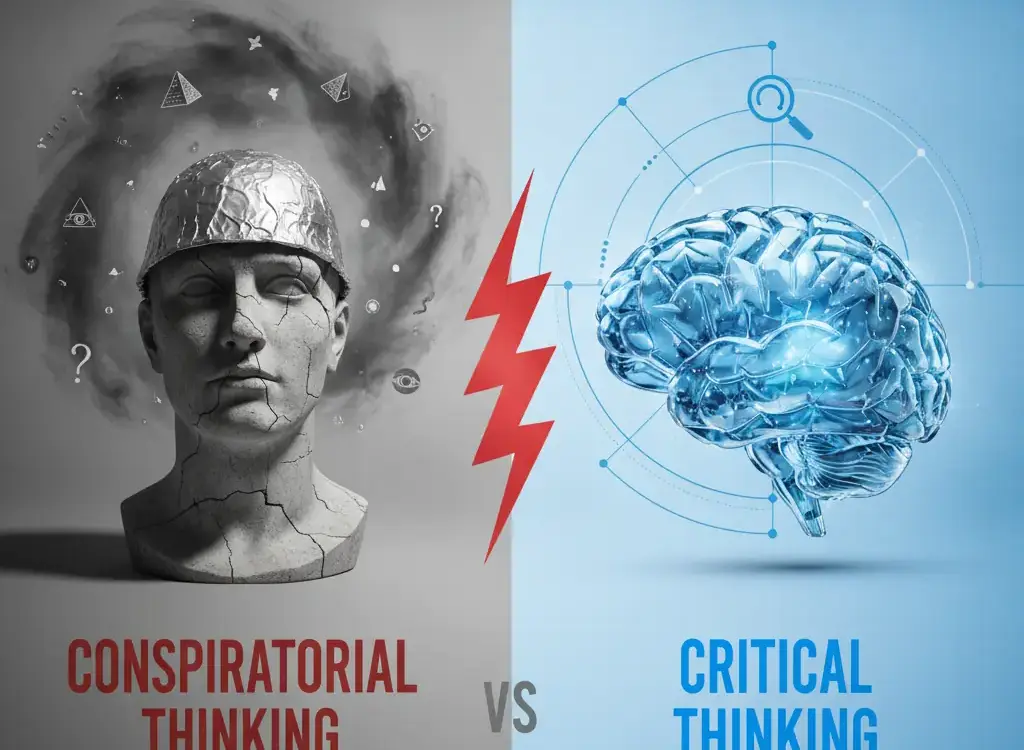
Conspiratorial vs critical thinking: why the difference matters more than ever
In 2020, the European External Action Service’s East StratCom Task Force documented a coordinated campaign in which state-aligned outlets amplified claims that Western governments had engineered the COVID-19 pandemic to accelerate digital surveillance. The content spread across dozens of languages, exploiting a single shared feature: it positioned itself as asking questions the mainstream won’t ask. That framing — skeptical, dissident, epistemically humble — is precisely what makes conspiratorial vs critical thinking so difficult to disentangle in practice. Both postures begin with doubt. Both resist official narratives. The difference lies in what they do with that doubt, and understanding that difference is not a philosophical luxury. For analysts, defense professionals, and policy researchers, it is an operational necessity. Conspiratorial thinking, when manufactured or amplified by state actors, functions as a cognitive weapon. Critical thinking, when systematically undermined, leaves populations epistemically defenseless. The challenge is structural, not merely intellectual.
What conspiracy theories actually do — and why that matters
Functional explanations over pathological ones
The academic literature has moved decisively away from treating conspiratorial belief as a symptom of individual pathology. Roland Imhoff and Pia Lamberty’s research on conspiracy mentality frames it instead as a stable cognitive style — a generalized tendency to suspect hidden, coordinated malevolence — that functions as a meaning-making tool under conditions of uncertainty. This matters because it shifts the analytical question. The question is no longer «who believes this nonsense» but «what structural conditions make this kind of explanation attractive, and to whom?»
Conspiracy theories, in this framing, perform specific social functions. They restore agency to people who feel structurally powerless. They offer coherence when official explanations seem incomplete or deliberately obscured. They create in-group solidarity. None of these functions require the theory to be true. They require only that the theory be emotionally and cognitively satisfying — which is a very different standard.
The proportionality problem
Critical thinking, by contrast, applies proportional skepticism: the degree of doubt applied to a claim scales with the available evidence, not with the identity of the claimant. This is precisely the distinction Cass Sunstein and Adrian Vermeule’s 2009 analysis of conspiracy theories tried to articulate, though their proposed response — «cognitive infiltration» of conspiratorial groups — was itself criticized as an overreach that confirmed conspiratorial suspicions about government intent.
Conspiratorial thinking tends to be disproportionate and unfalsifiable. Any evidence against the theory becomes evidence of how deep the cover-up goes. That epistemic closure — what C. Thi Nguyen describes in his 2020 analysis of «echo chambers» and «epistemic bubbles» as the systematic filtering of disconfirming evidence — is the definitional marker separating conspiratorial cognition from legitimate institutional skepticism.
Why legitimate grievances matter here
It would be analytically dishonest to ignore that some conspiratorial narratives attach themselves to genuine institutional failures. The Tuskegee syphilis study was real. COINTELPRO was real. The manufactured intelligence around Iraqi WMDs was real. These documented abuses create durable epistemic soil in which conspiratorial thinking grows long after the original event. Analysts who dismiss all conspiratorial belief without accounting for this history lose credibility — and the audience they most need to reach.
How does conspiratorial content spread — and who helps it?
Platform architecture as amplification infrastructure
You cannot understand the spread of conspiratorial thinking in 2024 without understanding platform recommendation systems. Recommendation algorithms optimized for engagement systematically favor emotionally activating content. Conspiratorial narratives — urgent, threatening, identity-affirming — reliably outperform measured analytical content on these metrics. This is not a bug that platforms have failed to fix. It is a structural feature of attention-economy business models, and several independent audits of YouTube and Facebook’s recommendation systems (including the Global Witness and Mozilla Foundation reports) have documented the radicalization pathways it creates.
Organic conspiracism versus manufactured disinformation
A critical distinction that often gets collapsed in policy discussions: not all conspiracy theories are state-sponsored, and not all disinformation takes conspiratorial form. Organic conspiracism emerges from communities processing shared anxieties without external direction. Manufactured conspiracism is deliberately seeded by state or non-state actors to achieve specific influence objectives. Peter Pomerantsev’s work on Russian information operations, and the documented activity of the Internet Research Agency, shows that the most effective manufactured conspiracies don’t invent beliefs from scratch — they identify pre-existing organic anxieties and amplify them with targeted content and coordinated inauthentic behavior.
The hybrid warfare angle
NATO’s 2021 Strategic Communications Centre of Excellence has documented how adversarial actors use conspiratorial narratives as a component of cognitive warfare — a term NATO defines as operations targeting the cognitive processes of individuals and populations to influence perception, judgment, and behavior. In this framework, conspiracy theories are not incidental byproducts of information disorder. They are deployable instruments. The goal is rarely to convince target populations of any specific claim. It is to generate sufficient epistemic noise that critical thinking becomes effortful enough to abandon.
Why debunking alone fails as a response strategy
The backfire effect and its limits
For years, the dominant response to conspiratorial content was fact-checking and direct refutation. The assumption was straightforward: expose the falsity, reduce the belief. Available evidence increasingly challenges this assumption. Brendan Nyhan and Jason Reifler’s research on the «backfire effect» — the phenomenon whereby corrections sometimes strengthen rather than weaken false beliefs — was influential in shifting this thinking, though subsequent replications have complicated the original findings. What the literature now suggests is more nuanced: debunking can work under the right conditions, but those conditions are rarely present in high-stakes, identity-linked conspiratorial belief.
Inoculation theory as a more promising approach
The more robust intervention framework emerging from the research of Sander van der Linden and colleagues is inoculation theory — pre-emptively exposing people to weakened forms of manipulative rhetoric so that they develop cognitive resistance before full exposure. The «prebunking» model, tested through platforms like the browser game «Bad News» and subsequent large-scale studies, shows more durable effects than reactive debunking. Jon Roozenbeek and van der Linden’s work on psychological inoculation against misinformation is among the more operationally useful outputs in this space.
The credibility asymmetry problem
There’s a structural asymmetry that debunking cannot resolve on its own: conspiratorial claims are cheap to produce and emotionally compelling; well-sourced rebuttals are expensive to produce and cognitively demanding to consume. In information environments where both circulate freely, the conspiracy has a structural advantage. This is why in my assessment, the most effective long-term responses operate at the level of media literacy infrastructure and institutional trust repair — not at the level of individual claims.
A framework for distinguishing conspiratorial from critical thinking
What follows is not a checklist for labeling beliefs. It is an analytical tool for assessing the epistemic structure of a given claim or reasoning pattern — relevant whether you are evaluating a public narrative, an intelligence report, or your own analysis.
| Dimension | Critical thinking | Conspiratorial thinking |
|---|---|---|
| Relationship to evidence | Updates on new evidence; acknowledges disconfirming data | Incorporates disconfirming data as further proof of cover-up |
| Falsifiability | Can specify what evidence would change the conclusion | No evidence can falsify; theory is structurally immune |
| Proportionality | Skepticism scales with evidentiary gaps | Maximum suspicion applied regardless of evidence level |
| Attribution of intent | Considers incompetence, complexity, and error as explanations | Assumes coordinated malevolent intent as default |
| Source evaluation | Assesses source reliability through established methodology | Inverts credibility — official sources are least trustworthy |
| Community function | Welcomes challenge from informed disagreement | Treats challenge as confirmation of threat or infiltration |
Three additional diagnostic indicators worth flagging:
- The lone-expert heuristic: When a single contrarian expert is elevated above established consensus without methodological justification, this is a structural marker of conspiratorial rather than critical reasoning.
- Motive substitution: Conspiratorial thinking often substitutes imputed motive for actual evidence — «they would benefit from this» becomes sufficient grounds for attribution of causation.
- Scale-immunity: Legitimate large-scale conspiracies (Watergate, mass surveillance programs) are typically uncovered precisely because coordinated secrets among large groups are structurally hard to maintain. Conspiratorial thinking often proposes coordination at implausible scales without accounting for this constraint.
A brief note on the evolution of these frameworks. Before the internet era, conspiratorial content spread slowly through samizdat networks, AM radio, and physical pamphlets. The 2000s saw forums and early social media compress that timeline. By the 2016–2020 period, what researchers now call «superspreader» accounts and state-linked coordinated inauthentic behavior could amplify a conspiratorial narrative globally within hours. The operational tempo for cognitive defense has not kept pace.
What this means for analysts and defenders
Epistemic hygiene as a professional discipline
For security and intelligence professionals, the distinction between conspiratorial and critical thinking is not abstract. Analytical tradecraft — as codified in frameworks like the U.S. Intelligence Community’s Tradecraft Primer and Richards Heuer’s Psychology of Intelligence Analysis — explicitly addresses cognitive biases that overlap significantly with conspiratorial reasoning patterns: confirmation bias, attribution error, and the tendency to construct coherent narratives from ambiguous data. These are not pathologies unique to outsiders. They are structural features of human cognition under uncertainty that professional training attempts to mitigate.
The institutional trust dimension
What concerns me here is a dynamic that no amount of prebunking content can fully address: the long-term erosion of institutional credibility creates a structural demand for alternative explanations. When intelligence agencies are revealed to have deceived public oversight, when health authorities issue guidance that later proves wrong, when financial regulators fail to anticipate crises — these events don’t just reduce trust in specific institutions. They create generalized epistemic environments in which conspiratorial explanations become comparatively more plausible. The supply-side response to conspiracy theories (better content, faster debunking, algorithmic adjustments) is insufficient without demand-side repair of institutional legitimacy.
Conclusion: the operational stakes of this distinction
The gap between conspiratorial and critical thinking is not a philosophical curiosity. It is a terrain that state actors actively exploit, that platform architectures systematically widen, and that institutional failures consistently deepen. Understanding the structural conditions that produce demand for conspiratorial explanations — and the mechanisms by which those explanations are amplified and immunized against correction — is foundational to any serious cognitive defense posture. The question worth sitting with: in your own analytical environment, what structures exist to surface disconfirming evidence before a preferred narrative becomes entrenched? And who has the standing to raise that challenge without being dismissed?
Sources
- Heuer, R. (1999). Psychology of Intelligence Analysis. Central Intelligence Agency, Center for the Study of Intelligence.
- Imhoff, R. & Lamberty, P. (2018). «How paranoid are conspiracy believers? Toward a more fine-grained understanding of the connect and disconnect between paranoia and belief in conspiracy theories.» European Journal of Social Psychology.
- Nguyen, C.T. (2020). «Echo chambers and epistemic bubbles.» Episteme, 17(2).
- Pomerantsev, P. (2019). This Is Not Propaganda: Adventures in the War Against Reality. PublicAffairs.
- Roozenbeek, J. & van der Linden, S. (2019). «The fake news game: actively inoculating against the risk of misinformation.» Journal of Risk Research, 22(5).
- NATO Strategic Communications Centre of Excellence (2021). Cognitive Warfare. NATO StratCom COE.