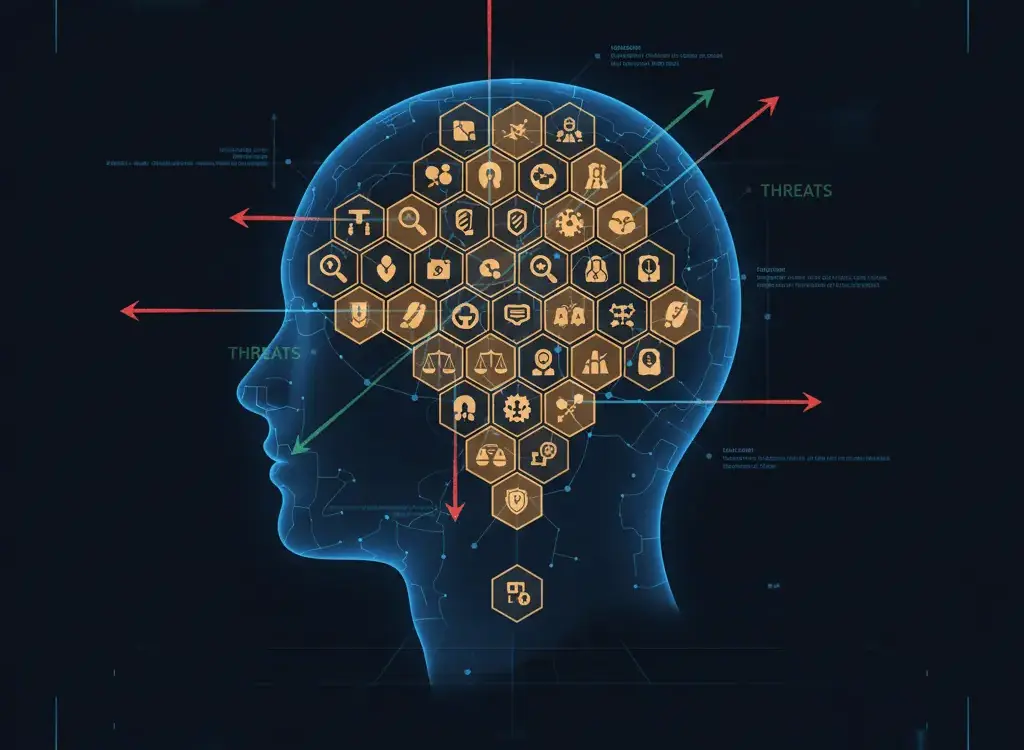
The Architecture of Deception: How Cognitive Biases Shape National Security Vulnerabilities
In 2016, researchers at Oxford’s Internet Institute documented how Russian information operations systematically exploited confirmation bias during the U.S. election cycle, targeting specific demographic clusters with content that reinforced pre-existing beliefs while amplifying divisive narratives. This wasn’t random propaganda—it was precision influence engineering that leveraged documented flaws in human cognitive architecture. The operation’s effectiveness stemmed not from sophisticated technology, but from intimate knowledge of how our minds process information under uncertainty.
Understanding the comprehensive cognitive biases list has evolved from academic curiosity to operational necessity. These systematic deviations from rational judgment represent exploitable vulnerabilities in human decision-making processes—vulnerabilities that adversaries increasingly model and target through information operations, social engineering, and influence campaigns. What makes this particularly concerning is that these biases operate below conscious awareness, making traditional training approaches largely ineffective.
The strategic implications extend beyond individual susceptibility. When cognitive biases operate at population scale, they create predictable patterns of collective behavior that can be manipulated to achieve political, economic, or military objectives. Defense professionals and analysts must understand not just that these biases exist, but how they function mechanistically and where they create institutional blind spots in intelligence analysis, threat assessment, and strategic planning.
The Scientific Foundation: Dual-Process Theory and Systematic Errors
System 1 and System 2 Processing
Daniel Kahneman and Amos Tversky’s groundbreaking work on dual-process theory provides the theoretical foundation for understanding cognitive biases. System 1 thinking operates automatically and intuitively, processing information rapidly with minimal cognitive effort. System 2 thinking is deliberative and analytical, requiring conscious attention and working memory resources. Most cognitive biases emerge from System 1’s reliance on heuristics—mental shortcuts that enable rapid decision-making but sacrifice accuracy for speed.
This architecture served our evolutionary ancestors well in environments where quick judgments about threats and opportunities meant survival. However, modern information environments exploit these same mechanisms. The confirmation bias, for instance, reflects System 1’s tendency to seek information that confirms existing beliefs while avoiding cognitively demanding reevaluation of those beliefs through System 2 processing.
The Replication Crisis and Methodological Limitations
While cognitive bias research has produced robust findings, practitioners must understand its limitations. The replication crisis in psychology has affected some classic bias studies, and many experiments rely on Western, educated populations that may not represent global cognitive patterns. Additionally, laboratory findings don’t always translate to real-world contexts where multiple biases interact simultaneously and emotional stakes are higher.
In my assessment, this uncertainty doesn’t invalidate the research—it demands more sophisticated application. Rather than treating bias catalogs as universal truths, analysts should view them as probabilistic models of cognitive vulnerability that require contextual validation.
High-Impact Biases in Operational Contexts
Availability Heuristic and Threat Perception
The availability heuristic causes people to estimate probability based on how easily examples come to mind. Information operations exploit this by flooding media environments with vivid, emotionally charged content that skews risk perception. The 2014 Malaysian Airlines incident demonstrates this mechanism: Russian media amplified dramatic but unsubstantiated theories about Ukrainian involvement, making these narratives cognitively accessible even to audiences who initially doubted them.
Intelligence analysts face particular vulnerability here. Recent, dramatic events tend to be overweighted in threat assessments, while systemic but gradual changes may be underestimated. The availability heuristic explains why spectacular terrorist attacks receive disproportionate attention compared to more statistically significant but less vivid threats like climate-related security risks.
Anchoring Bias and Information Warfare
Anchoring occurs when initial information disproportionately influences subsequent judgments. In influence operations, the first narrative to achieve widespread circulation often becomes the cognitive anchor for all subsequent information processing. This explains why disinformation campaigns prioritize speed over accuracy—establishing the initial frame matters more than providing comprehensive evidence.
The 2014 downing of MH17 illustrates tactical anchoring. Russian media immediately promoted alternative explanations before investigators could establish facts, creating cognitive anchors that persisted despite subsequent evidence. Even when confronted with contradictory information, many audiences adjusted their beliefs only marginally from these initial anchors rather than abandoning them entirely.
Social Proof and Cascade Effects
Social proof bias drives individuals to adopt behaviors they observe in others, particularly during uncertainty. Digital platforms amplify this through algorithmic curation that creates artificial consensus signals. Bot networks and sock puppet accounts exploit social proof by generating fake engagement metrics that suggest widespread adoption of specific viewpoints.
The concerning aspect is how social proof creates information cascades—situations where early adopters influence others to ignore their private information and follow the crowd. Once these cascades achieve critical mass, they become self-reinforcing and resistant to correction, even when the initial signal was artificially generated.
Why Do These Vulnerabilities Persist Despite Awareness?
The Bias Blind Spot
Perhaps the most operationally significant finding in bias research is the bias blind spot—people readily acknowledge that cognitive biases affect human judgment in general while believing they personally are less susceptible. This creates a particularly dangerous vulnerability for intelligence professionals and decision-makers who may recognize bias patterns in adversary behavior while remaining unconscious of their own susceptibilities.
Research by Pronin and Kugler demonstrates that even extensive training in bias recognition doesn’t eliminate personal susceptibility. Expertise in identifying biases in others may actually increase confidence in one’s own objectivity, creating overconfidence that can be operationally exploited by sophisticated adversaries.
Motivated Reasoning and Identity Protection
The motivated reasoning framework explains why logical arguments often fail to change minds on politically charged topics. When information threatens core beliefs or group identities, System 2 reasoning becomes motivated to defend rather than evaluate. People become more analytical when processing information that supports their position and less analytical when confronting challenging evidence.
This has profound implications for institutional analysis. Intelligence organizations may unconsciously select evidence that supports organizational preferences or policy positions. Similarly, think tanks and policy communities may engage in motivated reasoning that confirms their theoretical frameworks while dismissing contradictory data as flawed or irrelevant.
Population-Level Exploitation Patterns
Demographic Targeting and Bias Amplification
Sophisticated influence operations don’t apply biases uniformly across populations. Instead, they model demographic and psychographic profiles to identify which biases are most exploitable in specific communities. Cambridge Analytica’s documented methods illustrate this approach: using personality profiling to determine whether individuals were more susceptible to fear-based appeals (targeting loss aversion) or aspiration-based messaging (targeting optimism bias).
The strategic challenge is that different communities exhibit different bias patterns based on cultural, educational, and experiential factors. What works on one demographic may backfire on another, requiring adversaries to develop sophisticated targeting capabilities that map cognitive vulnerabilities to population segments.
Institutional Bias Patterns
Organizations develop characteristic bias patterns based on their culture, incentive structures, and operational requirements. Military organizations may exhibit planning fallacy (underestimating time and resources required for operations) and confirmation bias favoring kinetic solutions. Intelligence agencies may display anchoring bias toward established analytical frameworks and availability heuristic overweighting recent dramatic events.
Understanding these institutional patterns is crucial because adversaries study organizational behavior to identify exploitable cognitive vulnerabilities. Chinese information operations, for example, appear to target specific institutional biases within Western defense establishments, using gradual escalation tactics that exploit status quo bias and loss aversion in policy responses.
A Framework for Assessing Cognitive Vulnerability
Individual Assessment Indicators
Practitioners should evaluate cognitive vulnerability across multiple dimensions rather than focusing on single biases. Key indicators include:
- Information diet diversity: How varied are an individual’s information sources and do they actively seek disconfirming evidence?
- Metacognitive awareness: Do they demonstrate understanding of their own thinking processes and limitations?
- Stress and time pressure: These conditions amplify bias susceptibility by forcing reliance on System 1 processing
- Identity relevance: Topics connected to personal or professional identity trigger stronger motivated reasoning
- Social context: Group pressure and authority relationships can override individual critical thinking
Organizational Assessment Framework
Organizations require different evaluation criteria that account for collective decision-making processes:
- Diversity of perspectives: Homogeneous teams amplify groupthink and confirmation bias
- Incentive alignment: Reward structures that penalize uncertainty or dissent encourage overconfidence and suppress contrary views
- Information flow patterns: Hierarchical structures can create echo chambers and filter out inconvenient data
- Decision-making protocols: Formal processes for devil’s advocacy and red-teaming can mitigate institutional biases
- Learning mechanisms: How does the organization process feedback and adapt when initial assessments prove incorrect?
Environmental Risk Factors
Certain environmental conditions increase cognitive vulnerability across individuals and organizations. High-uncertainty environments amplify reliance on heuristics. Information overload forces greater dependence on social proof and authority cues. Time pressure prevents deliberative System 2 analysis. Emotional arousal—whether from fear, anger, or excitement—consistently impairs rational judgment and increases susceptibility to manipulation.
The concerning trend is that modern information environments systematically incorporate these risk factors. Social media platforms optimize for engagement through emotional arousal, create information overload through algorithmic feeds, and generate artificial time pressure through real-time interaction demands. This combination creates optimal conditions for cognitive exploitation.
Institutional Blind Spots and Strategic Implications
Intelligence Analysis Vulnerabilities
Intelligence organizations face particular challenges because their analytical products directly influence national security decisions. The Iraq WMD intelligence failure demonstrates how confirmation bias, groupthink, and anchoring can cascade through institutional hierarchies. Analysts focused on information supporting the WMD hypothesis while discounting contradictory evidence, and institutional pressure reinforced these tendencies.
More subtly, intelligence organizations may exhibit systematic biases toward dramatic, action-requiring assessments over more mundane but accurate evaluations. The availability heuristic makes spectacular threats more cognitively accessible than gradual, systemic changes. This creates incentive structures that favor analysts who identify urgent threats over those who counsel patience or uncertainty.
Policy and Strategic Planning Implications
Cognitive biases affect not only intelligence analysis but policy implementation and strategic planning. Planning fallacy consistently causes organizations to underestimate implementation time and resource requirements. Sunk cost fallacy leads to escalation of failed policies. Optimism bias results in insufficient contingency planning.
What concerns me most is how these individual cognitive patterns interact with bureaucratic incentives to create systematic strategic blind spots. Organizations may persist with failing approaches because admitting error threatens institutional credibility, while cognitive biases provide psychological rationalization for continuing ineffective policies.
Moving Forward: From Awareness to Mitigation
Understanding cognitive biases represents only the first step toward developing more resilient decision-making processes. The evidence suggests that simple awareness training has limited effectiveness—people continue exhibiting biases even after learning about them. More promising approaches focus on structural and procedural interventions that work with cognitive architecture rather than against it.
The strategic imperative is clear: as adversaries develop more sophisticated understanding of human cognitive vulnerabilities, defense organizations must evolve beyond traditional security frameworks that assume rational actors making optimal decisions. The future of cognitive security lies not in eliminating human judgment but in designing systems that account for its systematic limitations while preserving its essential strengths.
This represents a fundamental shift in how we approach threat assessment and strategic planning. Rather than treating cognitive biases as individual character flaws to be overcome through willpower, we must recognize them as architectural features of human cognition that require systematic mitigation through institutional design, procedural safeguards, and technological assistance.