History of conspiracy theories in America


Imagine you’re a colonial printer in Boston, 1773. A pamphlet lands on your press — anonymous, urgent, claiming that British tax collectors are secret agents of a papal conspiracy to enslave the colonies. You print it. It spreads. Within weeks, it has shaped public opinion more decisively than any official gazette. Now fast-forward to 2016: a fabricated story about a Washington pizza restaurant circulates on social media, travels through encrypted messaging apps, and ends with a man firing a rifle inside the building. The mechanism is eerily similar. The infrastructure is radically different. This is the structural reality of conspiracy theories in America — not an aberration, but a persistent feature of the information environment, one that interacts with genuine institutional failures, deliberate influence operations, and platform architectures in ways that matter enormously for cognitive security. The question worth asking is not whether Americans are uniquely gullible. It’s what structural conditions have made conspiracism such a durable and, at times, weaponizable feature of American political life.
Conspiracism as a functional artifact: what these theories actually do
Epistemic needs and the demand side of conspiracy belief
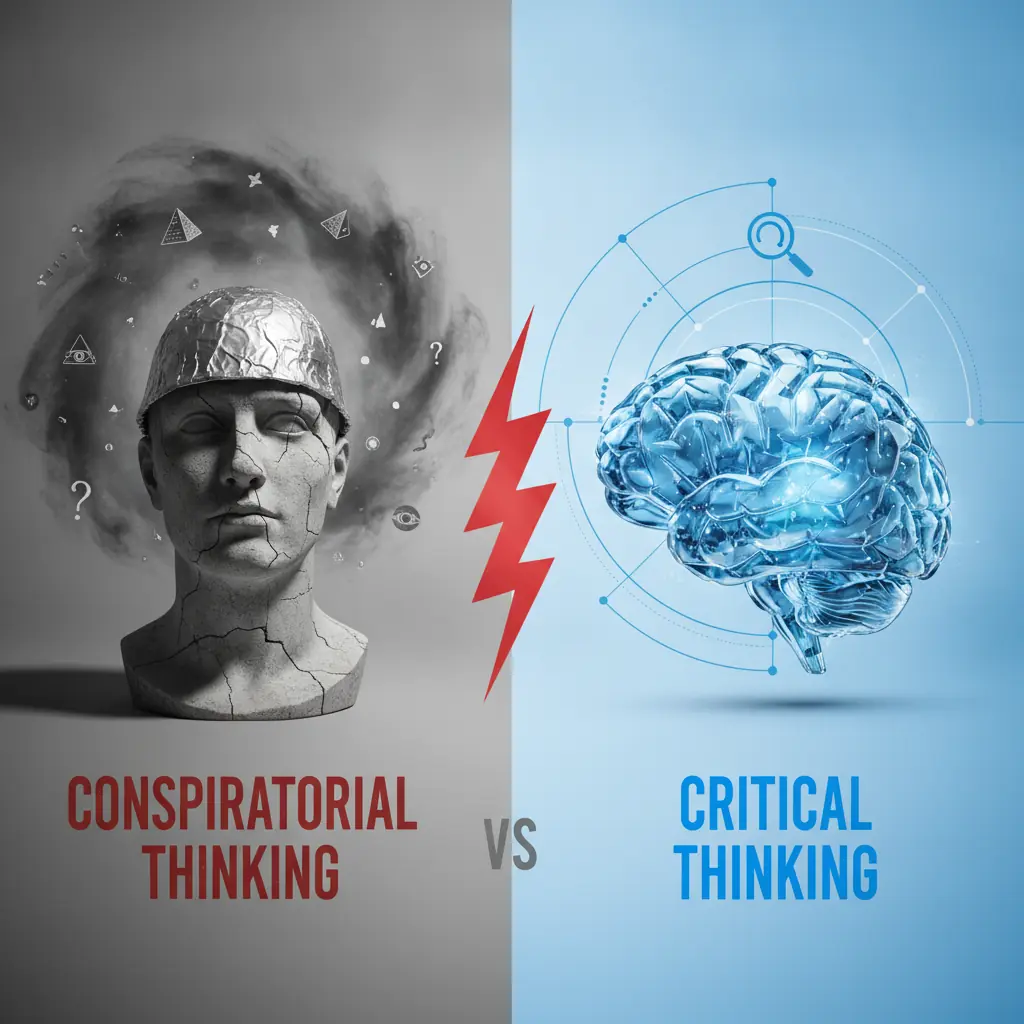
Conspiracy theories in America have never been simply a product of irrationality. Researchers like Roland Imhoff and Pia Lamberty have argued that conspiratorial thinking fulfills identifiable psychological and social functions: it restores a sense of agency in the face of uncertainty, assigns blame in a legible way, and creates community among believers. C. Thi Nguyen’s 2020 work on epistemic bubbles and echo chambers adds another layer — distinguishing between bubbles (where alternative information is simply absent) and echo chambers (where it is actively discredited). Most American conspiracy communities operate as echo chambers in Nguyen’s sense, which is why exposure to counter-evidence often strengthens rather than weakens belief.
This is not a new observation, but its implications are frequently ignored in policy discussions. When you treat conspiracy belief as a simple information deficit — a problem solvable by providing correct facts — you misread the demand structure entirely. People who believe the Federal Reserve is a shadow government or that water fluoridation is a population control measure are not primarily making empirical claims. They are expressing distrust of institutions, asserting autonomy, and signaling group membership. Understanding that distinction is foundational to any serious analysis.
The colonial and revolutionary roots
American conspiracism has colonial origins that predate the republic itself. Bernard Bailyn’s landmark 1967 work The Ideological Origins of the American Revolution documented how Whig pamphlets framed British policy as a deliberate conspiracy against colonial liberties. This wasn’t fringe thinking — it was mainstream revolutionary rhetoric, and it worked. The conspiratorial frame helped mobilize a population against a distant authority. What Bailyn identified was a tradition of what he called “transformative suspicion” — the notion that visible events are the surface manifestation of hidden, coordinated malevolence.
This tradition never disappeared. It evolved through anti-Masonic movements in the 1820s, nativist panics about Catholic conspiracies in the 1840s and 1850s, Populist-era suspicions of banking cabals in the 1890s, and Red Scare anxieties in the 1910s and 1950s. Each wave borrowed rhetorical and structural elements from its predecessors. The enemy changed; the narrative grammar did not.
Structural amplification: why American institutions create fertile ground
Genuine institutional failures as demand generators
It would be analytically dishonest to discuss the history of conspiracy theories in America without acknowledging that some government conspiracies have been real, documented, and consequential. The FBI’s COINTELPRO program targeted civil rights leaders, Native American activists, and socialist organizations through deliberate disinformation and infiltration — confirmed by congressional investigations in the 1970s. The Tuskegee Syphilis Study withheld treatment from Black men for decades. Operation Mockingbird, the CIA’s documented effort to influence domestic media, was exposed during the Church Committee hearings.
These are not conspiracy theories. They are documented history. And they matter because they create a legitimate evidentiary baseline for institutional suspicion — one that bad-faith actors routinely exploit to lend credibility to unfounded claims. When you conflate proven government deception with fabricated narratives, you erode the epistemic distinction that makes critical thinking possible. That erosion is itself a strategic asset for those who want to flood the information environment with noise.
Media fragmentation and the collapse of shared epistemic ground
The structural conditions for mass conspiracism accelerated dramatically with the decline of broadcast media as a shared information commons. By the early 2000s, the combination of cable news segmentation, talk radio, and early internet forums had created what researchers sometimes call epistemic tribalism — the tendency of information communities to sort not just politically but epistemologically, developing incompatible standards of evidence. Platforms then algorithmically rewarded outrage and novelty, which conspiracy content reliably delivers. This isn’t a media pathology. It’s a predictable outcome of attention-economy incentive structures applied to politically polarized populations.
What does the intersection with deliberate influence operations look like?
Manufactured versus organic conspiracism
One of the most important analytical distinctions in this field is between organic conspiracism — theories that emerge from genuine social anxieties and spread through normal community dynamics — and manufactured conspiracism, which is seeded or amplified by state or non-state actors pursuing strategic objectives. The line is not always clean, but the distinction matters enormously for response strategy.
Peter Pomerantsev’s analysis of Russian information operations, particularly in Nothing Is True and Everything Is Possible (2014), describes a model that doesn’t simply promote false narratives but deliberately amplifies existing social divisions and conspiratorial tendencies to create confusion and distrust. The Internet Research Agency’s documented activity before and after the 2016 U.S. election — confirmed by the Senate Intelligence Committee reports — included promoting conspiratorial content across the political spectrum simultaneously, not to persuade but to exhaust and disorient.
Conspiracy theories as hybrid warfare instruments
NATO’s framework for understanding hybrid warfare explicitly includes information operations targeting the cognitive domain. Conspiracy theories function well in this context because they are self-sealing: they incorporate refutation as further evidence of the conspiracy. Jon Roozenbeek and Sander van der Linden’s research on “prebunking” — inoculating audiences against manipulation techniques before exposure — suggests that this self-sealing quality can be partially addressed by teaching people to recognize the rhetorical moves of conspiracist content, rather than arguing about its factual content. This is an important shift in defensive strategy, and it maps onto what NATO’s StratCom Centre of Excellence in Riga has described as building “cognitive resilience” at the population level.
Why debunking alone has never been enough
The backfire effect and its limits
For years, the conventional wisdom was that conspiracy theories spread because people lacked correct information, and that providing it would correct belief. The evidence does not support this at scale. While the so-called “backfire effect” — where corrections strengthen false beliefs — has been debated and partially qualified in subsequent research, the broader point stands: corrections are often ineffective, and occasionally counterproductive, when the audience has strong prior commitments and social identity investment in the conspiratorial framework.
Brendan Nyhan and Jason Reifler’s original 2010 research on this dynamic, though later partially replicated with mixed results, usefully frames the problem: the emotional and social cost of updating a belief that is tied to group identity is higher than the epistemic gain from receiving accurate information. Fact-checkers can win the argument and lose the audience.
Platform architecture as an amplification system
What concerns me analytically here is the persistent tendency to treat platforms as passive conduits rather than active amplification architectures. YouTube’s recommendation algorithm, as documented in multiple investigations including work by researcher Guillaume Chaslot (a former Google engineer), systematically recommended progressively more extreme content because it maximized watch time. Facebook’s internal research, partially disclosed through the 2021 whistleblower documents, acknowledged that algorithmic amplification of outrage was understood internally as a problem before it became a public controversy. These are not accidents of design. They are features of engagement optimization applied without adequate epistemic externality accounting.
A framework for analyzing the spread of conspiracy theories in America
Researchers, platform analysts, and policy professionals need a structured approach to distinguish between types of conspiratorial content and assess their likely trajectory. The following framework draws on available academic literature and documented case material.
| Dimension | Organic conspiracism | Manufactured/state-sponsored conspiracism |
|---|---|---|
| Origin | Emerges from genuine social anxiety or institutional distrust | Seeded by identifiable actors with strategic objectives |
| Amplification pattern | Gradual, community-driven, platform-dependent | Coordinated, often cross-platform, timed to events |
| Falsifiability | Variable; some incorporate partial evidence | Often deliberately unfalsifiable by design |
| Response strategy | Prebunking, trusted messenger outreach, structural trust-building | Attribution, platform enforcement, counter-narrative operations |
| Indicators for analysts | Authentic community spread, no coordination signature | Inauthentic coordinated behavior, sock puppet networks, timing anomalies |
Beyond this table, analysts assessing a specific conspiracy theory’s trajectory should consider:
- Demand-side conditions: What institutional failures or information asymmetries make the narrative plausible to its audience?
- Supply-side actors: Who is producing and distributing the content, and what do they gain from its spread?
- Platform mechanics: Which algorithmic or community features are accelerating distribution?
- Self-sealing structure: Does the theory incorporate refutation as confirmatory evidence? If so, debunking is likely to be counterproductive.
- Intersection with documented events: Does the theory parasitically attach to real institutional failures? This increases credibility and complicates response.
OSINT practitioners can apply network analysis tools to map amplification chains — tracking when a narrative moves from fringe forums to mainstream platforms, which accounts serve as bridges, and whether coordination signatures are present. Stanford Internet Observatory and the Atlantic Council’s Digital Forensic Research Lab have published methodological guides on this approach that are worth consulting directly.
Conclusion: looking forward from a long history
The history of conspiracy theories in America is inseparable from the history of American institutions — their failures, their opacity, and the social anxieties those failures generate. Conspiracism is not going away, and it will not be solved by better fact-checking. What the historical record suggests is that durable conspiratorial ecosystems require structural conditions: information asymmetry, institutional betrayal, and amplification infrastructure. Addressing those conditions is slow, unglamorous work — rebuilding institutional credibility, designing platforms with epistemic externalities in mind, and investing in what researchers call cognitive resilience rather than reactive debunking. The questions worth sitting with: What institutional failures in your own context are currently generating legitimate demand for conspiratorial explanations? And who, precisely, is positioned to exploit that demand?
Sources
- Bailyn, B. (1967). The Ideological Origins of the American Revolution. Harvard University Press.
- Nguyen, C. T. (2020). Echo chambers and epistemic bubbles. Episteme, 17(2), 141–161. Cambridge University Press.
- Pomerantsev, P. (2014). Nothing Is True and Everything Is Possible. PublicAffairs.
- Roozenbeek, J., & van der Linden, S. (2019). Fake news game confers psychological resistance against online misinformation. Palgrave Communications, 5(65). Springer Nature.
- Imhoff, R., & Lamberty, P. (2020). A bioweapon or a hoax? The link between distinct conspiracy beliefs about the coronavirus disease and harm-related behaviors. Social Psychological and Personality Science, 11(8). SAGE.
- U.S. Senate Select Committee on Intelligence. (2019). Report on Russian Active Measures Campaigns and Interference in the 2016 U.S. Election. U.S. Senate.