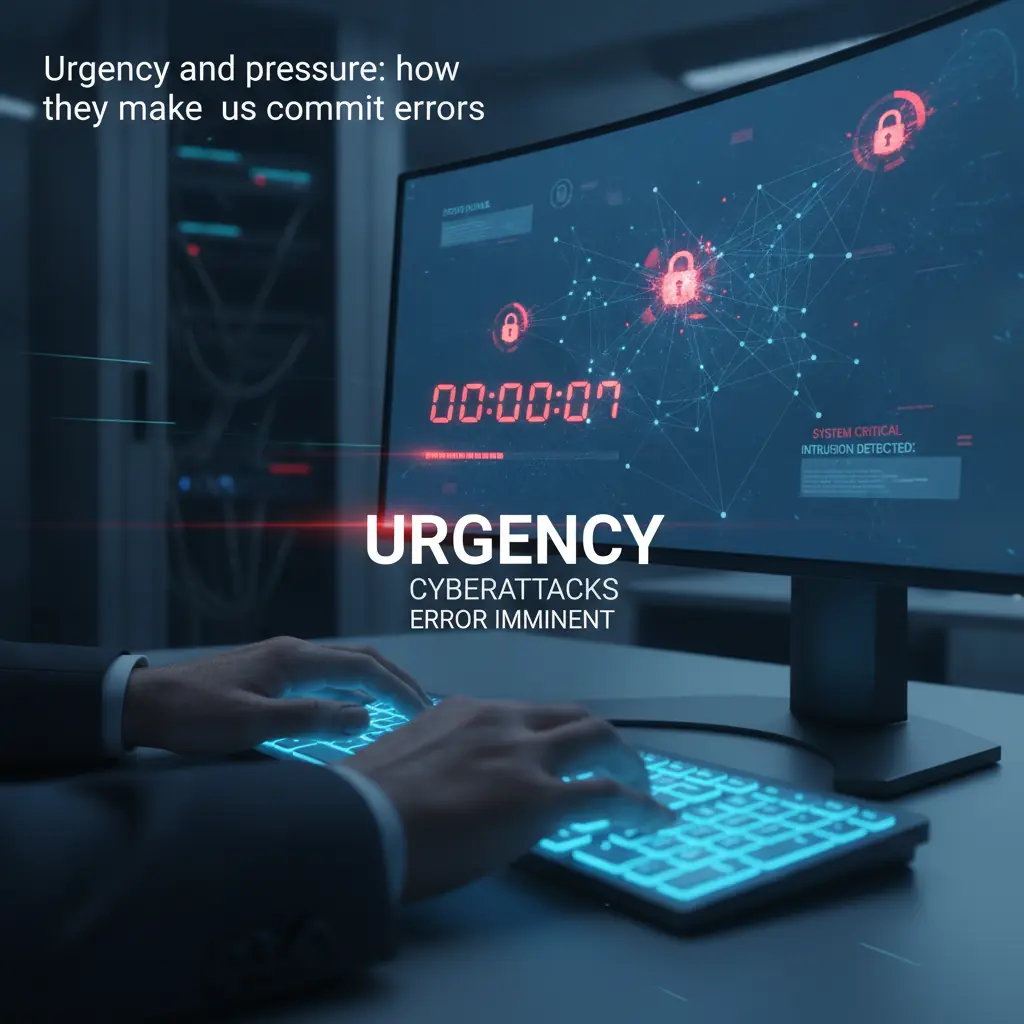
Urgency and pressure: how they make us commit errors

In March 2011, RSA Security — a company whose entire business model rested on protecting organizations from digital intrusion — suffered a breach that began with a single employee opening a phishing email titled “2011 Recruitment Plan.” The email contained an embedded Flash file exploiting a zero-day vulnerability, but the technical sophistication was almost beside the point. What made the attack succeed was the subject line. It felt timely, relevant, and mildly urgent. The employee didn’t linger. They opened it. The rest, as the saying goes, is history — and a cautionary lesson that the security community has still not fully absorbed.
The thesis here is uncomfortable but necessary: urgency cyberattacks succeed not because employees are careless or untrained, but because the cognitive architecture that makes humans functional under pressure is precisely the architecture that adversaries exploit. Security awareness training, as currently implemented across most organizations, addresses symptoms while leaving the underlying system intact. Until we treat urgency and pressure as structural threat vectors — not individual failure points — the human factor will remain the most reliable attack surface in any adversary’s toolkit.
The cognitive machinery behind urgency cyberattacks
What the neuroscience actually tells us
Urgency is not a feeling that humans consciously choose to experience. It is a neurological state — one that narrows attentional bandwidth, compresses deliberation time, and shifts decision-making from the prefrontal cortex toward faster, pattern-matching systems. Psychologists refer to this as cognitive load: the mental resources available for processing a given task at a given moment. When cognitive load is high — when someone is already managing competing demands, tight deadlines, or emotional stress — the brain economizes. It takes shortcuts.
This is not a flaw. In evolutionary terms, it was an asset. A predator in peripheral vision does not require the same deliberative analysis as a quarterly report. The problem is that digital adversaries have learned to simulate predators. A message that reads “Urgent: your account has been compromised — verify immediately” triggers the same narrowing response that a physical threat once did. The analytical brain steps aside. The reactive brain acts.
The role of authority and social compliance
Urgency rarely operates in isolation. Adversaries layer it with authority signaling — the appearance of a message coming from a CEO, an IT department, a government agency, or a trusted vendor. This combination is well-documented in the social psychology literature, most rigorously by Robert Cialdini’s work on influence, though it has been operationalized by threat actors in ways that academic researchers are still catching up to. Business Email Compromise (BEC) — a category of fraud in which attackers impersonate executives or vendors to authorize fraudulent wire transfers — consistently exploits this pairing of authority and urgency. The FBI’s Internet Crime Complaint Center has documented BEC losses in the billions annually, making it one of the most financially destructive categories of cybercrime despite involving no sophisticated malware.
How adversaries weaponize time pressure: documented tactics
Spear-phishing as the primary initial access vector
Urgency cyberattacks are not theoretical. They are the documented initial access vector for a significant portion of major intrusions. Verizon’s Data Breach Investigations Report consistently identifies phishing as a top action variety in data breaches — and spear-phishing, the targeted variant that personalizes the urgency signal to a specific individual, is the preferred technique of advanced persistent threat (APT) groups including APT29 (attributed to Russian SVR), APT28 (attributed to Russian GRU), and Lazarus Group (attributed to North Korea). These are not opportunistic actors fishing with generic lures. They invest in target research, often using open-source intelligence (OSINT) methodologies to identify organizational hierarchies, ongoing projects, and individual stress points before crafting their pretext.
The targeting logic is deliberate: a finance officer during end-of-quarter close is under higher cognitive load than the same officer in mid-month. A system administrator during an active incident response is more susceptible to a spoofed vendor email than during routine operations. Adversaries understand this. In many cases, they wait for it.
Vishing, pretexting, and the telephone attack surface
Vishing (voice phishing) and pretexting (constructing a fabricated scenario to extract information or action) amplify urgency through the medium of real-time voice communication. When a caller identifies themselves as from the IT help desk and says there is an active security incident requiring immediate credential verification, the time pressure is built into the medium itself — there is no pause to reflect, no opportunity to right-click and inspect a URL. The 2020 Twitter hack, in which attackers used vishing to socially engineer Twitter employees into providing access to internal tools, illustrated that even well-resourced platforms with formal security programs are not immune. The attackers reportedly impersonated IT staff and created sufficient urgency that employees complied without additional verification.
Does security awareness training actually address urgency cyberattacks?
The documented gap between training and behavior
The security awareness training industry generates substantial revenue and makes confident claims about reducing click rates on simulated phishing. Some of those claims are defensible in narrow terms. What the evidence does not support is the broader assertion that training reliably changes behavior under real-world pressure conditions. The core problem is transfer: skills learned in low-stress training environments do not transfer cleanly to high-stress operational environments where cognitive load is elevated.
Bruce Schneier has been direct about this for years: security awareness training, as most organizations implement it, is closer to security theater than to a genuine risk mitigation strategy. The Verizon DBIR does not show a consistent downward trend in human-factor breach rates despite a decade of expanding training investment. IBM’s X-Force Threat Intelligence Index similarly identifies phishing as a persistent top initial access vector year after year — a trend that should raise hard questions about the return on the billions spent on awareness programs.
What NIST and organizational frameworks actually recommend
NIST Special Publication 800-50, which addresses building an information technology security awareness and training program, is careful to distinguish between awareness and training — and to situate both within a broader organizational security culture framework. The document does not claim that training eliminates human error. It frames training as one layer within a defense-in-depth architecture. The gap between what NIST recommends and what organizations actually implement is, in my assessment, significant. Most programs focus on compliance metrics — completion rates, simulated phishing click rates — rather than on the behavioral and organizational conditions that make individuals more or less susceptible to pressure-based manipulation.
Did you know? Research on decision fatigue — the deterioration of decision quality after extended periods of choice-making — suggests that the time of day when a phishing email arrives may influence whether an employee clicks on it. Studies in behavioral economics have found that decision quality tends to decline in the afternoon, particularly after a cognitively demanding morning. Adversaries operating across time zones may not factor this in deliberately, but it is a structural vulnerability that organizations almost never account for in their security architecture.
A framework for evaluating organizational susceptibility to urgency-based attacks
Assessing organizational risk from urgency cyberattacks requires moving beyond simulated phishing click rates. The following indicators, drawn from available organizational psychology and security culture research, provide a more structurally grounded evaluation framework.
Structural and cultural risk indicators
- Verification friction: Does the organization have accessible, low-friction mechanisms for employees to verify unexpected requests — particularly those involving credentials, payments, or access changes — without fear of appearing obstructive or slow?
- Authority gradient: How steep is the organizational hierarchy, and how much implicit pressure exists to comply with executive requests without pushback? Steeper authority gradients increase susceptibility to BEC and executive impersonation attacks.
- Cognitive load conditions: Are there identifiable periods of elevated organizational stress — budget cycles, merger activity, regulatory deadlines, incident response periods — during which human factor risk is structurally elevated?
- Normalized urgency culture: Organizations where “urgent” is a permanent ambient condition have effectively disabled one of the primary psychological warning systems that might otherwise slow down a rash decision.
- Incident reporting culture: Do employees report suspected social engineering attempts without shame or penalty? CERT Insider Threat Center research at Carnegie Mellon consistently identifies reporting culture as a key variable in early detection.
Technical and process controls that reduce pressure-based error
- Out-of-band verification protocols for any request involving financial transactions, credential changes, or access escalation — enforced procedurally, not left to individual judgment.
- DMARC, DKIM, and SPF enforcement to reduce the technical surface area for email impersonation, reducing the ambient noise of urgency-exploiting messages that reach employee inboxes.
- Mandatory cooling periods for high-value financial authorizations — structural time delays that override urgency regardless of how the request is framed.
- Contextual anomaly alerting that flags unusual behavioral patterns in communication (after-hours wire requests, new vendor payment details) at the system level, rather than relying on individual employees to notice them under pressure.
The APT calculus: why urgency exploitation will intensify
Human exploitation as a lower-cost alternative to zero-days
State-sponsored APT groups and sophisticated cybercriminal organizations have reached a clear operational conclusion: exploiting urgency and pressure in human targets is cheaper, more reliable, and harder to detect than chaining technical vulnerabilities. A zero-day vulnerability has a finite lifespan — it gets patched, it gets burned. A well-crafted pretext that exploits the cognitive architecture of a human under pressure does not expire in the same way. The underlying vulnerability — our neurological response to urgency — is not patchable through a software update.
NATO’s conceptual framework for cognitive warfare, as articulated in documents emerging from the NATO Human Factors and Medicine Research Task Group, explicitly recognizes that adversaries are investing in understanding and exploiting human cognitive vulnerabilities at scale. This is not a peripheral concern for alliance cybersecurity planning. It is a central vector in the hybrid threat landscape that NATO member states face from actors including Russia and China-affiliated APT ecosystems.
The convergence of AI-generated content and urgency manipulation
What concerns me here is the near-term trajectory. Generative AI tools are already demonstrably capable of producing highly convincing, contextually tailored phishing content at scale — eliminating the grammatical errors and tonal inconsistencies that security training has traditionally taught employees to identify. The combination of AI-generated urgency messaging with OSINT-derived targeting intelligence means that the marginal cost of a highly personalized urgency attack is approaching zero. Organizations that have built their human factor defenses around “spot the suspicious email” training are operating on an assumption that is becoming less valid by the quarter.
Conclusion and forward assessment
Urgency cyberattacks succeed because they exploit something real and functional in human cognition — not a weakness, but an architecture that adversaries have learned to weaponize. The organizational response to this threat has been disproportionately focused on individual awareness training while underinvesting in the structural, procedural, and technical controls that reduce the attack surface regardless of individual employee state in a given moment. Available evidence suggests this imbalance will become more costly as AI-assisted social engineering matures. The forward assessment is not optimistic without structural change: organizations that continue to treat the human factor as a training problem rather than a design problem will find themselves systematically exploited by adversaries who understand human cognition better than their own security teams do.
Actionable takeaways
- Audit your verification protocols now. Every high-value transaction or access change should require out-of-band confirmation — this is a procedural control that functions independent of employee cognitive state.
- Map your organizational stress calendar. Identify the periods of elevated cognitive load (quarter-end, regulatory deadlines, merger activity) and increase monitoring and control friction during those windows.
- Reframe the training conversation internally. Move away from click-rate metrics as primary KPIs; measure reporting culture and near-miss disclosure rates instead.
- Brief leadership on the BEC threat specifically. Executive impersonation attacks exploit authority gradients that senior leaders create — they need to understand their role in the attack surface.
- Assess your AI-generated content exposure. If your phishing simulation vendor is not yet using AI-generated content in simulations, your employees are not being tested against the actual current threat.
Sources
- Verizon. (2026). Data Breach Investigations Report. Verizon Business.
- IBM Security. (2023). X-Force Threat Intelligence Index. IBM Corporation.
- NIST. (2003). SP 800-50: Building an Information Technology Security Awareness and Training Program. National Institute of Standards and Technology.
- Cialdini, R. (2006). Influence: The Psychology of Persuasion. Harper Business.
- Cappelli, D., Moore, A., & Trzeciak, R. (2012). The CERT Guide to Insider Threats. Carnegie Mellon University / Addison-Wesley.
- Schneier, B. (2013). Liars and Outliers: Enabling the Trust That Society Needs to Thrive. Wiley.