Far-left and anarchist radicalization online

In the summer of 2020, as protests following George Floyd’s murder spread across American cities, federal law enforcement agencies began circulating intelligence assessments warning of coordinated anarchist violence. Some of those assessments, later scrutinized by journalists and civil liberties researchers, conflated legal protest participation with violent extremism in ways that revealed as much about institutional threat perception as they did about any actual radicalization pipeline. That conflation matters analytically. Far-left radicalization is a genuinely documented phenomenon — black bloc tactics, anti-fascist direct action networks, and anarchist infrastructure have produced real political violence in specific contexts — but it is also one of the most analytically muddled areas in the radicalization research literature. Understanding the difference between legal radical politics and structured mobilization toward violence is not a courtesy to the left. It is a prerequisite for accurate threat assessment.
This article examines the online dimension of that process: how far-left and anarchist communities form digitally, how ideological escalation occurs across platforms, where the evidence is strong, and where analysts routinely overreach.
What the pathway models actually tell us about far-left radicalization
The pyramid model and its discontents
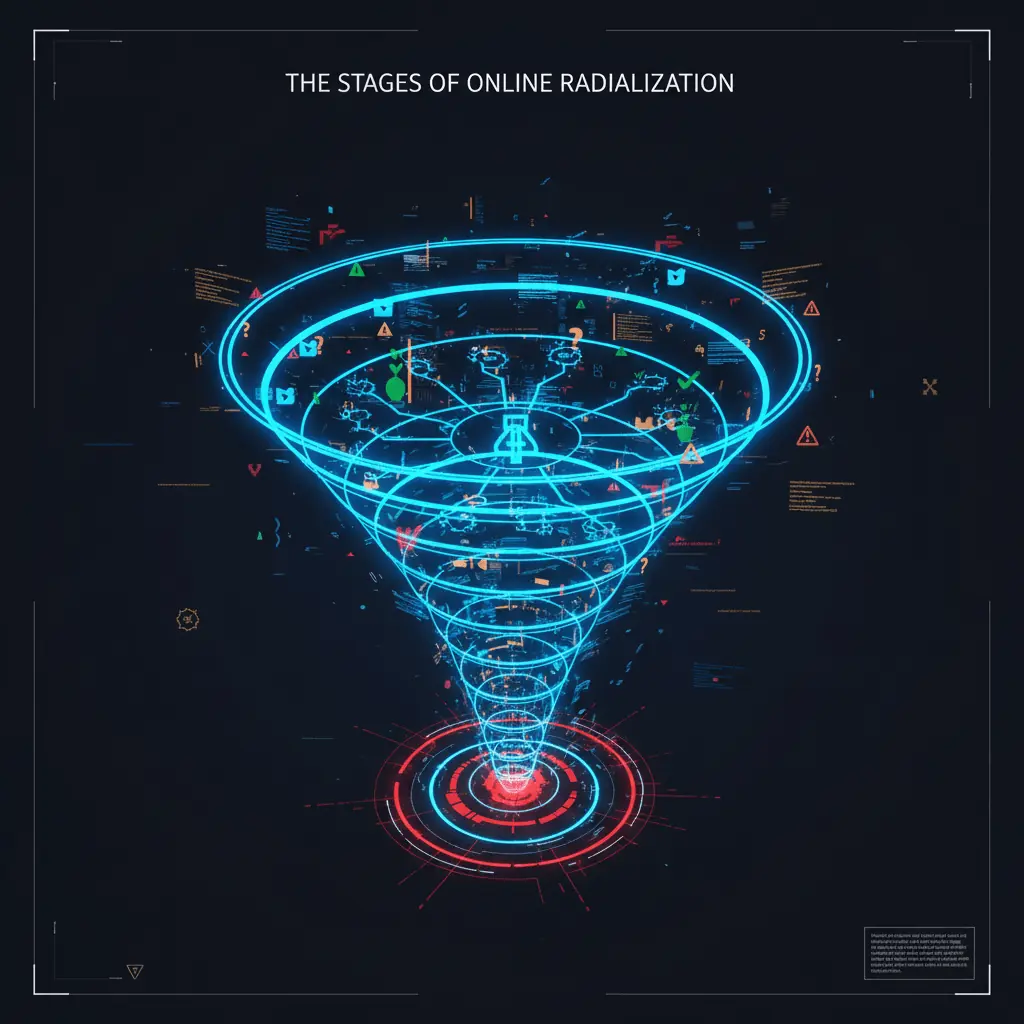
The dominant conceptual model in Western CVE — Countering Violent Extremism, the policy framework adopted by governments and multilateral bodies including NATO — draws heavily on what researchers Moskalenko and McCauley described as a radicalization pyramid: a large base of sympathizers, a smaller layer of activists, and a narrow apex of those willing to use violence. The intuition is sound. The implication that movement through the pyramid is linear, predictable, or algorithmically detectable is not supported by the empirical record.
For far-left communities specifically, available evidence suggests that pathway dynamics are considerably more heterogeneous than the funnel metaphor implies. Researchers at the International Centre for the Study of Radicalisation (ICSR) at King’s College London have documented what they call “mosaic” pathways — individuals moving laterally across ideological communities, often cycling between grievance-focused spaces and more explicitly action-oriented ones, without ever passing through a recognizable recruitment structure.
The distinction between radicalization of opinion and radicalization toward violence
This is where analytical discipline becomes non-negotiable. A person who moves from liberal politics to anarcho-communism through online reading and community engagement has radicalized in the sense that their political views have shifted dramatically. That process is legal, common throughout history, and not inherently a security concern. The subset of that population who then move toward advocacy of political violence — and the smaller subset who act on it — represents a genuinely different analytical object.
Conflating the two produces two distinct failures: it overcounts the threat, wasting intelligence resources on legal political activity, and it delegitimizes the entire research area when analysts are caught surveilling activists who never posed a violence risk. Both failures are documented. RAND Corporation assessments of domestic CVE programs have repeatedly flagged this conflation as a structural problem, not an isolated error.
How does platform architecture shape far-left online communities?
The migration pattern from mainstream to federated platforms
Far-left and anarchist online communities have followed a distinctive platform migration pattern that differs meaningfully from the far-right pipeline. Where far-right communities have been documented migrating from Reddit to 4chan to Telegram to Gab in response to deplatforming, far-left communities have tended to move toward federated, privacy-preserving infrastructure: Mastodon instances, Matrix-based encrypted messaging, and self-hosted forums. This architectural preference reflects an older tradition of operational security in anarchist organizing — predating the internet — and creates a different surveillance and research challenge.
The practical consequence for analysts is that far-left online radicalization is substantially less visible in the open-web data that OSINT methodologies most easily access. Studies relying on Twitter or Reddit data, which constitute the bulk of published platform radicalization research, are structurally less likely to capture far-left escalation pathways than far-right ones. That asymmetry in data availability has almost certainly distorted the research literature.
The role of recommendation systems: what the evidence actually supports
A recurring claim in media coverage of online radicalization is that algorithmic recommendation systems actively funnel users toward extremism. For far-right content, there is documented internal research — including the leaked Facebook integrity reports and external investigations by the Mozilla Foundation and The Markup — showing that recommendation systems amplified high-engagement, emotionally activating content in ways that systematically elevated inflammatory material. Whether the same dynamic applies to far-left content is far less documented. The honest answer is that the experimental evidence is thin, the observational studies are methodologically contested, and analysts should be cautious about asserting algorithmic radicalization pipelines without specifying the platform, the content category, and the evidence base for the specific claim.
Community formation and identity investment in anarchist networks
The role of shared grievance and in-group culture
What the research literature does support — across ideological categories, including far-left spaces — is the centrality of community formation in radicalization pathways. Online anarchist communities, particularly those organized around antifascism, prison abolition, or direct action, develop strong in-group cultures with distinctive aesthetics, language, and social norms. For individuals entering these spaces through genuine political grievance — police violence, economic precarity, ecological crisis — the community dimension can become more psychologically binding than the ideological content itself.
This is consistent with what psychologist Arie Kruglanski and colleagues have described as significance quest theory: the idea that radicalization is driven less by ideological conviction than by the need for personal significance, which extreme communities can satisfy through identity, belonging, and a sense of moral mission. Applied to far-left spaces, this framework helps explain why individuals with diverse entry points — some politically sophisticated, others primarily socially motivated — can arrive at similar behavioral dispositions.
From digital community to operational network
The transition from online community participation to offline operational activity is the critical juncture that most radicalization research struggles to adequately model. Available case evidence — drawn from post-incident analysis of individuals arrested in connection with politically motivated property destruction, arson, or assault in the United States and Western Europe — suggests that the online-to-offline transition is rarely a sudden activation event. It typically involves an extended period of community immersion, gradual exposure to more operationally oriented subgroups, and the development of real-world social ties that originate in online spaces but consolidate offline.
State actor exploitation of far-left radicalization dynamics
Documented amplification campaigns
One dimension of far-left online radicalization that receives insufficient attention in Western CVE frameworks is the role of external state actors in amplifying domestic far-left grievances. The Internet Research Agency’s operations, as documented by the Senate Intelligence Committee’s bipartisan report, included systematic amplification of Black Lives Matter content, anti-police sentiment, and anarchist messaging — not because Russian information operations ideologically support these movements, but because amplifying polarizing content on all sides serves the strategic goal of social fragmentation.
In my assessment, this is the analytically most significant and most underappreciated dimension of the far-left radicalization problem. A domestic security apparatus focused narrowly on the ideological content of anarchist communities will systematically miss the external amplification layer — and will also risk treating organically radicalized domestic actors and foreign-amplified personas as equivalent threats, which they are not.
NATO frameworks and the cognitive warfare dimension
NATO’s evolving cognitive warfare doctrine — as articulated in materials from the NATO Strategic Communications Centre of Excellence in Riga — explicitly recognizes the exploitation of domestic social divisions as a core adversarial capability. Far-left radicalization narratives, particularly those centered on state illegitimacy, police violence, and economic injustice, provide exploitable cognitive terrain. This does not mean that individuals holding these views are foreign agents or that the grievances are manufactured. It means that adversarial information operations are structurally incentivized to locate and amplify authentic domestic fracture lines.
A framework for assessing far-left online radicalization pathways
Given the analytical complexity outlined above, security professionals and researchers need structured indicators rather than content-based heuristics. The following framework draws on documented research and OSINT methodological practice.
- Entry point analysis: What grievance or event triggered initial community engagement? Is the entry point primarily ideological, social, or event-driven? Entry point shapes trajectory.
- Community architecture: Is the individual engaging with open-web communities or migrating toward encrypted, invitation-only spaces? Migration toward operational security-conscious platforms is a meaningful behavioral signal.
- Language escalation: Movement from political critique to dehumanizing language about opponents, glorification of past political violence, or explicit discussion of tactical methods represents a qualitatively different signal than ideological radicalization.
- Social network consolidation: Narrowing of social ties to primarily in-group members, particularly with offline components, is consistently associated with advanced radicalization across ideological categories.
- Operational indicators: Procurement of materials, reconnaissance of targets, or explicit planning discussion — these are legal thresholds, not analytical ones, but they mark the boundary between radicalization as a research object and radicalization as a security concern.
- Assess pathway stage: opinion radicalization, behavioral mobilization, or operational preparation.
- Distinguish organic radicalization from externally amplified content ecosystems using network provenance analysis.
- Apply the ICSR’s Profiles of Individual Radicalization in the United States (PIRUS) dataset criteria where applicable for cross-case comparison.
- Document evidence basis for each assessment claim — separating what platform data shows, what behavioral indicators suggest, and what remains inferred.
What concerns me here is the tendency — in both government assessments and media coverage — to collapse these stages into a single undifferentiated threat category. The result is analytical noise that obscures both genuine threats and civil liberties boundaries.
Forward assessment: where the research gaps are and why they matter
Far-left radicalization online remains one of the least rigorously studied dimensions of the broader radicalization literature, in part because of data access limitations, in part because of institutional focus asymmetries, and in part because the political sensitivity of the topic creates incentives for both overstatement and understatement depending on the institutional context. The migration of far-left communities toward federated, encrypted infrastructure will deepen this research gap over time.
What is likely to matter most in the coming period is not content surveillance but network analysis: understanding how communities form, consolidate, and develop operational capacity, rather than what specific ideological content they consume. State actors will continue to exploit these dynamics regardless of their organic trajectory. Analysts who treat far-left radicalization as a purely domestic ideological phenomenon, without the external amplification dimension, will systematically produce incomplete threat pictures. The analytical challenge is to hold both simultaneously — and to remain honest about the boundaries of what the evidence actually supports.
Sources
- Moskalenko, S. & McCauley, C. (2009). Measuring Political Mobilization: The Distinction Between Activism and Radicalism. Terrorism and Political Violence, 21(2).
- Kruglanski, A. et al. (2014). The Psychology of Radicalization and Deradicalization: How Significance Quest Impacts Violent Extremism. Political Psychology, 35(S1).
- ICSR (2022). Profiles of Individual Radicalization in the United States (PIRUS). International Centre for the Study of Radicalisation, King’s College London.
- Senate Select Committee on Intelligence (2019). Report on Russian Active Measures Campaigns and Interference in the 2016 U.S. Election, Volume 2: Russia’s Use of Social Media. United States Senate.
- NATO Strategic Communications Centre of Excellence (2020). Cognitive Warfare. NATO StratCom COE, Riga.
- RAND Corporation (2019). Countering Violent Extremism Programs: Findings and Recommendations. RAND.