SITUATION ASSESSMENT
In November 2020, researchers at the Stanford Internet Observatory documented a coordinated inauthentic behavior network operating across Facebook, Instagram, and Twitter that generated over 15 million interactions through fake personas promoting divisive content around the U.S. election. The operation, attributed to domestic actors rather than foreign adversaries, demonstrated how social media manipulation has evolved beyond state-sponsored disinformation campaigns to encompass a broader ecosystem of influence operations targeting democratic processes.
Open-source evidence indicates that understanding what is social media manipulation has become essential for information security in the digital age. This analysis examines the mechanisms, detection indicators, and defensive countermeasures necessary to identify and counter these cognitive warfare tactics.
THREAT VECTOR: Defining Social Media Manipulation
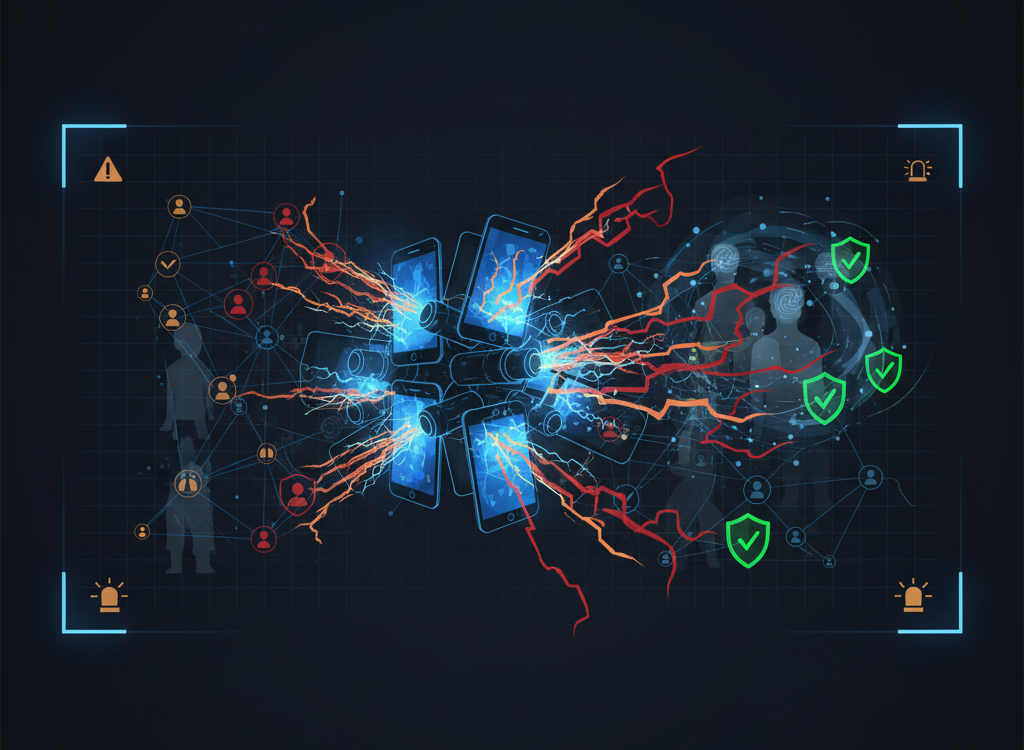
Social media manipulation encompasses coordinated efforts to artificially amplify, suppress, or distort information flows on digital platforms to influence public opinion, behavior, or decision-making processes. The operational pattern suggests three primary vectors: coordinated inauthentic behavior (fake accounts operating in networks), computational propaganda (automated content distribution), and platform exploitation (gaming algorithmic systems for reach).
The RAND Corporation’s 2016 «Firehose of Falsehood» model provides a framework for understanding modern influence operations. Unlike traditional propaganda, these campaigns prioritize volume and repetition over factual accuracy, leveraging what psychologist Daniel Kahneman describes as System 1 thinking—rapid, emotion-driven cognitive processing that bypasses critical evaluation.
NATO’s 2021 cognitive warfare concept recognizes social media manipulation as a primary attack vector targeting «the human domain» through information pollution and attention capture rather than traditional kinetic warfare.
Critical assessment: The threat landscape has shifted from centralized broadcast propaganda to decentralized, algorithmic manipulation that exploits cognitive biases and social proof mechanisms identified in Robert Cialdini’s influence research.
OPERATIONAL TAXONOMY
Intelligence analysis reveals four primary manipulation categories:
- Astroturfing: Creating artificial grassroots movements through coordinated fake accounts
- Brigading: Organized harassment or mass reporting to silence targets
- Sockpuppeting: Single actors managing multiple false personas
- Bot amplification: Automated accounts boosting content visibility
CASE STUDY: Documented Operations
Operation 1: Internet Research Agency (2016-2020)
The Internet Research Agency’s multi-year campaign, documented by the Mueller investigation and confirmed by Facebook’s threat intelligence team, demonstrates sophisticated social media manipulation tactics. The operation created over 100,000 fake social media posts reaching 146 million Americans, focusing on divisive topics including immigration, gun rights, and racial tensions.
Key operational indicators included coordinated posting schedules aligned with Moscow working hours, identical messaging across multiple accounts, and strategic targeting of swing states during election periods. DFRLab analysis revealed the network’s evolution from crude bot activity to sophisticated persona development with years-long posting histories.
Operation 2: COVID-19 «Infodemic» Campaigns (2020-2022)
EU DisinfoLab documented coordinated campaigns spreading medical misinformation during the pandemic, with some operations attributed to state actors while others appeared commercially motivated. These campaigns exploited health anxiety and political polarization, achieving viral spread through emotional manipulation rather than factual accuracy.
Bellingcat investigators identified recycled content patterns, coordinated hashtag campaigns, and cross-platform amplification networks that generated millions of engagements despite originating from relatively small actor groups. This aligns with documented TTPs for information pollution operations designed to erode trust in authoritative sources.
DETECTION PROTOCOL: Behavioral Signatures
Open-source intelligence reveals consistent patterns across social media manipulation operations. A critical indicator is the presence of multiple operational signatures occurring simultaneously rather than individual anomalies.
Technical Markers:
- Account creation patterns: Clusters of accounts created within similar timeframes
- Posting synchronization: Identical or near-identical content posted across multiple accounts within short windows
- Engagement anomalies: Disproportionate likes, shares, or comments relative to follower counts
- Network analysis indicators: Unusual connection patterns between accounts suggesting coordination
- Content recycling: Repeated use of images, phrases, or narrative frameworks across ostensibly unrelated accounts
Behavioral Signatures:
- Profile inconsistencies: Stock photos, limited personal information, or demographic mismatches
- Temporal patterns: Posting schedules suggesting automated or coordinated human operation
- Language markers: Grammatical patterns, idiom usage, or cultural references inconsistent with claimed identity
- Interaction patterns: Primarily engaging with network members rather than organic community participation
DEFENSE FRAMEWORK: Multi-Layer Countermeasures
Assessment: Effective defense against social media manipulation requires coordinated action across individual, organizational, and systemic levels. The Stanford Internet Observatory’s research indicates that platform-level interventions combined with user education provide the most robust protection against influence operations.
Individual Cognitive Security:
- Source verification protocols: Cross-reference information across multiple credible sources before sharing
- Engagement pattern analysis: Examine account histories and interaction patterns before trusting content
- Emotional regulation techniques: Pause and fact-check when content triggers strong emotional responses
- Platform literacy development: Understand algorithmic content curation and echo chamber effects
- Network hygiene practices: Regularly audit connections and unfollow accounts exhibiting manipulation indicators
Organizational Defense Protocols:
Organizations require systematic approaches to identify and counter social media manipulation targeting their operations, personnel, or stakeholders:
- Threat monitoring systems: Deploy social media monitoring tools to identify coordinated campaigns
- Staff training programs: Regular briefings on current manipulation tactics and detection methods
- Crisis communication protocols: Predetermined responses to influence operation targeting
- Verification partnerships: Relationships with fact-checking organizations and academic researchers
Systemic Countermeasures:
The operational pattern suggests that platform-level and policy interventions provide the most scalable defense against social media manipulation campaigns.
Research by Nathaniel Gleicher at Facebook’s threat intelligence team demonstrates that coordinated takedowns of inauthentic networks significantly reduce manipulation campaign effectiveness, but require continuous adaptation as actors evolve their tactics.
Policy frameworks must address cross-border coordination between democratic governments while preserving free expression principles. The EU’s Digital Services Act and similar legislation represent attempts to balance platform accountability with user rights.
ASSESSMENT: Key Intelligence
Forward-looking analysis indicates that social media manipulation will continue evolving as artificial intelligence capabilities advance and platform defenses improve. Critical intelligence findings include:
- Scale and sophistication increasing: Operations now integrate multiple platforms, languages, and cultural contexts
- Attribution challenges growing: Commercial actors and domestic operations complicate traditional state-actor focused defenses
- Defensive adaptation required: Static detection methods quickly become obsolete as tactics evolve
- Cognitive resilience essential: Individual and societal preparation provides the most durable protection against influence operations
- Multi-stakeholder cooperation critical: Effective defense requires coordination between platforms, governments, civil society, and users
The threat landscape assessment indicates that understanding social media manipulation mechanisms and implementing layered defensive measures has become a fundamental requirement for information security in democratic societies. As influence operations continue adapting to platform countermeasures and technological advancement, maintaining cognitive security requires ongoing education, vigilance, and international cooperation.
REFERENCES
Cialdini, R. (2006). Influence: The Psychology of Persuasion. Harper Business.
DiResta, R. et al. (2019). The Tactics and Tropes of the Internet Research Agency. Stanford Internet Observatory.
Gleicher, N. (2020). Removing Coordinated Inauthentic Behavior. Facebook Threat Intelligence.
Kahneman, D. (2011). Thinking, Fast and Slow. Farrar, Straus and Giroux.
RAND Corporation (2016). The Russian «Firehose of Falsehood» Propaganda Model. RAND Research Reports.
Rid, T. (2020). Active Measures: The Secret History of Disinformation and Political Warfare. Farrar, Straus and Giroux.