SITUATION ASSESSMENT
In October 2022, the Digital Forensic Research Lab documented a coordinated information operation targeting European energy security discourse. The campaign, traced across 15 social media platforms and 200+ inauthentic accounts, systematically amplified anti-wind energy narratives during Europe’s energy crisis. Open-source evidence indicates this operation exemplifies information geopolitics — the strategic manipulation of information flows to achieve geopolitical objectives without kinetic warfare.
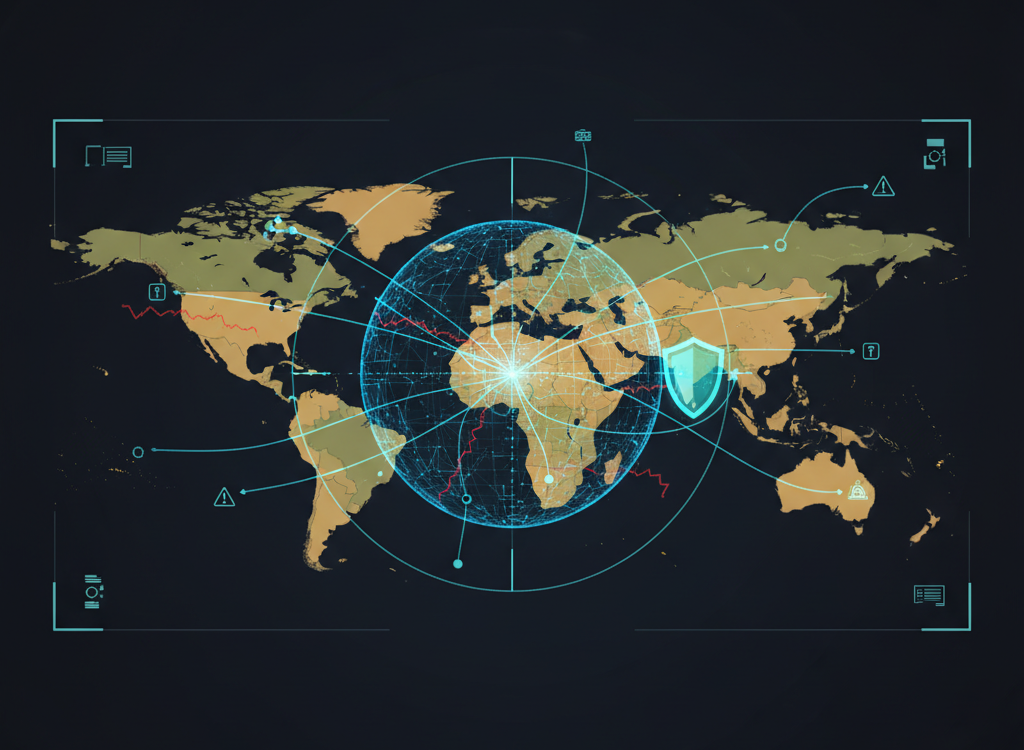
What is information geopolitics? It represents the convergence of traditional statecraft with digital-age influence operations, where control over information narratives becomes a primary vector for projecting power across borders. Unlike conventional diplomatic or military tools, information geopolitics operates in the cognitive domain, targeting decision-making processes of populations, institutions, and governments.
THREAT VECTOR: The Weaponization of Information Flows
Information geopolitics fundamentally alters how states compete for influence. The RAND Corporation’s 2016 analysis of Russian propaganda techniques identified what researchers termed the «Firehose of Falsehood» model — high-volume, multi-channel dissemination of contradictory messages designed to overwhelm target audiences’ cognitive defenses.
The operational pattern suggests information geopolitics functions through three primary mechanisms:
- Narrative Warfare: Strategic construction and dissemination of competing reality frameworks
- Cognitive Overload: Information flooding to degrade analytical capacity
- Trust Erosion: Systematic undermining of institutional credibility and social cohesion
NATO’s 2021 cognitive warfare concept paper defines this domain as «the art of using technologies to alter the cognition of human targets.» Critical assessment indicates information geopolitics extends beyond individual psychological manipulation to encompass systemic attempts to reshape political discourse, electoral outcomes, and policy decisions across national boundaries.
CASE STUDY: Documented Information Geopolitics Operations
Operation 1: Brexit Referendum Influence Campaign
The UK’s Intelligence and Security Committee’s 2020 Russia Report documented extensive information operations targeting the 2016 Brexit referendum. Bellingcat researchers identified over 400 Twitter accounts linked to the Internet Research Agency that pushed anti-EU content to UK audiences. The Stanford Internet Observatory’s analysis revealed these accounts generated over 65,000 Brexit-related posts, reaching an estimated 5 million UK users.
The operational signature demonstrated classic information geopolitics: external actors exploiting domestic political divisions to achieve strategic objectives aligned with their national interests.
Operation 2: German Election Interference Framework
The EU DisinfoLab’s 2021 investigation exposed «Indian Chronicles» — a 15-year information operation spanning 265 pro-Indian websites across 65 countries. The campaign systematically targeted Pakistani and Chinese interests while promoting Indian foreign policy positions. German intelligence services assessed this network attempted to influence EU parliamentary votes on Kashmir resolutions through manufactured grassroots pressure.
This aligns with documented TTPs for astroturfing — creating artificial grassroots movements to simulate organic political pressure while advancing state interests.
DETECTION PROTOCOL: Identifying Information Geopolitics Signatures
A critical indicator framework for recognizing information geopolitics operations includes:
- Temporal Clustering: Sudden narrative emergence synchronized with geopolitical events or policy decisions
- Platform Coordination: Identical messaging across multiple social media platforms using different account networks
- Linguistic Anomalies: Content produced in target languages showing non-native grammatical patterns or cultural references
- Amplification Patterns: Artificial engagement metrics inconsistent with organic social media behavior
- Source Obscuration: Information pathways that deliberately mask original attribution or funding sources
- Narrative Convergence: Multiple ostensibly independent sources promoting identical interpretive frameworks
The operational pattern suggests successful detection requires monitoring information ecosystems rather than individual pieces of content. DFRLab researchers emphasize analyzing behavior patterns over content analysis alone.
DEFENSE FRAMEWORK: Multi-Level Countermeasures
Individual-Level Defenses
- Source Verification: Implement systematic fact-checking using established verification protocols before sharing information
- Cognitive Bias Recognition: Apply Kahneman’s System 1/System 2 framework to identify when emotional responses may override analytical thinking
- Information Diet Management: Diversify information sources across different political and geographical perspectives
- Temporal Verification: Cross-reference breaking news against multiple independent sources before accepting as factual
Organizational-Level Protocols
Institutional defenses must incorporate threat awareness training and systematic information verification procedures. The Carnegie Endowment’s 2021 report on information integrity recommends organizations establish dedicated information assessment units trained in cognitive warfare recognition.
Assessment: Organizations lacking formal information verification protocols remain vulnerable to becoming unwitting amplifiers of geopolitical influence operations.
Systemic-Level Countermeasures
Policy frameworks require international cooperation mechanisms. The EU’s Digital Services Act provides regulatory architecture for platform accountability, while NATO’s 2022 Strategic Concept formally recognizes information operations as Article 5-level threats requiring collective defense responses.
ASSESSMENT: Strategic Intelligence Summary
Information geopolitics represents a fundamental shift in international competition, where narrative control becomes equivalent to territorial control in traditional warfare. The threat vector operates below conventional conflict thresholds while achieving strategic objectives previously requiring military intervention.
KEY TAKEAWAYS
- Information geopolitics transforms cognitive space into contested geopolitical terrain where states compete for influence over target populations’ decision-making processes
- Detection requires behavioral analysis focusing on coordination patterns and amplification signatures rather than content verification alone
- Defensive resilience demands multi-level approaches combining individual cognitive hygiene, organizational verification protocols, and systematic policy responses
- International cooperation frameworks are essential for countering cross-border information operations that exploit democratic discourse vulnerabilities
- Future threat evolution will likely incorporate artificial intelligence and deepfake technologies, requiring adaptive defense capabilities
The strategic assessment indicates information geopolitics will continue expanding as states recognize its cost-effectiveness compared to traditional influence tools. Building cognitive resilience across democratic societies represents a critical national security imperative for maintaining information sovereignty in an interconnected global environment.
REFERENCES
- EU DisinfoLab. (2021). «Indian Chronicles: Deep Dive into a 15-year Operation.» EU DisinfoLab
- Intelligence and Security Committee of Parliament. (2020). «Russia Report.» UK Parliament
- RAND Corporation. (2016). «The Russian ‘Firehose of Falsehood’ Propaganda Model.» RAND Corporation